
Table of Contents
- 1. Redefining the Khipu: The Fabric Ledger of the Andes
- 2. The Elite Myth: Who Really Controlled the Knots?
- 3. A Chemical Time Capsule: Testing the Hair of an Empire
- 3.1. The Radiocarbon Surprise
- 4. Dismantling the Elite Hierarchy Through Diet
- 5. Pinpointing the Geographic Origins
- 6. A New Window Into Indigenous Literacy
- 7. Conclusion: Validating Forgotten Voices
- 8. Frequently Asked Questions
- 8.1. What exactly is an Inca khipu?
- 8.2. How did a strand of hair prove commoners used khipus?
- 8.3. What did the elite Inca diet look like compared to a commoner’s?
- 8.4. Where did the person who made this specific khipu live?
- 8.5. Why did previous historians believe only elites used khipus?
500-Year-Old Hair Unlocks Secret Inca Records Today
For generations, the standard historical narrative of the great Inca Empire framed its unique, knot-based recording system as an exclusive weapon of state control. Textbooks asserted that these intricate textile documents were manufactured and deciphered solely by a highly trained caste of elite male bureaucrats. However, a revolutionary study has completely upended this long-standing assumption, rewriting what we know about literacy and everyday life in ancient South America.
By conducting a high-tech forensic analysis on a half-millennium-old artifact, scientists discovered that ordinary peasants and non-elite working-class citizens were actively creating their own complex records. Locked within a single strand of human hair woven into the document’s central core, researchers uncovered the chemical signature of a humble diet, proving that the sophisticated art of textile ledger-keeping extended far down the social ladder.
500-Year-Old Hair Unlocks Secret Inca Records Today

Redefining the Khipu: The Fabric Ledger of the Andes
To appreciate the weight of this discovery, one must first understand how the Inca managed a vast, multi-ethnic empire stretching across the Andes without a traditional written alphabet. In place of ink and paper, they engineered the khipu (sometimes spelled quipu)—a highly sophisticated recording system made entirely of woven threads.
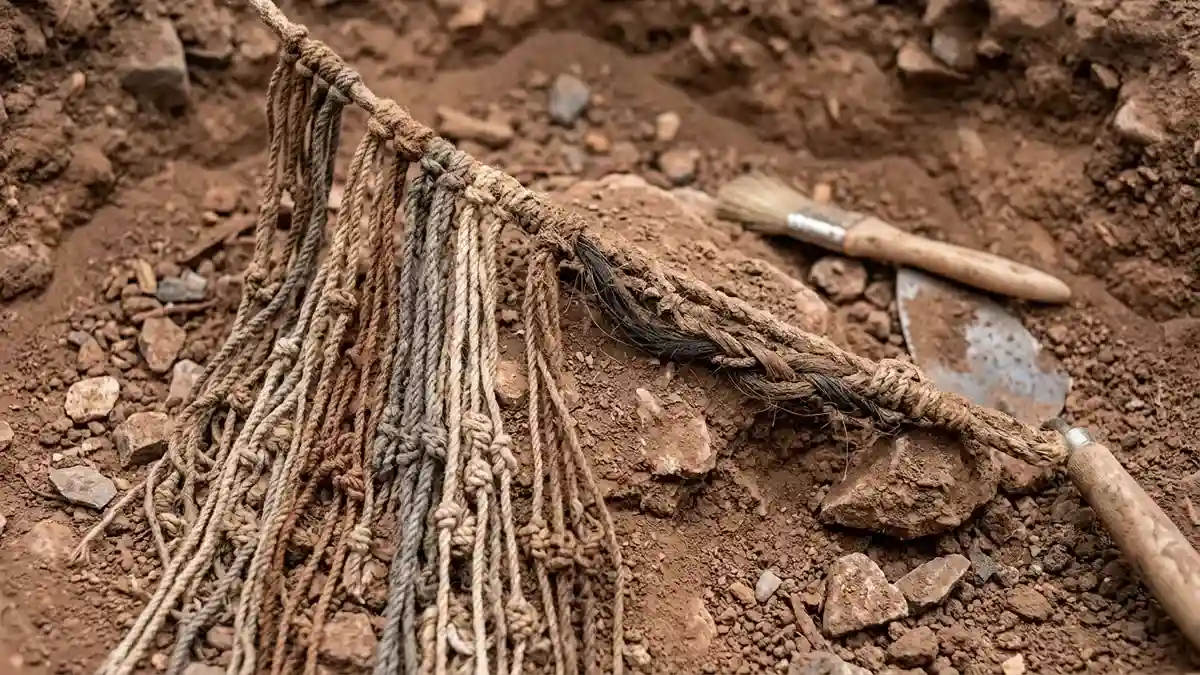
A standard khipu featured a thick primary horizontal cord from which dozens, sometimes hundreds, of smaller woolen or cotton strings suspended vertically. By tying different styles of knots at specific intervals along these hanging strings, creators recorded complex data sets.
The system operated on a precise base-10 decimal arrangement, where the position of a knot relative to the top cord determined its numerical value (units, tens, hundreds, and thousands). Beyond simple accounting, variations in string color, the direction of the fiber twist, and the specific materials used allowed these instruments to store census data, tax records, narrative histories, and ritual calendars.

The Elite Myth: Who Really Controlled the Knots?
Following the Spanish conquest of Peru in the 16th century, European chroniclers documented the inner workings of the falling empire. These early colonial writers focused almost exclusively on the royal court in Cusco, creating a skewed historical record that survived for five centuries.
According to Spanish texts, khipus were the absolute monopoly of the khipukamayuqs (knot-keepers)—an elite class of male state officials who underwent rigorous institutional training. The chroniclers stated that these sacred administrative devices were so closely tied to royal power that they were buried exclusively alongside their high-ranking owners as symbols of prestige.
However, dissenting voices existed even in the colonial era, though they were largely ignored by modern academics. In the early 17th century, the indigenous Peruvian author Felipe Guaman Poma de Ayala penned a massive illustrated chronicle asserting that non-elite citizens, including women, were fully capable of manufacturing and reading khipus.

By the 19th and 20th centuries, field anthropologists discovered isolated Andean farming communities still utilizing simple string systems to manage communal livestock herds. Yet, until now, physical, scientific proof that pre-colonial commoners independently produced pre-conquest khipus remained entirely elusive.
A Chemical Time Capsule: Testing the Hair of an Empire
The breakthrough came when a multidisciplinary research team subjected a rare, 500-year-old khipu to advanced chemical and radiocarbon testing. Structurally, this specific artifact stood out because its primary support cord was explicitly reinforced with braided strands of human hair, a traditional practice meant to physically bind the creator’s identity to the record itself.
The Radiocarbon Surprise
Initially, museum curators assumed the artifact was a relatively modern, post-conquest replica. This skepticism arose because authentic imperial Inca khipus were typically manufactured from harvested cotton, whereas post-colonial examples from the 18th and 19th centuries increasingly relied on coarser animal fibers.
However, when researchers performed precise radiocarbon dating on the alpaca wool and human hair elements, the results delivered a shock: the document was an authentic artifact forged during the peak of the pre-contact Inca Empire.
Dismantling the Elite Hierarchy Through Diet
With the antiquity of the khipu firmly secured, scientists turned their attention to a single, 104-centimeter-long strand of human hair extracted from the main cord. By performing stable isotope analysis, the team measured the specific ratios of carbon, nitrogen, and sulfur locked within the hair’s keratin structure. Because our bodies build tissues directly from the food we consume, these elemental ratios act as an unalterable biological journal of an individual’s long-term diet.
The resulting data completely contradicted the profile of a royal imperial scribe:
The Elite Diet: In the Inca caste system, high-ranking officials and nobles regularly indulged in luxurious state banquets. Their diets were packed with high-quality llama meat and massive amounts of maize (corn), which was heavily consumed in the form of chicha—a potent, ritually significant fermented maize beer.
The Commoner Signature: The isotope levels within the khipu hair revealed that this individual consumed virtually zero marine resources, very little red meat, and minimal maize. Instead, their long-term nutrition was completely dominated by wild greens and high-altitude tubers, such as potatoes and oca—the quintessential daily survival rations of an impoverished Andean peasant.
Given that state ceremonies required imperial recorders to regularly drink massive quantities of maize beer with the ruling elite, it is structurally impossible that a royal khipukamayuq could possess this humble, plant-based dietary profile. The person who painstakingly spun this cord was a common agricultural laborer.
Pinpointing the Geographic Origins
The isotopic data didn’t just reveal what the maker ate; it also pinpointed where they lived out their life. By analyzing oxygen and sulfur signatures, which vary across distinct geographic elevations and climates, the study determined that the individual resided in the high-altitude Andes mountain range at an elevation sitting precisely between 2,600 and 2,800 meters (roughly 8,560 to 9,186 feet) above sea level.
This specific environmental reading, combined with the total absence of ocean-derived food markers in their tissues, matches inland agrarian valleys located in modern-day southern Peru or northern Chile, far removed from the lavish urban core of the imperial capital.
A New Window Into Indigenous Literacy
Though this individual occupied a low rung on the social ladder, their craftsmanship was anything but primitive. The physical structure of the khipu demonstrates a flawless mastery of textile engineering, featuring uniform cord tension, intricate fiber blending, and precise mathematical knot placements.
This proves that complex data management was not a top-down skill forced upon the masses by a centralized state; rather, it was a widespread, democratic cultural practice woven into the fabric of everyday Andean life. While the exact meaning of the knots on this specific commoner khipu remains a mystery, lead researchers hypothesize they may have tracked local communal duties, agricultural rotations, or small-scale ritual offerings to regional earth deities.
Conclusion: Validating Forgotten Voices
While a single artifact cannot single-handedly rewrite every chapter of South American prehistory, it provides a vital new trajectory for future archaeological science. This study validates centuries-old indigenous testimonies, confirming that historical figures like Guaman Poma de Ayala were telling the truth when they recorded that writing with strings was a universal language shared by kings, peasants, men, and women alike. By turning the tools of modern chemistry onto ancient strands of hair, science is finally giving a voice back to the silent millions who actually built the ancient world.
Frequently Asked Questions
What exactly is an Inca khipu?
A khipu (or quipu) was a highly advanced textile recording system utilized by the Inca Empire. It consisted of a main horizontal cord made of cotton or wool, from which numerous colored strings hung vertically. Information was stored numerically and narratively using a complex system of knots based on a decimal arrangement.
How did a strand of hair prove commoners used khipus?
Researchers extracted a strand of human hair woven into an authentic 500-year-old khipu cord and performed stable isotope analysis. The chemical signature revealed a diet completely devoid of elite luxury foods like meat and maize beer, consisting instead of peasants’ tubers and greens, proving the maker was an ordinary laborer.
What did the elite Inca diet look like compared to a commoner’s?
Inca nobles and state officials regularly consumed large quantities of meat and maize, frequently drinking a fermented corn beer called chicha during state banquets. In contrast, working-class peasants survived primarily on agricultural staples like potatoes, indigenous tubers, and local wild greens.
Where did the person who made this specific khipu live?
Isotopic analysis of the hair elements indicated that the creator lived in the Andean highlands at an elevation between 2,600 and 2,800 meters above sea level. The lack of marine signatures places their homeland in an inland region, likely within modern southern Peru or northern Chile.
Why did previous historians believe only elites used khipus?
Most of our early information about the Inca came from Spanish conquistadors and chroniclers who only interviewed royal elites and centralized rulers in Cusco. These European accounts framed the khipu as an exclusive, top-secret tool managed solely by specialized royal officials called khipukamayuqs.