
Table of Contents
**Rare Ancient Egyptian Burial Treasure Discovered in Heliopolis**
Archaeologists in Cairo have made an exciting discovery that brings ancient Egyptian burial traditions vividly back to life. A nearly complete set of funerary objects, hidden for centuries beneath a mudbrick tomb, has been unearthed at the Panhesy necropolis in the Ain Shams district. This remarkable find offers fresh insights into the lives, beliefs, and rituals of people who lived near one of Egypt’s most sacred cities.
The Supreme Council of Antiquities-led mission revealed the cache during ongoing excavations at a cemetery tied to ancient Heliopolis, known in Egyptian texts as Iunu or On. This site served as the primary center for worship of the sun god Ra for thousands of years. The new artifacts stand out as the first near-complete funerary assemblage found in this specific necropolis, making the discovery particularly significant for understanding evolving burial practices.
Rare Ancient Egyptian Burial Treasure Discovered in Heliopolis
### What the Funerary Cache Reveals About Daily and Ritual Life
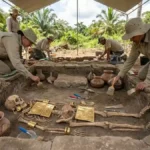
Beneath a mudbrick tomb containing human skeletal remains, excavators found a carefully arranged group of personal and ritual items. These objects paint a detailed picture of how ancient Egyptians prepared for the afterlife while honoring the deceased in the present world.
Key items include:
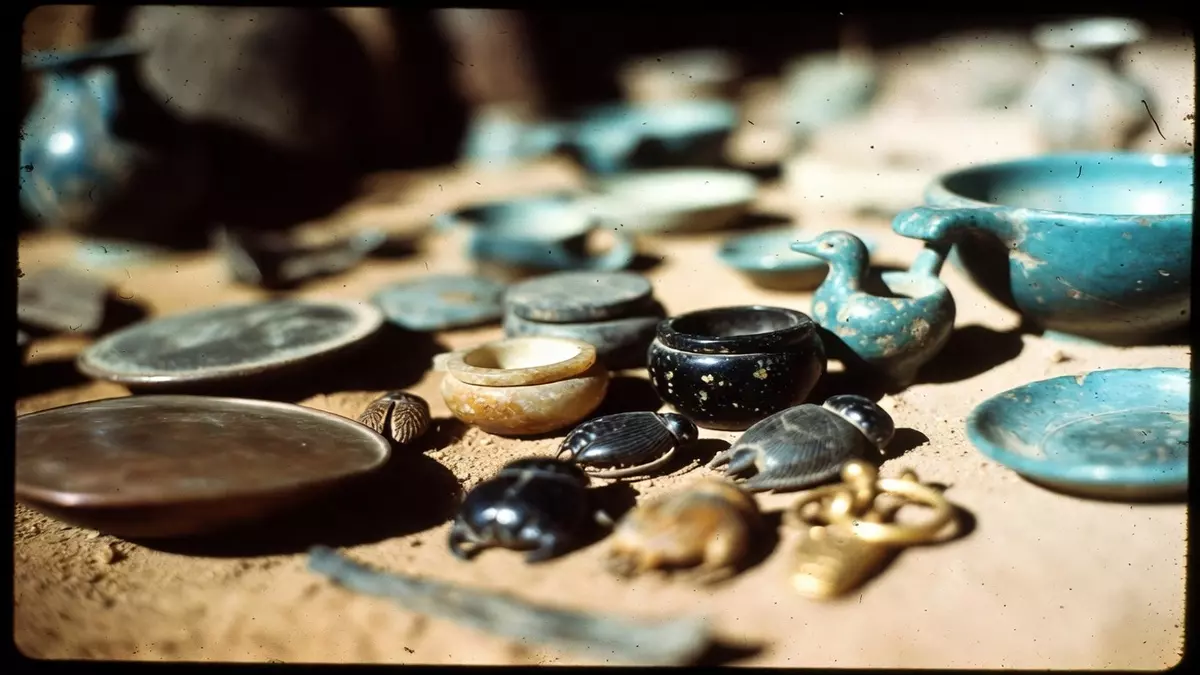
– A copper mirror, likely used for both daily grooming and symbolic purposes in the journey to the afterlife.
– Two alabaster cosmetic vessels with lids still intact, containing traces of kohl eyeliner that survived thousands of years underground.
– A rare black obsidian kohl container, highlighting access to valuable imported materials.
– Light blue faience vessels, one holding six symbolic scarabs—two set in yellow metal frames consistent with gold.
– Faience amulets shaped as a duck and the Atef crown, representing powerful protective and royal symbolism.
– Four decorative stones, including possible agates, with one mounted in a gold-colored frame.
– Five pairs of earrings, ranging from 1.5 to 2.5 centimeters in diameter, believed to be made of gold.
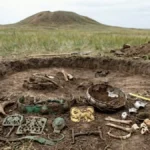
These objects were not randomly placed. Their deliberate arrangement suggests intentional rituals meant to equip the deceased with everything needed for eternity while reflecting their social status and personal identity.
### Heliopolis: The Sacred City of the Sun
Ancient Heliopolis ranked among Egypt’s most important religious and intellectual centers from the Old Kingdom onward. Dedicated primarily to Ra (and later Atum-Ra), the city housed massive temples, obelisks, and schools of learning that influenced Egyptian theology for millennia. Its priests held considerable power, and its location near modern Cairo made it a hub where religious, political, and economic forces intersected.
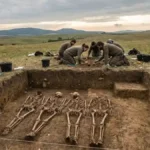
The Panhesy (or Banhsi) necropolis formed part of Heliopolis’s extensive burial grounds. Used across multiple eras—from the Late Period through Roman times and into the early Christian period—the cemetery captures how burial customs adapted amid major historical changes, including foreign rule, religious shifts, and cultural blending.
Earlier finds at the site this season included mudbrick and limestone tombs, fragments of two coffins (one ceramic and one with gilded plaster featuring red motifs), and gilded human remains possibly belonging to a military figure accompanied by a Roman-era coin. Hieroglyphic inscriptions on limestone blocks further enrich the historical context.
### Symbolism and Meaning Behind the Artifacts
Ancient Egyptian funerary practices blended practicality with deep spiritual meaning. Mirrors could symbolize reflection and rebirth, while kohl containers represented protection for the eyes—both in life and in the dangerous underworld journey. Scarabs embodied regeneration and the sun’s daily cycle, perfectly aligned with Heliopolis’s solar theology.
Faience amulets, such as the duck (possibly linked to creation myths) and the Atef crown (associated with Osiris and kingship), offered magical protection. The use of materials like alabaster, obsidian, and possible gold underscores the deceased’s access to luxury goods and connections to trade networks spanning the Mediterranean and beyond.
Some vessels and objects appear deliberately positioned to “activate” symbolic power during the burial rites. This level of preservation allows researchers to study not just the items but the complete ritual context—an uncommon opportunity at this site.
**Social Insights from the Finds**
The presence of high-quality items like gold earrings and imported stones suggests the buried individuals held elevated social positions. In a city like Heliopolis, this could include priests, administrators, or military elites who served the temple complexes and the state.
The mix of Egyptian, Roman, and potentially other influences in the artifacts reflects Heliopolis’s long history as a cosmopolitan center where cultures met and merged.
### Broader Context of Egyptian Funerary Evolution
Egyptian burial customs evolved significantly over time. While pharaonic-era elites built elaborate tombs filled with treasures, later periods saw more modest yet still symbolically rich assemblages. The Panhesy finds bridge these traditions, showing continuity in core beliefs—such as the importance of the afterlife—alongside adaptations to new political realities under Persian, Greek, Roman, and later influences.
The transition toward early Christian times brought further changes, as some communities shifted away from traditional polytheistic practices. Studying sites like Panhesy helps archaeologists trace these transformations in everyday terms through personal objects rather than grand monuments.
### Why This Discovery Matters for Modern Understanding
This cache stands out because it is unusually complete for the Heliopolis area, where urban development over centuries has disturbed many ancient remains. Modern Cairo sits atop much of the ancient city, making every new find valuable for reconstructing its layout and significance.
Egyptian officials, including those from the Ministry of Tourism and Antiquities, see such discoveries as vital for both scholarship and cultural heritage preservation. They also help boost interest in Egypt’s rich history, supporting tourism and local communities.
Ongoing excavations at Panhesy promise more revelations about the people who lived and died in Heliopolis’s shadow—their health, diets, occupations, and beliefs. Advanced techniques like DNA analysis, material sourcing, and digital reconstruction could further enhance what these artifacts tell us.
**Connecting Past and Present**
For many Americans fascinated by ancient civilizations, these discoveries resonate on a human level. They remind us that people thousands of years ago cared deeply about beauty, protection, and legacy—much like we do today. Cosmetic items, jewelry, and symbolic amulets show that even in death, personal identity and hopes for the future remained central.
This find also highlights the dedication of Egyptian archaeologists who work to uncover and protect their country’s heritage amid the challenges of a modern metropolis.
### Future Research and Preservation at Heliopolis
The Supreme Council of Antiquities continues systematic work across the broader Heliopolis area. Each season brings new pieces to the puzzle, helping scholars understand how this sun-centered city influenced Egyptian religion, science, and governance for over 3,000 years.
Plans include further study of the recovered materials, conservation efforts, and potential public display. Such artifacts often end up in museums where they educate global audiences about ancient Egyptian achievements.
### Conclusion: A Window into Ancient Lives
The rare funerary cache from the Panhesy necropolis represents more than beautiful objects—it offers a deeply personal glimpse into the spiritual world of ancient Heliopolis. From gilded earrings to symbolic scarabs, these items reveal how Egyptians blended daily elegance with profound religious beliefs across centuries of change.
As researchers analyze this near-complete assemblage, our knowledge of one of Egypt’s most important sacred landscapes grows richer. This discovery reinforces Heliopolis’s enduring legacy as a center of light, learning, and life after death, while reminding us why protecting such sites remains essential in our own time.
The ancient sun city continues to illuminate the past, one carefully preserved artifact at a time.
## FAQ
**What is the Panhesy necropolis?**
The Panhesy (or Banhsi) cemetery forms part of the larger ancient burial grounds of Heliopolis in modern Cairo’s Ain Shams and Matariya districts. It was used over many centuries for burials linked to the sun god Ra’s cult center.
**What makes this funerary cache special?**
It is described as the first near-complete funerary assemblage found at the site, containing a full set of ritual, cosmetic, and personal items preserved together in context.
**What artifacts were discovered?**
Items include a copper mirror, alabaster and obsidian kohl containers, faience vessels with scarabs, amulets, decorative stones, and five pairs of likely gold earrings.
**When was the Heliopolis necropolis used?**
The cemetery saw activity from the Late Period through Roman and early Christian eras, showing how burial practices evolved over time.
**Why is Heliopolis historically important?**
Known as Iunu, it was ancient Egypt’s main religious center dedicated to the sun god Ra, influencing theology, astronomy, and politics for thousands of years.
**Where are the artifacts being studied?**
The finds are under analysis by the Supreme Council of Antiquities, with potential for eventual museum display to showcase Heliopolis’s heritage.
**How does this discovery help researchers?**
It provides concrete evidence of daily rituals, social status, trade connections, and cultural changes in one of ancient Egypt’s most influential cities.