
Table of Contents
- 1. Highway Construction Uncovers Forgotten Battlefields
- 1.1. Mapping Ballistic Evolution
- 2. The 1745 Mass Grave: A Rare Echo of the Second Silesian War
- 2.1. Evidence of Frontline Trauma
- 2.2. Rare 18th-Century Artifacts
- 3. The 1866 Prussian Graves: Relics of Nový Rokytník
- 3.1. Personal Possessions in the Trenches
- 4. The 23 Austrian Fallen: Boots and Battlefield Luxury
- 4.1. Treasures of a Non-Commissioned Officer
- 5. From the Highway to the Laboratory
- 5.1. Multi-Disciplinary Analysis
- 6. Frequently Asked Questions
- 6.1. Why were these graves found along a modern highway route?
- 6.2. What caused the Second Silesian War?
- 6.3. How did archaeologists know which soldiers were Prussian versus Austrian?
- 6.4. Why are 18th-century mass graves considered so rare?
- 6.5. What will happen to the soldiers’ bodies now?
Centuries of Conflict Unearthed Under a Czech Highway
A major highway expansion in eastern Bohemia has inadvertently opened a breathtaking window into over a century of European warfare. While conducting routine rescue excavations ahead of the construction of the future D11 motorway, a team of archaeologists uncovered a remarkable series of mass military graves. The findings span two entirely distinct historical conflicts fought across the very same landscape: the Second Silesian War of 1745 and the Austro-Prussian War of 1866.
The discoveries provide researchers with a rare side-by-side look at the evolution of military technology, uniform design, and the brutal reality of frontline casualties across the 18th and 19th centuries.
Centuries of Conflict Unearthed Under a Czech Highway
Highway Construction Uncovers Forgotten Battlefields
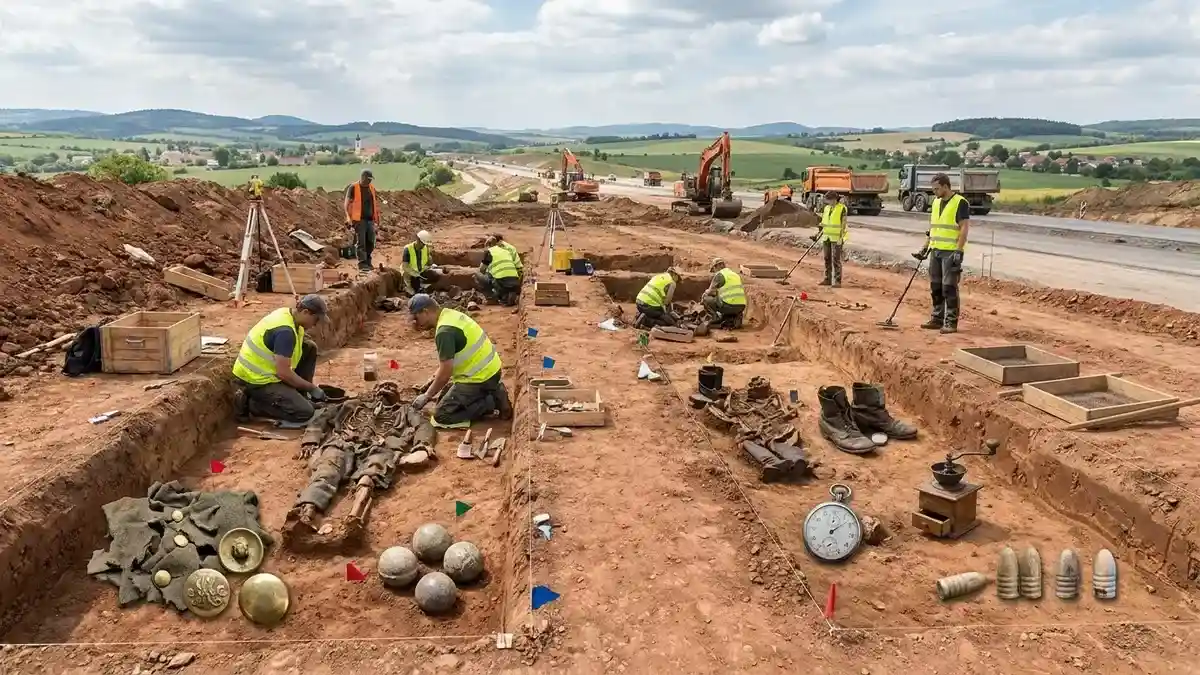
The archaeological rescue operation was executed by a specialized consortium under the leadership of the Archaeological Centre Olomouc. The team meticulously surveyed a 3.6-kilometer corridor of the planned motorway route stretching between the towns of Jaroměř and Trutnov.

Before breaking ground with heavy machinery, researchers deployed systematic metal-detector surveys across the landscape. The detectors signaled dense concentrations of subterranean metallic anomalies, which turned out to be historic lead ammunition and military hardware scatter patterns. These ballistic hot spots directed scientists directly to the exact locations of the long-forgotten burial trenches.
Mapping Ballistic Evolution
The ammunition recovered on-site tells a stark story of rapid industrial and military transformation. The team discovered two distinctly different classes of small-arms projectiles:
Spherical Lead Musket Balls: Found in the earlier sectors, these round balls perfectly match the smoothbore flintlock muskets deployed during the chaotic mid-18th-century War of the Austrian Succession.
Elongated Cylindro-Conical Bullets: Recovered from the later graves, these aerodynamic minié-style bullets represent the highly accurate rifled infantry weapons that came to define mid-19th-century combat mechanics.

The 1745 Mass Grave: A Rare Echo of the Second Silesian War
Between kilometers 126 and 129 of the planned highway, near the quiet village of Střítež, archaeologists struck a particularly historic find: a mass grave tied directly to the Battle of Žďár, fought on September 30, 1745.
A total of 12 individuals were found interred inside a single trench located squarely within what was once the active historical battle line. The positioning of the remains suggests the fallen soldiers were quickly buried right where they fell under heavy fire.
Evidence of Frontline Trauma
An anthropological examination of the skeletal remains revealed the violent nature of their final moments. Multiple skulls within the trench bear unmistakable, catastrophic trauma from close-range gunshot wounds, providing brutal physical evidence of the close-quarters musket exchanges that decided the day.
Rare 18th-Century Artifacts
Finding intact 18th-century mass graves is an exceedingly rare event anywhere in Europe. Despite centuries in the soil, the Střítež grave yielded highly informative cultural material, including:
Degraded fragments of wool uniforms
Metallic uniform buttons still anchoring petrified textile fibers
In-situ lead musket balls and personal gear assemblies
While lab work is ongoing to definitively verify which specific imperial regiment these men fought for, the context confirms their sacrifice during Frederick the Great’s campaign to secure Silesia.
The 1866 Prussian Graves: Relics of Nový Rokytník
Further along the motorway route, near kilometer 130, the excavation teams encountered a second layer of history. Here, they uncovered two separate mass graves stemming from the Austro-Prussian War of 1866—specifically the Battle of Nový Rokytník, which raged on June 28, 1866. This particular clash involved retreating Austrian units attempting to hold off the advancing Prussian Guard.
One of these trenches contained seven soldiers, while the adjacent grave held three. Thanks to the highly favorable chemical composition of the local soil, the preservation of organic elements in this sector was nothing short of miraculous.
Personal Possessions in the Trenches
The level of preservation allowed archaeologists to recover an astonishing array of personal effects belonging to the Prussian troops. Alongside heavy wool uniform layers and standard-issue weapon components, researchers pulled deeply personal items from the earth, including a pocket-sized personal mirror and a compact, hand-cranked mechanical pocket coffee grinder. The specific insignia on the uniform components left absolutely no doubt as to the soldiers’ Prussian alignment.
The 23 Austrian Fallen: Boots and Battlefield Luxury
The fourth and largest burial site was discovered closer to kilometer 132, moving toward the village of Studenec. This mass grave contained the tightly packed remains of 23 Austrian soldiers who perished during the same June 1866 engagement.
Unlike the Prussian graves, the skeletal material here was in an advanced state of decay due to localized water pooling. To determine the exact body count, anthropologists had to carefully count and map the pairs of heavy leather military boots that outlasted the bones inside them.
Treasures of a Non-Commissioned Officer
Though the bone matrix had degraded, the metallic and high-grade leather equipment survived beautifully. Excavators recovered heavy winter coat remnants, structural brass military fittings, and two remarkable standout artifacts:
An 1854 Gold Franc: A valuable foreign coin likely carried as a personal good-luck token or savings.
A Silver Pocket Watch: A finely crafted timepiece featuring an elegant engraved dog motif on the outer casing.
Additionally, the recovery of a specific decorative brass saber scabbard fitting strongly indicates that a high-ranking non-commissioned officer was laid to rest alongside his infantry squad.
From the Highway to the Laboratory
The intensive field phase of the motorway rescue excavation wrapped up ahead of winter conditions. All recovered skeletal elements, uniform fragments, and metallic personal items were safely packaged and transferred to specialized conservation facilities in Olomouc.
Multi-Disciplinary Analysis
Over the coming months, teams of anthropologists, materials scientists, and weapons historians will subject the collection to exhaustive laboratory scrutiny. Through advanced analysis, experts hope to pinpoint the ages, nutritional backgrounds, and precise medical causes of death for these forgotten combatants.
Once the comprehensive data extraction and chemical stabilization processes are complete, the physical artifacts will be transferred to the permanent historical collections of the Museum of Eastern Bohemia, located in Hradec Králové. The human remains will eventually receive formal, respectful reburials in local military cemeteries in strict accordance with European humanitarian conventions.
Frequently Asked Questions
Why were these graves found along a modern highway route?
Modern infrastructure projects, like the Czech D11 motorway, require extensive ground clearance across vast stretches of countryside. Because the planned highway cuts directly through historical battlefields from the 1745 and 1866 campaigns, the route naturally intersected the original, undocumented frontline burial trenches.
What caused the Second Silesian War?
The Second Silesian War (1745) was a localized theater of the much larger War of the Austrian Succession. It was fought primarily between Prussia and Austria over control of the wealthy, strategic region of Silesia, ultimately resulting in a Prussian victory that solidified its status as a major European power.
How did archaeologists know which soldiers were Prussian versus Austrian?
Archaeologists determined nationality by analyzing the highly specific metallic buttons, belt buckles, unit insignia, and weapon components found directly on the remains. The excellent preservation of uniform textiles further allowed researchers to match fabric patterns and colors directly to official 1866 military dress codes.
Why are 18th-century mass graves considered so rare?
During the mid-1700s, armies often scattered their dead across vast areas or utilized existing churchyards, making concentrated battlefield mass graves difficult to locate today. Additionally, poor soil conditions across Europe often dissolve clothing and skeletal elements over a span of nearly 300 years.
What will happen to the soldiers’ bodies now?
Following complete scientific, anthropological, and forensic documentation in the lab, all human remains will be removed from the research facilities. They will receive formal, dignified reburials in established historical military cemeteries, ensuring the fallen are laid to rest with proper honors.