
Table of Contents
- 1. The Historic Excavation at Hallstatt’s Funicular Station
- 1.1. A Lost Roman Lakeside Community
- 1.2. Preserving a Multilayered History
- 2. The Artistry of the Medusa Cameo: A Masterpiece in Miniature
- 2.1. The Legacy of Aquileia’s Gem Cutters
- 2.2. Agate, Onyx, and Sculptural Dimension
- 3. The Power of the Gorgoneion: Protection in the Ancient World
- 3.1. Warding Off the Evil Eye
- 3.2. A Ubiquitous Symbol of Security
- 4. Who Wore the Hallstatt Medusa?
- 5. Rewriting the History of Upper Austria
- 6. Frequently Asked Questions
- 6.1. What exactly is a cameo?
- 6.2. Why did the Romans use Medusa as a protective symbol?
- 6.3. Where was the Hallstatt cameo manufactured?
- 6.4. How big is the discovered Medusa artifact?
- 6.5. Can the public see the Medusa cameo?
Rare Roman Medusa Jewel Found in Austria Shakes Up Ancient History
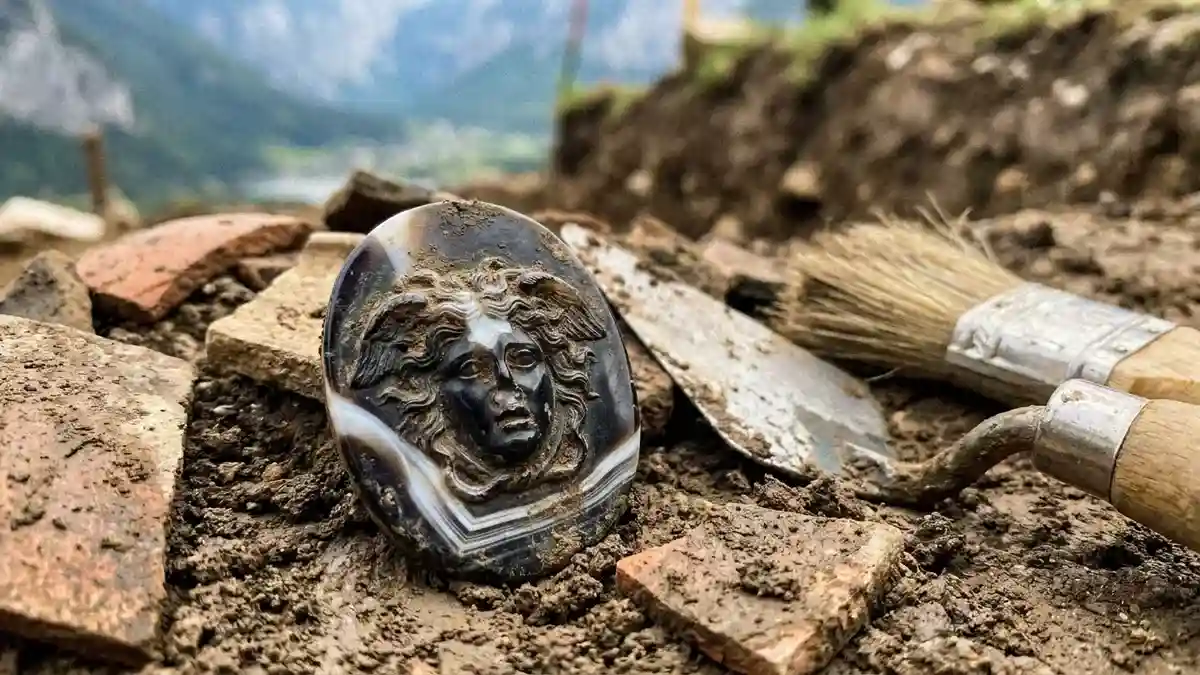
Archaeologists excavating in the historic alpine village of Hallstatt, Austria, have made a breathtaking discovery that bridges the gap between the high-altitude Alps and the luxurious trade networks of the ancient Mediterranean. During routine excavations ahead of a local infrastructure project, teams unearthed an exceptionally rare, masterfully crafted Roman cameo featuring the terrifying yet protective face of Medusa, the iconic Gorgon from classical mythology.
Though the miniature masterpiece measures a mere 1.5 centimeters in height, its historical and cultural weight is immense. Experts are already hailing the artifact as one of the most significant individual discoveries from the Roman era ever recorded in the region of Upper Austria. The find provides an unprecedented glimpse into the lives of the wealthy elites who inhabited this rugged terrain nearly two millennia ago, offering tangible proof that Hallstatt was far more than just an isolated mining outpost.
Rare Roman Medusa Jewel Found in Austria Shakes Up Ancient History
The Historic Excavation at Hallstatt’s Funicular Station
The stunning piece of jewelry did not emerge from a grand palace or a known temple, but rather from the ground beneath a modern transportation upgrade. Archaeologists from ARDIS Archäologie GmbH, working in close coordination with Upper Austrian provincial cultural institutions, discovered the artifact during investigations at the new valley station for the Hallstatt funicular railway.

A Lost Roman Lakeside Community
Today, Hallstatt is world-renowned for its fairytale landscapes and prehistoric salt mines, but this discovery shines a bright light on its vibrant Roman chapter. The funicular station site sits directly atop what was once a bustling, lakeside Roman settlement. While centuries of shifting geography and modern development have obscured the exact layout and the original Roman name of this ancient town, the structural foundations and scattered domestic items uncovered by the dig team prove that this lakeside community was a thriving hub of activity.
Preserving a Multilayered History
The excavation serves as a reminder of Hallstatt’s continuous strategic importance across millennia. The discovery of high-end luxury goods mixed with everyday foundational remnants demonstrates that the Roman inhabitants enjoyed a surprisingly sophisticated standard of living, surrounded by the dramatic cliffs of the Salzkammergut region.
The Artistry of the Medusa Cameo: A Masterpiece in Miniature
What makes the Hallstatt cameo stand out to historians is not just its survival, but the extraordinary level of craftsmanship required to create it.

The Legacy of Aquileia’s Gem Cutters
Style analysis and historical context lead researchers to believe the cameo dates back to the 2nd century CE. Archaeologists attribute its creation to the workshops of Aquileia, a major Roman metropolis situated on the northern Adriatic coast. Aquileia was celebrated throughout the empire as a premier center for luxury crafts, particularly famous for its schools of highly skilled gem cutters and lapidary artists.
Agate, Onyx, and Sculptural Dimension
The artisan responsible for the piece utilized a prized piece of black-and-white banded agate, a variety of chalcedony frequently referred to as onyx. Roman jewelers favored this material because its natural, contrasting layers allowed them to create striking visual depth.
The anonymous master craftsman carved into these microscopic layers at a slight angle, utilizing the stone’s organic color transitions to give the Medusa head a lifelike, three-dimensional perspective. Despite its tiny 1.5-centimeter frame, the cameo features a profound sculptural relief that catches the light in a way that flat carvings simply cannot match.

The Power of the Gorgoneion: Protection in the Ancient World
The image carved into the stone is the traditional Gorgoneion—the severed, winged head of Medusa framed by a chaotic halo of writhing snakes. To modern audiences, Medusa is often viewed purely as a monster, but to the ancient Greeks and Romans, her image held a deeply positive, protective function.
Warding Off the Evil Eye
In antiquity, the Gorgoneion served as a powerful apotropaic symbol—a magical amulet designed to turn away evil, misfortune, and malevolent spirits. The myth held that just as Medusa’s gaze could turn enemies to stone, her likeness on an object would paralyze bad luck or malicious intent before it could harm the owner.
A Ubiquitous Symbol of Security
Because of this perceived protective power, the face of Medusa was integrated into almost every facet of Roman life. Her image could be found:
Emblazoned on the breastplates and shields of Roman legionaries to terrify enemies.
Molded into the architectural terracotta tiles of residential villas to guard the home.
Stamped onto everyday household pottery, oil lamps, and bronze utensils.
Carved into fine gemstones to be carried constantly by individuals.
Who Wore the Hallstatt Medusa?
While many Roman cameos were small enough to be set into everyday signet rings, the Hallstatt Medusa breaks the mold. Its physical dimensions and pronounced, heavy three-dimensionality make a ring setting highly improbable.
Instead, jewelry experts believe this miniature sculpture was designed to be the central statement piece of an elegant, multi-strand necklace. Given the immense cost of imported onyx jewelry from the Adriatic coast, this necklace would have belonged exclusively to a woman of immense wealth and high social standing—likely the wife or daughter of a high-ranking Roman official, a wealthy merchant, or a military commander stationed in the province.
For this aristocratic woman, the cameo was not merely a display of fashion and affluent status; it was a personal shield worn close to the chest, invoking the gods to protect her health and family from the hidden dangers of the world.
Rewriting the History of Upper Austria
The historical implications of the Medusa cameo stretch far beyond the borders of Hallstatt. Prior to this discovery, Roman cameos were considered an extreme rarity in the entire province. In fact, there are currently only two other Roman-era cameos on public display in all of Upper Austria. This third addition changes how historians evaluate the wealth and cultural integration of the region.
The presence of such an exquisite piece of Mediterranean luxury goods in an alpine valley confirms that Hallstatt was deeply woven into the economic fabric of the broader Roman Empire. It proves that despite the challenging mountain terrain, trade routes between the Adriatic Sea and the Alps were highly efficient, allowing for the steady flow of not just essential commodities like salt and iron, but also high-end art, religious trends, and luxury fashion.
Frequently Asked Questions
What exactly is a cameo?
A cameo is a method of carving an object, such as a gemstone or piece of jewelry, where a raised relief image stands out against a background of a contrasting color. This is achieved by carving through the natural, distinct parallel layers of stones like agate or onyx.
Why did the Romans use Medusa as a protective symbol?
In classical mythology, the sight of Medusa could turn onlookers to stone. The Romans adopted her image as an apotropaic symbol, believing that displaying her likeness would visually deflect bad luck, curses, and evil forces, effectively shielding the wearer from harm.
Where was the Hallstatt cameo manufactured?
Archaeologists believe the cameo was crafted in Aquileia, a prominent Roman city located near the modern-day Gulf of Trieste on the northern Adriatic coast. Aquileia was an empire-wide hub for trade, art, and premium gemstone carving during the 2nd century CE.
How big is the discovered Medusa artifact?
The cameo is remarkably small, measuring only about 1.5 centimeters in height. Despite this miniature scale, it features an advanced level of three-dimensional detail and deep sculptural relief.
Can the public see the Medusa cameo?
The artifact is currently undergoing careful preservation and study by cultural and archaeological institutions in Upper Austria. Given its immense historical significance, it is expected to eventually join the region’s other rare Roman cameos on public display for educational purposes.