
Table of Contents
- 1. The Architectural Splendor of Ancient Naachtun
- 2. Anatomy of an Elite Mesoamerican Gameboard
- 2.1. The Cosmological Power of Red
- 3. Entertainment and Ritual in Classic Maya Society
- 4. A Double Anomaly in Maya Archaeology
- 5. Future Horizons in Maya Gaming History
- 6. Frequently Asked Questions
- 6.1. What is a patolli board?
- 6.2. Why is the Naachtun patolli board unique?
- 6.3. How old is this newly discovered gameboard?
- 6.4. What is the symbolic meaning of the red tiles?
- 6.5. What does this find tell us about Maya architecture?
Unique Mosaic Patolli Board Discovered in Guatemala Redefines Maya Gaming
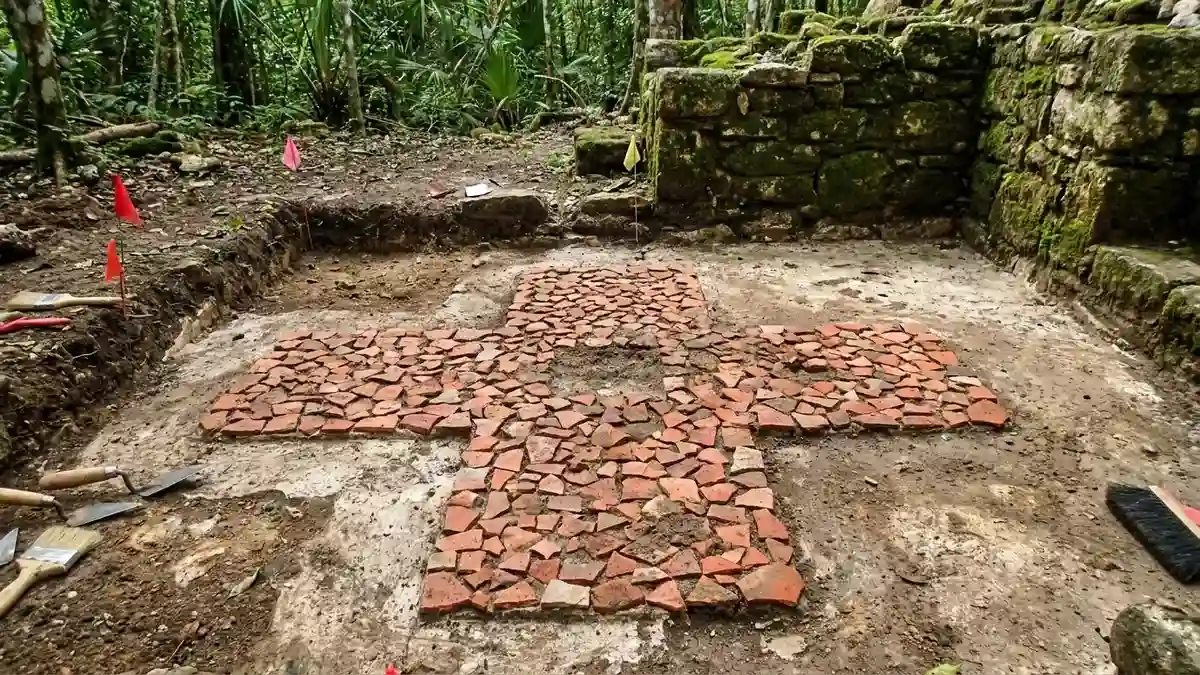
A remarkable archaeological discovery in the dense jungles of northern Guatemala has fundamentally altered our understanding of ancient Mesoamerican recreation and architecture. While conducting excavations at the classic Maya city of Naachtun, researchers unearthed a completely unprecedented artifact: a patolli gameboard created entirely as a ceramic mosaic.
Historically, every known example of a Maya gameboard has been found roughly scratched or carved into existing stone or plaster surfaces, often dismissed as ancient graffiti. This new find, documented by Julien Hiquet and Rémi Méreuze of the French National Centre for Scientific Research (CNRS), shatters that narrative. By revealing a board that was meticulously planned, designed, and built directly into the floor using hundreds of microscopic pottery fragments, the discovery proves that gaming held a deeply formalized, enduring role in elite Maya society.
Unique Mosaic Patolli Board Discovered in Guatemala Redefines Maya Gaming
The Architectural Splendor of Ancient Naachtun
Naachtun was a powerful, highly strategic city during the Classic period (circa 250–900 CE), positioned precisely between the rival superpower urban centers of Tikal and Calakmul. The mosaic board was uncovered during excavations within a grand residential compound designated Group 6L13, specifically embedded inside the floor of Structure 6L-19.
The scale and sophistication of the surrounding architecture indicate that this building was far from a common residence. It likely belonged to an incredibly wealthy aristocratic family or served as a prominent local administrative center.
   [MAYA CLASSIC SUPERPOWERS & NAACHTUN]

        [CALAKMUL] (North)
            │
            ▼
       [NAACHTUN]  <-- Location of Mosaic Patolli Board
            ▲
            │
         [TIKAL]   (South)
Because the mosaic board was found sealed beneath later construction layers and partially covered by a subsequent wall, archaeologists know it predates the room’s final structural phase. It was deliberately integrated into the fresh mortar when the room was first built, proving it was a permanent, intentional feature of the building’s original blueprint rather than a casual afterthought.
 DNA analysis reveals dynastic succession and maternal inheritance among early Celtic elites
Anatomy of an Elite Mesoamerican Gameboard
The gameboard itself is a masterpiece of ancient recycling and precision craftsmanship. It consists of a traditional Mesoamerican board pattern: a large rectangular layout crossed cleanly by a central axis.
To create the lines and boundaries of the game, builders utilized approximately 478 tiny tesserae—broken fragments of red and orange pottery measuring between 1 and 3 centimeters. Forensic analysis of these pieces revealed they were harvested from worn, everyday household vessels, including distinct Early Classic ceramic types known to specialists as Dos Hermanos Red and Aguila Orange.
       [NAACHTUN MOSAIC PATOLLI SPECIFICATIONS]
                          │
  ┌───────────────────────┼───────────────────────┐
  ▼                       ▼                       ▼
Dimensions             Piece Count             Materials Used
~80 x 110 cm           ~478 Tesserae          Recycled Early Classic
                                               Household Pottery
A digitized reconstruction of the artifact indicates the entire layout measured roughly 80 by 110 centimeters, with the hundreds of colorful fragments meticulously arranged into approximately 45 individual squares.

The Cosmological Power of Red
The choice of bright red and orange pottery fragments was likely heavily driven by spiritual symbolism rather than mere aesthetics. In the complex world of Maya cosmology, colors were intrinsically linked to the cardinal directions and the structure of the universe:
Red: Symbolized the East, the sacred direction of rebirth, renewal, and the rising sun.
Black: Associated with the West and the setting sun.
White: Linked to the North.
Yellow: Represented the South.
Scholars have long noted that patolli boards across the Maya lowlands consistently cluster within the eastern sectors of residential and ceremonial compounds. The Naachtun board perfectly honors this sacred solar alignment, embedding the celestial journey of the sun directly into the physical floor of the elite compound.
Entertainment and Ritual in Classic Maya Society
Patolli is a game famously detailed in later post-conquest Central Mexican codices, but this discovery emphasizes how deeply rooted it was across earlier Mesoamerican cultures. For the Maya, the game was a highly sophisticated hybrid of casual entertainment and profound religious ritual.
| Feature | Casual/Recreational Aspect | Ritual/Cosmological Aspect |
| Social Function | Served as a common pastime to reinforce community and household bonds. | Connected players to the movements of the heavens and cosmic cycles. |
| Placement | Found in high-traffic common areas of wealthy residential compounds. | Embedded in palace benches and sacred temple floors (e.g., Seibal, Uxmal). |
| Craftsmanship | Usually consists of quick, informal incised lines on stone surfaces. | Naachtun example shows extreme, time-consuming mosaic devotion. |
While elites used patolli to gamble, socialize, and foster alliances during grand courtly gatherings, the game also acted as a miniature model of the cosmos. Rolling dice and moving markers across the cross-shaped grid allowed players to actively participate in the cyclical laws of time, fate, and the gods.
A Double Anomaly in Maya Archaeology
The Naachtun board is considered doubly exceptional by the international scientific community because floor mosaics are almost entirely non-existent in ancient Maya architecture. While the Maya were masters of stone carving, painted stucco, and grand structural reliefs, they rarely utilized the mosaic technique for flooring.
+-------------------------------------------------------------+
|                THE TIMELINE OF JUXTAPOSITION                |
|                                                             |
|   400s CE (5th Century)                        600s-800s CE |
|   [ NAACHTUN BOARD ] <──────────────────────> [ OTHER SITES]|
|   • Meticulous Mosaic                          • Casual Graffiti|
|   • Deep Plaster Inlay                         • Quick Carvings |
|   • Secure 5th-Century Context                 • Late Classic   |
+-------------------------------------------------------------+
To create this board, an artisan had to dedicate hours to selecting hundreds of uniformly colored, flat fragments, shaping them to size, and painstakingly setting them into wet plaster before it cured. This intensive labor investment places the creation of the gameboard roughly in the fifth century CE. This secure, early architectural context officially establishes the Naachtun mosaic as one of the oldest verified patolli boards ever discovered in the Maya world.
Future Horizons in Maya Gaming History
The uncovering of this mosaic permanently changes how historians interpret the layout of ancient Mesoamerican living spaces. It proves that gaming was not always a temporary or secondary activity, but an essential social pillar that was literally cast in stone and mortar to outlast generations.
Archaeologists are already planning future excavation seasons targeting Structures 6L-19 and 6L-20. The primary objective will be to determine whether the mosaic gameboard sat within an open-air courtyard or was sheltered inside a roofed, intimate interior chamber. Resolving this architectural question will provide invaluable context about the exact social environment—whether a public courtyard spectacle or a private elite gathering—where this beautiful ancient board once hosted its players.
Frequently Asked Questions
What is a patolli board?
Patolli is an ancient Mesoamerican board game played by various cultures, including the Maya and Aztecs. It typically features a cross-shaped or rectangular grid where players move markers based on the roll of dice or beans, serving both recreational and ritualistic purposes.
Why is the Naachtun patolli board unique?
Every other known ancient Maya patolli board was roughly scratched or incised into stone benches or plaster floors. The Naachtun board is completely unique because it was crafted as a formal mosaic, using nearly 480 recycled pieces of red and orange pottery embedded directly into wet mortar.
How old is this newly discovered gameboard?
Because the board was built directly into the original flooring of a specific construction phase, archaeologists have securely dated it to the fifth century CE, making it one of the earliest known examples of a Maya gameboard.
What is the symbolic meaning of the red tiles?
In ancient Maya cosmology, the color red is explicitly tied to the East—the direction of the rising sun and cosmic rebirth. The red tiles and the eastern positioning of the board inside the compound suggest the game was linked to solar cycles and spiritual renewal.
What does this find tell us about Maya architecture?
Floor mosaics are incredibly rare and almost entirely absent from ancient Maya architecture. The presence of this time-consuming mosaic board proves that the builders purposefully planned the gaming space as a permanent, high-status feature of the elite residential compound.