
Table of Contents
Early Humans Methodically Mapped Volcanic Landscapes for Toolmaking 800,000 Years Ago
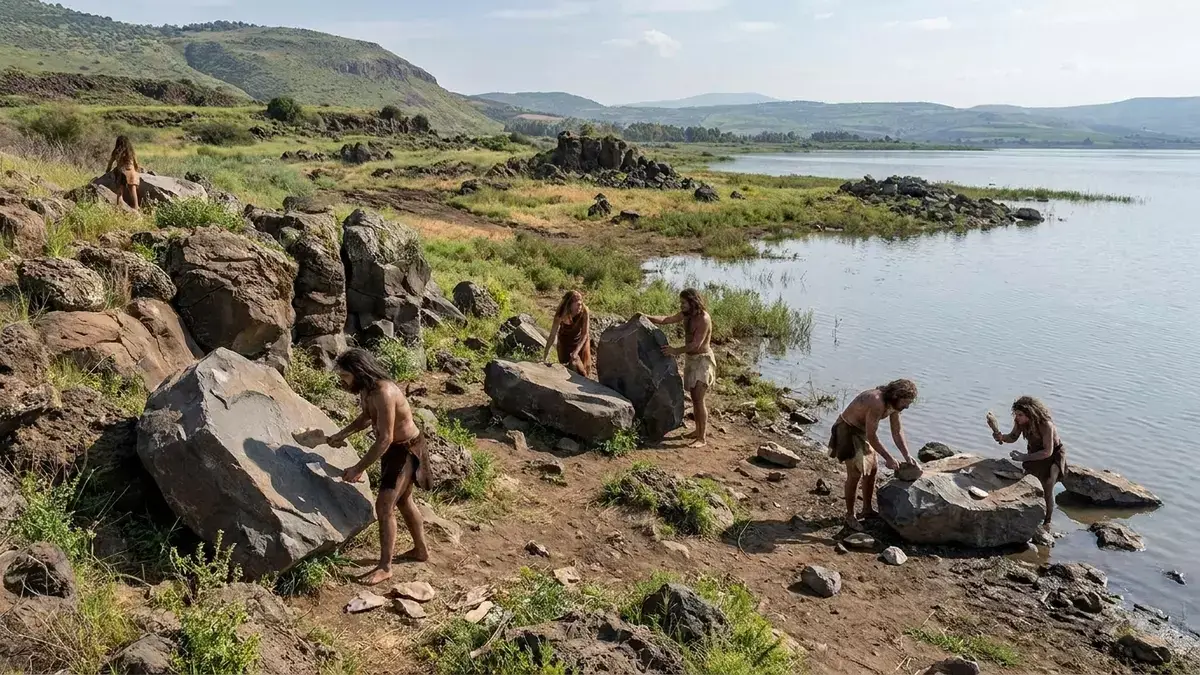
Around 780,000 years ago, early human ancestors gathering along the swampy banks of an ancient lake in northern Israel did not just pick up the nearest rocks to shatter bones or butcher meat. Instead, they acted as primitive geologists, possessing a sophisticated understanding of the local terrain and selecting specific types of volcanic rock tailored to the exact tools they intended to manufacture.
This striking insight into prehistoric cognition comes from a study published in the journal Scientific Reports. By analyzing the chemical “fingerprints” of stone artifacts, an international research team has demonstrated that Acheulian hominins executed a highly organized, deliberate strategy for gathering raw materials—a behavioral pattern that remained unbroken across tens of thousands of years.
The research centered on the world-renowned Acheulian site of Gesher Benot Ya’aqov (GBY), located in the Upper Jordan Valley. Positioned along the shifting shoreline of the prehistoric paleo-Lake Hula, GBY has long been celebrated as an archaeological goldmine. Previous excavations have yielded well-preserved stone toolkits, fossilized animal bones, edible plant remains, and some of the earliest universally accepted evidence for the controlled use of fire in human history.
Early Humans Methodically Mapped Volcanic Landscapes for Toolmaking 800,000 Years Ago

Decoding the Basalt Fingerprints
Basalt, a heavy, durable volcanic rock formed from cooled lava, was the lifeblood of daily life at GBY. The site’s ancient inhabitants relied heavily on it to manufacture their heavy-duty cutting toolkit, which primarily featured teardrop-shaped handaxes and flat-edged cleavers.
Producing these items was an incredibly demanding engineering process. Prehistoric artisans had to track down massive slabs of basalt, shape them into colossal “giant cores,” strike off exceptionally large, sharp flakes, and then painstakingly knap those flakes into specialized, finished handaxes.
The Prehistoric Basalt Manufacturing Chain
├── 1. Locate massive, un-fractured basalt slabs
├── 2. Shape slabs into giant, stabilized cores
├── 3. Strike off highly specific, oversized flakes
└── 4. Intricately knap flakes into finished cleavers/handaxes
While scientists understood how these tools were made, a fundamental question remained unanswered for decades: Where exactly were these early humans sourcing their stone?

To solve this mystery, researchers conducted a comprehensive geochemical analysis. They gathered basalt tools from multiple layers of the excavation and compared them against modern rock outcrops across the Jordan Valley. Crucially, the team also analyzed deep basalt cores pulled from underground drilling boreholes beneath the site, accessing deep-seated lava flows that have been buried by hundreds of feet of soil over the millennia.
By measuring the precise concentrations of major elements, trace elements, and rare earth elements within the stone, the team established chemical profiles for each source, effectively matching tools to their original parent cliffs like forensic detectives matching fingerprints.
Reconstructing a Distant, Sunken Landscape
The geochemical testing revealed that the vast majority of the large basalt cores came from outcrops located remarkably close to the ancient lake camp—often within a single kilometer of the site. Remarkably, many of these artifacts perfectly matched the chemical signature of the deeply buried basalt flows directly beneath GBY.

This specific match tells an incredible story about the volatile environment of the ancient Dead Sea Transform—a major tectonic fault zone that has shaped the Middle East for millions of years. Over the last 800,000 years, relentless seismic activity, fault movements, erosion, and heavy sediment accumulation completely altered the topography of the Jordan Valley.
Rock formations that lay completely exposed on the surface to prehistoric toolmakers were eventually dropped by earthquakes and buried beneath thick layers of mud and silt. By analyzing the tools, modern researchers were able to map out ancient stone outcrops that had been lost to the geosphere for hundreds of thousands of years.
This finding proves that early humans had access to a highly localized, hyper-specific volcanic landscape that modern geologists could never have detected through simple surface observations alone.
Custom Sourcing: Different Rocks for Different Tools
The study’s most profound revelation is that raw material gathering was not an accidental or lazy process. Hominins were highly selective, choosing completely different basalt flows depending on the type of tool they wanted to build.
While the “giant cores” used to produce standard flakes were sourced from the immediate vicinity, several highly specialized stone cleavers matched distinct basalt signatures that are completely missing from the nearby local outcrops.
This indicates that toolmakers intentionally bypassed perfectly functional, nearby stone to go on targeted search missions for specific variants of basalt. They likely evaluated the rock based on critical internal characteristics, such as:
Slab Geometry: Finding flat, naturally pre-shaped blocks that required minimal prep work.
Vesicle Density: Selecting basalt with fewer gas bubbles (vesicles) to ensure the rock would not crack unexpectedly when struck.
Grain Texture: Sourcing ultra-dense, fine-grained volcanic variants capable of holding a razor-sharp, durable edge during heavy butchering.
A Multi-Generational Technological Legacy
Remarkably, this exact pattern of calculated, highly selective stone gathering was identified across multiple distinct archaeological layers at GBY, spanning tens of thousands of years of human occupation.
This long-term consistency points directly to a deeply entrenched, multi-generational technological tradition. Long before the evolution of Homo sapiens, these early human ancestors possessed a complex culture capable of passing down abstract geographical and geological knowledge. For thousands of generations, elders successfully taught youth exactly where to walk, how to evaluate raw volcanic stone, and which cliffs held the absolute best material for the survival of the tribe.
Frequently Asked Questions
Why did early humans prefer basalt for making tools at this site?
Basalt is a highly durable, heavy volcanic rock. Its structural strength and density made it ideal for creating large, heavy-duty cutting tools like handaxes and cleavers, which were required for processing large animal carcasses, chopping wood, and fracturing bones for marrow.
How did scientists determine where the ancient stone came from?
Scientists used geochemical fingerprinting. By measuring major, trace, and rare earth elements within the stone tools and comparing those numbers to rock samples collected from regional outcrops and deep underground boreholes, they were able to match tools to their exact geological origins.
What does this discovery tell us about the intelligence of early humans?
It proves they possessed advanced spatial reasoning, planning capabilities, and a deep familiarity with their environment. Instead of randomly picking up rocks, they actively sought out specific basalt flows based on the size, shape, and internal qualities needed for specialized tools, demonstrating complex decision-making 780,000 years ago.
How did the landscape change since the tools were made?
The site is located in the Dead Sea Transform, an active tectonic fault line. Over the last 800,000 years, earthquakes, volcanic activity, and heavy sedimentation completely rearranged the valley, burying the ancient stone quarries deep underground where they are no longer visible on the modern surface.
Did this toolmaking knowledge happen overnight?
No. The study showed that this precise, highly selective sourcing pattern remained identical across different archaeological layers representing tens of thousands of years. This proves that the knowledge of the landscape and specialized toolmaking techniques was passed down systematically from one generation to the next as a long-lasting cultural tradition.