
Table of Contents
Ancient Mesoamerica Rewritten: High-Tech Scan Reveals Oldest Maya Long Count Date
Deep within the ancient ruins of El Palmar in Campeche, Mexico, a heavily eroded stone monument has quietly shattered our understanding of early Maya history. Using cutting-edge 3D scanning technology, international researchers have unveiled what is now believed to be the oldest known Long Count calendar date ever discovered in the Maya lowlands. The ancient inscription records the specific date 8.7.1.0.0, which translates precisely to August 31, CE 180—a staggering 112 years older than the region’s previous record-holder.
This monumental discovery shifts the timeline for the development of divine kingship and political statecraft in the region. Published in the journal Ancient Mesoamerica, the study demonstrates that the Maya were using their sophisticated, linear calendar system to legitimize royal authority far earlier than historians previously assumed.
Ancient Mesoamerica Rewritten High-Tech Scan Reveals Oldest Maya Long Count Date
Decoding the Worn Stones of El Palmar
The breakthrough emerged from a comprehensive research project focused on the rise of early Maya kingdoms during the late Terminal Preclassic period. A team of experts targeted three heavily weathered limestone monuments at the site: Stelae 20, 45, and 46.
For centuries, these monuments stood exposed to the punishing tropical elements of southeastern Mexico. Because limestone is highly susceptible to acid rain and environmental erosion, the intricate hieroglyphic carvings on the stones had faded to near-invisibility. To the naked eye, the surfaces appeared completely smooth, rendering traditional archaeological drawing and epigraphic study impossible.
Turning to Millimeter-Precision 3D Modeling
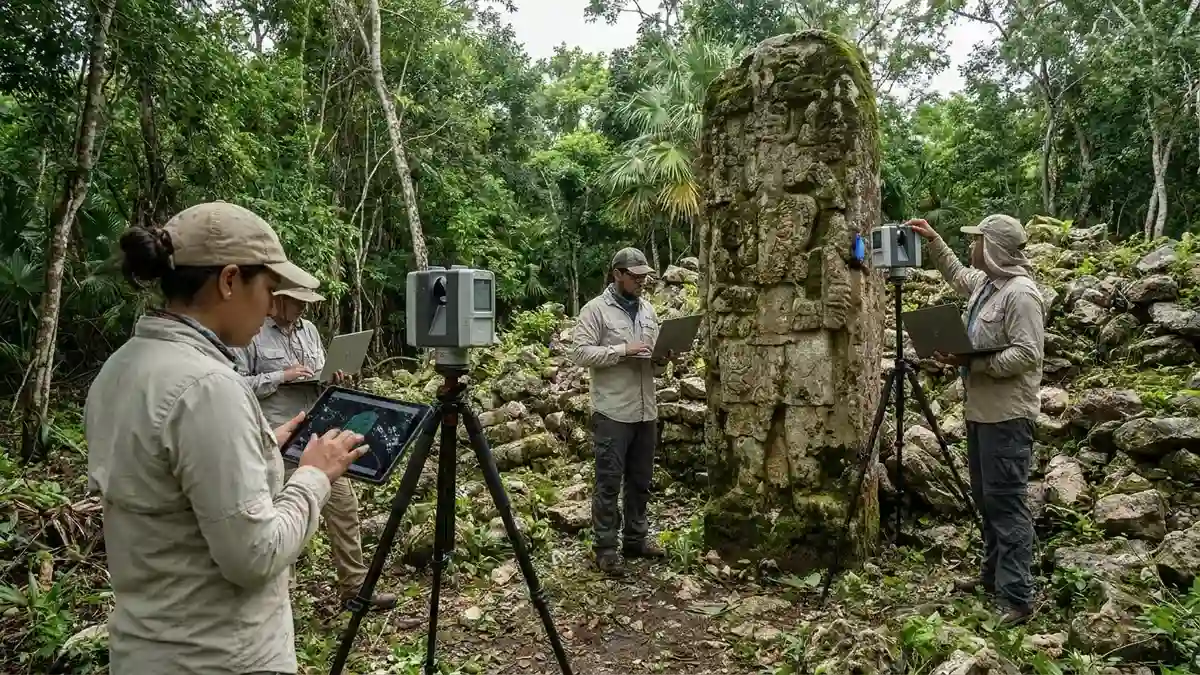
To bypass the limitations of human sight, the research team deployed advanced digital documentation techniques. They utilized a combination of high-resolution photogrammetry and a specialized macro-scanner capable of recording topographical stone features as minute as one-tenth of a millimeter.

Digital Epigraphy Workflow at El Palmar
├── High-Resolution Macro-Scanning (0.1 mm precision)
├── 3D Photogrammetry Surface Mapping
└── Digital Raking Light Analysis (Varying shadow angles)
By processing these massive data sets on a computer, researchers were able to manipulate artificial “raking light” across digital models of the monuments. By shifting the angle of virtual shadows, minuscule grooves carved by ancient scribes nearly two millennia ago suddenly became legible, breathing new life into a forgotten royal text.
Stela 46: A Preclassic Royal Time Capsule
While all three monuments provided valuable data, Stela 46 delivered the most historic revelation. Not only did the 3D models reveal the historic 8.7.1.0.0 Long Count date, but they also showed that the monument was significantly more complex than other known inscriptions from this early era.
Many of the earliest calendar dates found across the broader Maya world are isolated numbers, lacking surrounding context. Stela 46 breaks this mold entirely: it features a comprehensive narrative text that directly ties the CE 180 date to specific, high-status royal activities.

Royal Succession: Portions of the digital epigraphic text describe the formal political transition and ascension of a pre-Classic ruler.
Sacred Ceremonies: The carvings detail complex dedication rituals performed by the early court to sanctify the new regime.
Underworld Deities: The text makes a rare, early reference to the Jaguar God of the Underworld, a major figure in Maya cosmology associated with fire, war, and the authority of kings.
Calendar Integration: The monument references the Tzolk’in (the 260-day ritual calendar) alongside the Long Count, proving that the early elite intentionally intertwined political power with cosmic, sacred cycles of time.
How Kingship Rose Across the Lowlands
The discovery at El Palmar provides critical data regarding how the institution of the K’uhul Ajaw (Divine Lord) first emerged. For a long time, scholars debated whether Maya kingship originated within a single powerful capital and spread outward, or if it developed independently across multiple independent kingdoms simultaneously.
The highly sophisticated text on Stela 46 strongly supports the multi-center model. By demonstrating that a medium-sized kingdom like El Palmar was already utilizing advanced recording systems, formal state rituals, and dynastic propaganda in CE 180—long before the dawn of the Classic period in CE 250—the evidence suggests that regional elites across the lowlands were collectively experimenting with the trappings of divine royalty.
The Continuing Quest for Preclassic Secrets
While the readings of Stela 46 have provided a massive historical leap forward, the authors of the study note that some sections of the heavily damaged text remain tentative. Because the limestone base is so fragile, certain glyph blocks are still on the threshold of legibility.
As digital imaging software and laser-scanning hardware continue to improve, researchers hope to revisit these models to extract even finer details from the stone. Even in its partially eroded state, Stela 46 stands as an extraordinary link to the past, preserving the deliberate actions of an ancient king who tied his destiny to a cosmic calendar nearly 1,850 years ago.
Frequently Asked Questions
What makes the inscription found at El Palmar so historic?
The inscription on Stela 46 contains the oldest known Long Count calendar date ever found in the Maya lowlands. The date, recorded as 8.7.1.0.0, corresponds to August 31, CE 180, pushing back the documented use of this calendar system in the region by 112 years.
What is the Long Count calendar?
The Long Count is a highly sophisticated, linear calendar system used by the ancient Maya to record long periods of time. Unlike repeating cyclical calendars, the Long Count counts sequentially from a fixed mythological starting point, making it invaluable for recording precise historical timelines, royal births, and political accessions.
How did researchers read a monument that was too weathered for human eyes?
The research team used high-resolution macro-scanners and 3D photogrammetry to map the stone’s surface at a precision level of one-tenth of a millimeter. By rendering the monument as a digital 3D model, they used virtual lighting to cast shadows across the microscopic grooves, revealing glyphs that were completely invisible under normal sunlight.
What does the text on Stela 46 actually describe?
Unlike other early calendar markers, Stela 46 features a detailed historical narrative. It records a royal succession ceremony, describes complex sacred rituals, references the 260-day ritual calendar, and invokes the Jaguar God of the Underworld to legitimize the ruler’s political authority.
What does this discovery teach us about the origin of Maya kings?
It proves that sophisticated dynastic politics, written history, and calendar-based propaganda were fully operational in the late Terminal Preclassic period (before CE 250). It also indicates that divine kingship was developing independently across multiple regional centers throughout the Maya lowlands rather than radiating out from a single city.