
Table of Contents
- 1. Debunking the Crime Scene: The Mammoth Cave Kangaroo Bone
- 2. Reclaiming History: The World’s Earliest Paleontologists
- 3. Uncovering a 3,000-Kilometer Ancient Trade Network
- 4. Re-evaluating Supposed Signs of Prehistoric Slaughter
- 5. Oral Traditions, Rock Art, and the Fossil Record
- 6. Conclusion
- 7. Frequently Asked Questions
- 7.1. If humans didn’t hunt them, why did Australia’s megafauna go extinct?
- 7.2. How do scientists tell the difference between an ancient butcher mark and later handling?
- 7.3. What kind of animal was a sthenurine kangaroo?
- 7.4. How did a fossil travel 3,000 kilometers across ancient Australia?
- 7.5. What is X-ray fluorescence and why was it used in this study?
Fossil Discovery Overturns Long-Held Beliefs About Ancient Australia
For generations, one of the most fiercely debated mysteries in paleontology has revolved around the sudden disappearance of Australia’s Ice Age giants. Long before European colonization, the ancient landmass of Sahul—which topographically welded Australia, Tasmania, and New Guinea together—was dominated by terrifying and magnificent megafauna. Among these prehistoric titans were short-faced kangaroos taller than grizzly bears, flightless birds heavier than ostriches, and Zygomaturus, a car-sized marsupial closely resembling a modern rhinoceros or wombat.
When archaeological records confirmed that ancient humans arrived on the continent roughly 65,000 years ago, and that the megafauna vanished approximately 40,000 years ago, many scientists naturally linked the two events. The prevailing theory suggested that incoming Aboriginal populations aggressively hunted these slow-moving giants, driving them to a swift extinction. However, a revolutionary study has completely overturned this narrative, revealing that a foundational piece of evidence used to incriminate early humans was completely misinterpreted.
Fossil Discovery Overturns Long-Held Beliefs About Ancient Australia
Debunking the Crime Scene: The Mammoth Cave Kangaroo Bone
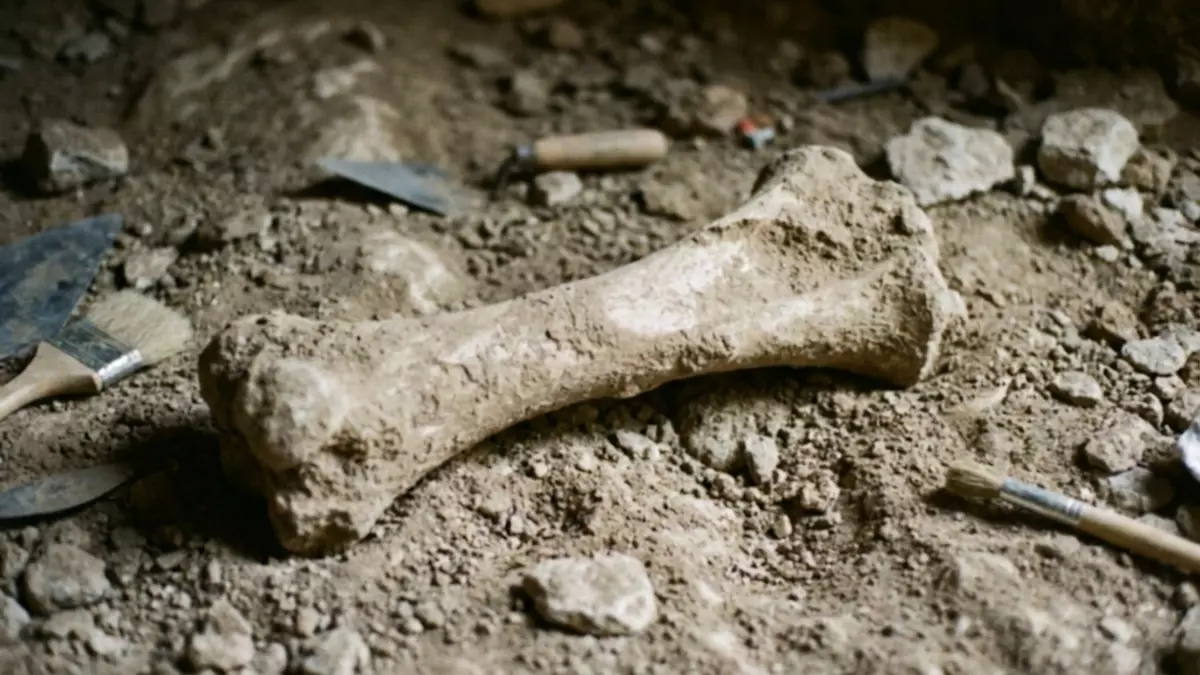
The cornerstone of the “overhunting” hypothesis rested heavily on a unique fossilized leg bone. Discovered in Western Australia’s famed Mammoth Cave, located in the Margaret River region, the artifact is a 40,000 to 50,000-year-old shinbone (tibia) belonging to an extinct, giant short-faced kangaroo known as Sthenurus.
+---------------------+-------------------------------------------------------+
| Fossil Attribute    | Research and Analysis Details                         |
+---------------------+-------------------------------------------------------+
| Specimen Type       | Extinct short-faced kangaroo (Sthenurus) tibia        |
| Estimated Age       | Between 40,000 and 50,000 years old                   |
| Original Site       | Mammoth Cave, Margaret River, Western Australia       |
| Key Technologies    | Micro-computed tomography (micro-CT), X-ray microscopy |
+---------------------+-------------------------------------------------------+
For decades, textbook consensus held that distinct grooves etched into the surface of this kangaroo bone were butcher marks made by ancient stone tools. To early researchers, this was the ultimate smoking gun: physical proof that prehistoric Aboriginal people actively slaughtered and consumed Australia’s largest native marsupials.
However, an international research team decided to re-examine the legendary Mammoth Cave tibia using modern forensic tools. Utilizing high-resolution micro-computed tomography (micro-CT) scanning alongside microscopic wear analysis, the scientists peered beneath the surface of the bone’s ancient fractures.
The results were stunning. The scans revealed that the structural cracks in the kangaroo shinbone had dried out, weathered, and aged completely before the incisions were ever made. In fact, the microscopic evidence proved the marks were inflicted long after the animal’s death—and likely after the bone had already completed the mineralized process of fossilization.

This critical distinction shifted the entire paradigm. The lines on the bone were not the frantic slice marks of an Ice Age butcher prepping a fresh carcass; they were the deliberate incisions of a human hand interacting with a stone-hard fossil millennia later.
Reclaiming History: The World’s Earliest Paleontologists
By dismantling the narrative of aggressive overhunting, the study opens the door to an far more nuanced and culturally rich reality. The findings suggest that instead of acting as environmental destroyers who wiped out native megafauna, prehistoric Aboriginal Australians may actually hold the title of the world’s very first paleontologists and fossil collectors.
Rather than hunting live Sthenurus kangaroos to extinction, ancient populations were exploring their landscapes, identifying uniquely fossilized remains eroding from caves and riverbeds, and curating them. This behavioral shift demonstrates deep-time awareness, a profound curiosity about the natural history of their environment, and an innate drive to collect and preserve rare geological anomalies.
Uncovering a 3,000-Kilometer Ancient Trade Network
To determine whether this fossil collection was an isolated incident or a widespread cultural practice, the researchers expanded their investigation to other rare artifacts. They focused on a highly unusual charm fashioned from the tooth of a Zygomaturus trilobus (the massive, extinct wombat-like creature). The unique pendant had originally been collected by researchers back in the 1960s in the remote Kimberley region, located in the far northern reaches of Western Australia.
Using non-destructive X-ray fluorescence to analyze the distinct elemental signature of the fossilized tooth, the scientific team made an unbelievable geographic connection. The chemical composition of the Kimberley charm did not match local geology; instead, it was a near-perfect match to the unique chemical makeup of the fossils found inside Mammoth Cave—nearly 3,000 kilometers (1,860 miles) away in the southwestern corner of the continent.
                  ANCIENT AUSTRALIAN FOSSIL MOVEMENT

  [Kimberley Region]  <==================================  [Mammoth Cave]
  (Northern Australia)         ~3,000 Kilometers           (Southern Australia)
  * Fossil tooth found         Ancient Trade Route         * Original source of
    fashioned into a charm                                   the fossilized tooth
This staggering distance provides undeniable evidence of vast, highly organized prehistoric trade networks. Ancient Aboriginal peoples were not just picking up interesting stones; they were transporting, trading, and circulating highly valued megafauna fossils across the entire length of the Australian continent. These fossils were clearly treated as special, prestigious, or spiritually powerful objects, passed down through cultural exchanges over countless generations.
Re-evaluating Supposed Signs of Prehistoric Slaughter
As part of their comprehensive sweep, the researchers re-evaluated several other high-profile archaeological sites across Australia that claimed to showcase direct human-megafauna conflict. This included analyzing various fractured animal bones and burnt megafauna eggshells previously attributed to ancient hunting parties or cooking fires.
Upon closer inspection with modern technology, none of these sites held up to intense scientific scrutiny. The alleged tool marks and burn patterns were consistently found to be the result of natural environmental processes—such as wild bushfires, subterranean pressure, mineral staining, or non-human scavenger gnawing. The study concluded that there is currently no definitive, ironclad archaeological proof that early humans systematically hunted or butchered Australia’s extinct megafauna.
Oral Traditions, Rock Art, and the Fossil Record
This groundbreaking study also reshapes how we view ancient Indigenous art and storytelling. Throughout Australia, spectacular rock art panels and deeply embedded Aboriginal oral histories describe monstrous, giant creatures, including terrifying predatory reptiles and massive marsupial lions.
For years, Western scientists assumed these stories were firsthand accounts passed down from ancestors who lived alongside the living animals. While some overlap may have occurred, the new research suggests a fascinating alternative: these ancient depictions and legends may actually represent early human interpretations of the fossil record.
Just as ancient Europeans invented stories of dragons upon discovering dinosaur bones, early Aboriginal Australians likely observed the massive skeletons of Sthenurus or Zygomaturus eroding from the earth, recognizing them as powerful ancestral beings from the Dreamtime. They integrated these remarkable discoveries into their spiritual framework, preserving the bones as sacred relics of a bygone era.
Conclusion
The revelation that ancient Australians were actively collecting, modification, and trading fossils completely redefines our understanding of human history on the continent. It replaces the primitive archetype of the destructive hunter with a portrait of sophisticated, inquisitive stewards of the land. Long before the birth of modern Western paleontology, Australia’s First Peoples were already reading the pages of deep time written in stone, valuing the remnants of the past, and weaving the continent’s ancient giants into the permanent fabric of human culture.
Frequently Asked Questions
If humans didn’t hunt them, why did Australia’s megafauna go extinct?
With human hunting largely ruled out by this new evidence, the scientific consensus is shifting heavily toward severe environmental factors. Rapid climate fluctuations, prolonged droughts, and massive changes to the continent’s vegetation layout toward the end of the Ice Age likely created an ecosystem that could no longer sustain such massive, specialized creatures.
How do scientists tell the difference between an ancient butcher mark and later handling?
Using micro-CT scans, scientists look at the microscopic edges of the cut. If an animal was butchered fresh, the stone tool would cut into elastic, organic bone tissue, leaving smooth, distinct edges. If the bone was already dry or fossilized into stone when cut, the tool would cause micro-chipping, fracturing, and crumbling along the edges of the groove, which is exactly what was observed on the Mammoth Cave kangaroo tibia.
What kind of animal was a sthenurine kangaroo?
The sthenurine kangaroo (Sthenurus) was a genus of giant, short-faced kangaroos that lived during the Pleistocene epoch. Unlike modern kangaroos, they had a single large claw on each foot (resembling a horse’s hoof), a short, robust snout like a koala, and a skeletal structure that suggests they walked upright on two legs rather than hopping.
How did a fossil travel 3,000 kilometers across ancient Australia?
The fossilized Zygomaturus tooth traveled across Australia via extensive, deeply interconnected Indigenous trade and ceremonial networks. Known traditionally as “Songlines” or trade paths, these routes crossed the entire continent, allowing specialized goods, greenstone axes, ochre, shell ornaments, and precious fossils to be traded sequentially from one tribal group to another over hundreds of miles.
What is X-ray fluorescence and why was it used in this study?
X-ray fluorescence (XRF) is a non-destructive analytical technique used to determine the elemental composition of materials. By exposing the fossil tooth to high-energy X-rays, scientists can read the unique “chemical fingerprint” of the minerals inside it. This allowed the team to match the Kimberley charm’s exact mineral matrix to the specific geological environment of Mammoth Cave without damaging the precious artifact.