
Table of Contents
- 1. An Accidental Salvage Operation Yields Historic Wealth
- 2. The Thracian Elite and the Companion War Horse
- 3. A Trove of Extravagant Grave Goods and Specialized Weapons
- 3.1. Ornate Personal Adornments
- 3.2. Elite Weaponry and the Gem-Encrusted Makhaira
- 4. Masterpieces of Hellenistic Metallurgy
- 5. Unveiling a Dynastic Necropolis of Ancient Thrace
- 6. Conclusion
- 7. Frequently Asked Questions
- 7.1. 1. Where was this Thracian warrior tomb discovered?
- 7.2. 2. What makes this specific tomb unique compared to other burials?
- 7.3. 3. Why was a horse buried alongside the Thracian commander?
- 7.4. 4. What is depicted on the medallions found on the horse’s harness?
- 7.5. 5. What is a dynastic necropolis and why do experts think this site is one?
Opulent Tomb Discovery Reveals Thracian Warriors Had Elite Global Ties
The modern world often associates ancient global trade networks exclusively with major empires like Rome, Carthage, or the successor kingdoms of Alexander the Great. Independent regional cultures are frequently overshadowed by these Mediterranean heavyweights, relegated to the margins of history textbooks as isolated provincial societies. However, a stunning archaeological discovery in southern Bulgaria is completely upending this viewpoint.
During a routine infrastructure project, a team of researchers uncovered an undisturbed, masterfully provisioned burial site belonging to an ancient Thracian military commander. Packed with rare gold jewelry, exotic imported luxuries, and a gemstone-encrusted ceremonial sword, this 2nd-century BCE tomb is now being recognized as the most opulent Hellenistic-era warrior burial ever discovered in Bulgaria. The find provides an unprecedented look at how local tribal leaders navigated the complex political, economic, and cultural crosscurrents of the ancient Mediterranean world.
Opulent Tomb Discovery Reveals Thracian Warriors Had Elite Global Ties
An Accidental Salvage Operation Yields Historic Wealth
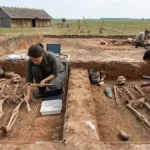
The remarkable discovery did not begin with a planned academic expedition, but as a time-sensitive rescue excavation. Construction crews preparing the ground for a new electrical power cable near the village of Kapitan Petko Voivoda, located within the Topolovgrad municipality of southern Bulgaria, noticed signs of ancient structural remains beneath the surface soil. Local authorities halted the construction work immediately, clearing the way for an emergency archaeological team to secure the site.
[Power Cable Construction] ➔ [Discovery of Subsurface Ruins] ➔ [Emergency Archaeological Team Deployed]
A specialized team from the Bulgarian Academy of Sciences, spearheaded by field archaeologists Vladimir Staykov and Deyan Dichev, rushed to the location. The excavation was conducted under the scientific guidance of Dr. Daniela Agre, a renowned specialist in ancient Thracian culture.
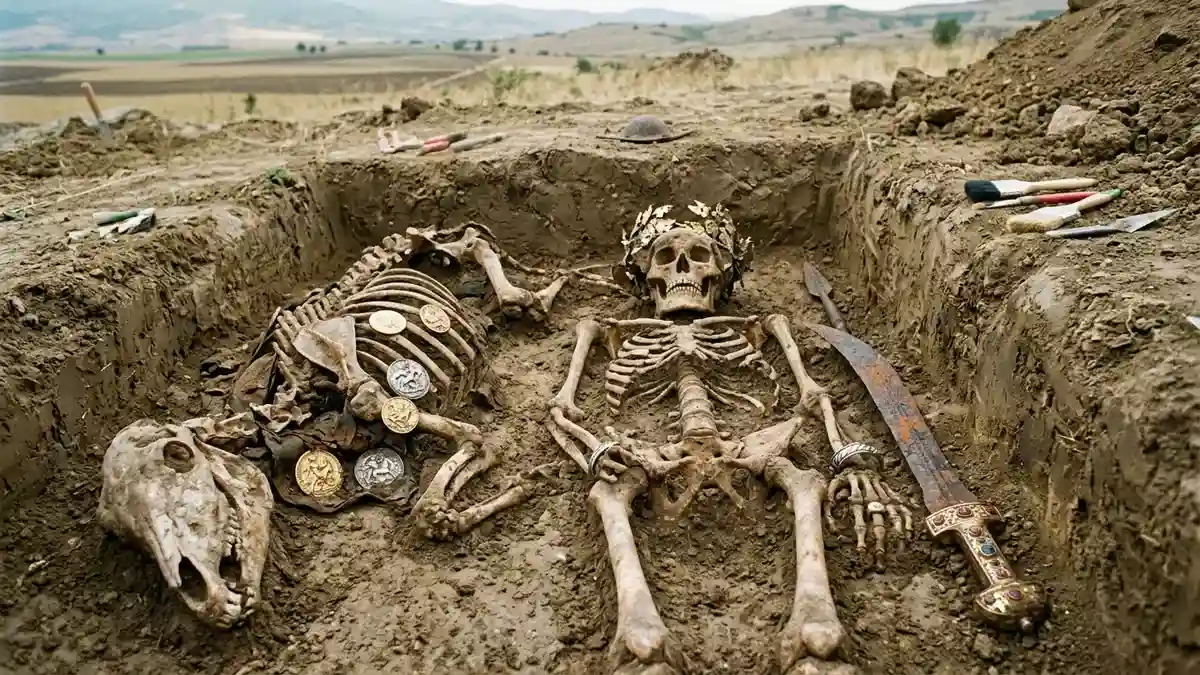
As the team cleared away the clay and soil, they exposed a well-preserved burial pit measuring precisely three meters long by one meter wide (approximately 10 by 3.3 feet). Inside the pit lay the skeletal remains of a robust male warrior, whose age at the time of death was estimated by physical anthropologists to be between 35 and 40 years old—the prime of life for a high-ranking military commander in antiquity.
The Thracian Elite and the Companion War Horse
The structural layout of the burial chamber reveals a deep alignment with the sacred spiritual customs of the ancient Thracian nobility. The commander was not laid to rest alone; he was interred alongside his prized war horse, which was carefully positioned on the left-hand side of his body.
For the Thracians, a warrior’s horse was far more than a tactical battlefield asset. It was viewed as a spiritual companion destined to accompany its master into the afterlife.
This elaborate practice was reserved strictly for the highest echelon of the tribal aristocracy. It served as a highly visible public statement of the family’s immense wealth, political authority, and elite status within the community. The presence of the horse confirms that this specific individual was a prominent cavalry leader, capable of commanding substantial military forces during a highly volatile period in Balkan history.
 Ancient Shamanic Mask Unveils Hidden Dynamic Between Europe’s First Farmers and Hunter-Gatherers
A Trove of Extravagant Grave Goods and Specialized Weapons
What elevates this specific burial above all previous regional discoveries is the sheer quantity, quality, and diversity of the artifacts deposited alongside the deceased commander. The grave goods indicate that this Thracian leader had direct access to high-end commercial networks spanning the entire Mediterranean basin.
Ornate Personal Adornments
Resting directly upon the warrior’s skull was the ultimate symbol of leadership and societal honor: a magnificent, delicately crafted silver-gilt ceremonial wreath. These wreaths were intentionally manufactured for elite funerary rites, designed to showcase the deceased’s high standing and civic achievements to both the living mourners and the gods of the underworld.
In addition to the wreath, the commander was adorned with an array of premium personal jewelry. The team recovered a heavy silver bracelet, a masterfully engraved ring, and an intricately worked fibula—a decorative brooch used to fasten heavy military cloaks. Each of these items exhibited a level of advanced metalworking craftsmanship that highlights the sophisticated taste of the Thracian aristocracy.
Elite Weaponry and the Gem-Encrusted Makhaira
The weaponry arrayed around the skeleton provides an intimate look at Hellenistic battlefield tactics. The team uncovered a heavy iron spear and a robust metal shield boss, which originally formed the reinforced center of a wooden shield. However, the true showstopper of the military cache was an exceptionally rare Greek makhaira.
[Greek Makhaira] ➔ Curved, Single-Edged Slashing Blade ➔ Gold-Inlaid Handle with Semi-Precious Gemstones
The makhaira was a specialized, single-edged curved sword designed primarily for devastating slashing attacks from horseback. While standard versions of this weapon are occasionally found in regional excavations, this specific sword is entirely unique in the global archaeological record. Its handle features intricate gold inlay work and is encrusted with genuine semi-precious gemstones. This level of weapon customization was a luxury that only the wealthiest rulers of the ancient world could afford.
Masterpieces of Hellenistic Metallurgy
The elite treatment extended to the commander’s war horse, which was decorated as if preparing for a royal procession. The animal’s leather harness was covered in a series of heavy gold, silver, and bronze medallions. These metallic disks were encased in high-relief sculptural representations depicting classic scenes from Greek mythology.
The central motif on the prominent medallions portrays the legendary demi-god Heracles wrestling with the Libyan giant Antaeus. According to the myth, Antaeus derived his invincible strength directly from contact with his mother, Gaia (the Earth). Heracles defeated the giant by lifting him high into the air, breaking his connection to the ground and crushing him.
The inclusion of this specific Greek narrative on a Thracian warrior’s horse armor demonstrates a profound level of cultural fusion. It proves that the Thracian elite were not culturally isolated; they were deeply literate in classical Greek mythology and actively commissioned Mediterranean artisans to produce high-end luxury goods that blended indigenous power with international artistic trends.
Unveiling a Dynastic Necropolis of Ancient Thrace
The discovery of this elite tomb provides vital context for a broader archaeological theory. Remarkably, just 60 meters (about 196 feet) to the north of this exact spot, Dr. Daniela Agre’s team had unearthed a separate, similarly lavish cremation burial during the 2024 excavation season. That previous grave belonged to a Thracian noble who maintained direct administrative or military links to expanding Roman forces, and it contained its own cache of rare gold jewelry and weapons.
Because these two ultra-wealthy burials are located in such close physical proximity, researchers now believe they have discovered a formal, dynastic necropolis used exclusively by a single ruling family line of Thracian elites during the Late Hellenistic period. This was one of the most dynamic and chaotic eras in Balkan history, a transitional period where indigenous Thracian traditions collided directly with the fading artistic legacies of Alexander the Great’s empire and the relentless, upward march of Roman military expansion.
All the newly recovered treasures from the power cable salvage site are undergoing meticulous laboratory cleaning and stabilization work. Once this preservation process is complete, they will be moved to the Historical Museum in Topolovgrad to join the 2024 discoveries on permanent public display, securing the region’s status as a premier hub for Thracian studies.
Conclusion
The excavations around the village of Kapitan Petko Voivoda have provided the global historical community with far more than a simple collection of precious metals and ancient weapons. Locked within the 3×1 meter burial pit of this anonymous 35-year-old commander is definitive proof of an interconnected, globalized ancient world. By showing that a Thracian tribal leader could possess a gemstone-encrusted Greek sword and horse armor depicting Mediterranean myths, this discovery demonstrates that ancient cultures were bound together by trade, art, and mutual respect long before the formal rise of the Roman Empire in the region.
Frequently Asked Questions
1. Where was this Thracian warrior tomb discovered?
The tomb was discovered in southern Bulgaria, near the village of Kapitan Petko Voivoda in the Topolovgrad municipality. It was found entirely by accident during a time-sensitive rescue excavation ahead of a construction project for a new electrical power cable.
2. What makes this specific tomb unique compared to other burials?
This burial is officially recognized as the most opulent Hellenistic-era warrior tomb ever uncovered in Bulgaria. It stands out due to the exceptional richness of its grave goods, including a silver-gilt ceremonial wreath, elite personal jewelry, and a highly unique Greek makhaira sword featuring a gold-inlaid, gemstone-encrusted handle.
3. Why was a horse buried alongside the Thracian commander?
In ancient Thracian noble culture, horses were viewed as sacred spiritual companions. Interring a warrior’s war horse on the left-hand side of his body was a prestigious funerary custom reserved strictly for the military aristocracy, serving as a status symbol and ensuring the rider had his mount in the afterlife.
4. What is depicted on the medallions found on the horse’s harness?
The gold, silver, and bronze medallions feature high-relief sculptural depictions of classical Greek mythological scenes. Specifically, they show the famous demi-god Heracles wrestling with the giant Antaeus, illustrating a deep appreciation and adoption of Greek art and lore by Thracian rulers.
5. What is a dynastic necropolis and why do experts think this site is one?
A dynastic necropolis is a centralized, exclusive burial ground used across generations by a single ruling family or royal bloodline. Archaeologists believe this site is one because this opulent tomb was found just 60 meters away from another equally lavish noble burial discovered in 2024, indicating a dedicated resting place for the regional elite.