
Table of Contents
- 1. Mapping 30,000 Years of Prehistoric Connectivity
- 2. Obsidian Trails and Shared Technologies
- 3. Rewriting the Timeline of Human Cultural Shift
- 4. Why Social Ties Were a Matter of Life and Death
- 5. Frequently Asked Questions
- 5.1. Where exactly did this prehistoric social network exist?
- 5.2. How do scientists know ancient humans traveled such long distances?
- 5.3. What did these ancient groups share across their networks?
- 5.4. Why does this study change our view of human history?
- 5.5. Why were social networks so vital to ice-age survival?
Ancient Social Networks Saved Caucasus Hunter-Gatherers From Extinction
When we think about how prehistoric humans survived the brutal, fluctuating climates of the Ice Age, we often imagine them developing sharper spears, discovering better caves, or simply following migrating herds. But a comprehensive archaeological study suggests that our ancestors’ most powerful survival tool wasn’t a physical weapon at all—it was their social network.
According to research published in Quaternary Science Reviews, prehistoric hunter-gatherers in the southern Caucasus survived for an astonishing 30,000 years by maintaining expansive, long-distance social connections. By sharing knowledge, trading vital resources, and maintaining cultural ties across hundreds of kilometers, these tiny, scattered populations managed to endure massive environmental transformations that could have easily wiped out isolated groups.
The findings completely reshape our understanding of early human resilience, demonstrating that long before the internet or ancient trade routes, humanity was already relying on regional networking to survive a changing world.
Ancient Social Networks Saved Caucasus Hunter-Gatherers From Extinction
Mapping 30,000 Years of Prehistoric Connectivity
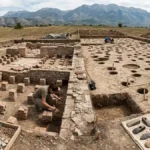
The study meticulously reconstructs life in the southern Caucasus—a diverse geographic region encompassing modern-day Armenia, Georgia, and neighboring territories—between 57,000 and 27,000 years ago. This specific timeline is highly significant, as it captures a turbulent chunk of Earth’s climate history, alongside the profound evolutionary shift from the Middle Paleolithic to the Upper Paleolithic era.
While traditional archaeological papers focus exclusively on local climates or isolated piles of stone artifacts, this international research team chose to look at the bigger picture. By compiling environmental, geological, and archaeological data from dozens of scattered excavation sites, they mapped out how these ancient people physically moved, interacted, and communicated.

The data revealed a striking paradox: while the overall population of the region was incredibly small and individual bands lived scattered across vast distances, their cultural and social reach was immense. These early humans were far from isolated; they belonged to a highly sophisticated web of information exchange.
Obsidian Trails and Shared Technologies
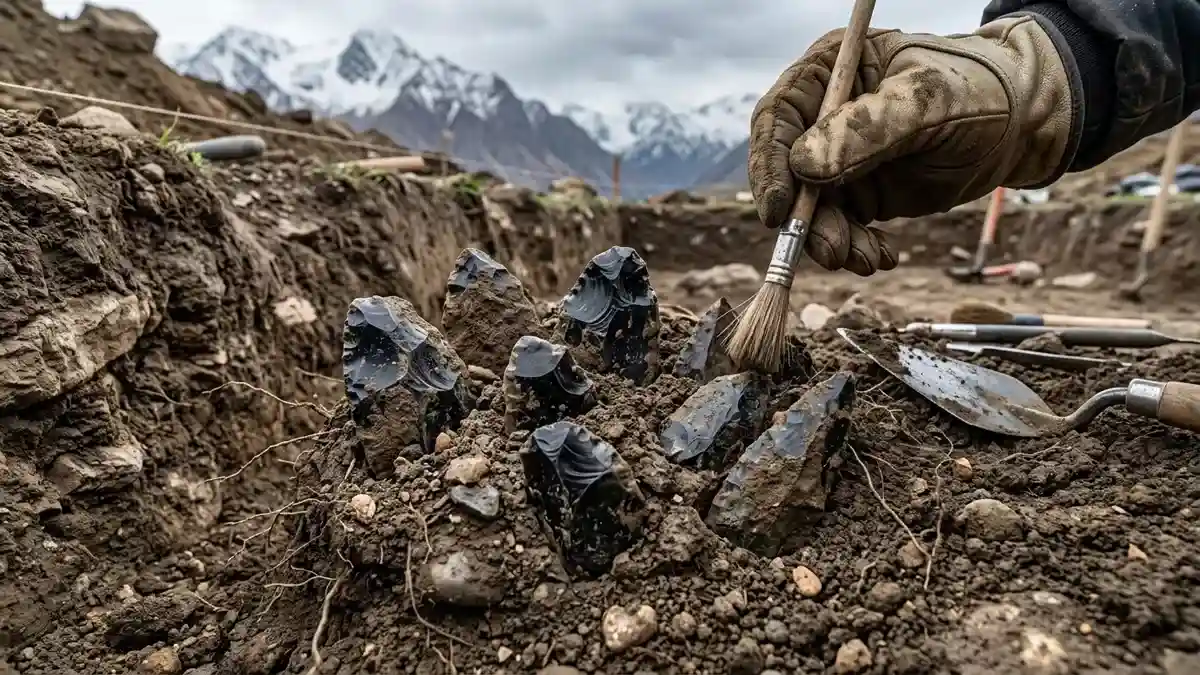
Some of the most definitive proof of this prehistoric networking came from the raw materials used to manufacture daily hunting tools. Archaeologists analyzed stone tools made from obsidian—a naturally occurring volcanic glass prized for its razor-sharp edges.
By tracing the geological signatures of the obsidian back to its original volcanic sources, the team discovered that these ancient hunter-gatherers routinely traveled distances ranging from 40 to 200 kilometers (approximately 25 to 124 miles). These grueling treks effectively linked communities living in the lowlands of the southern Caucasus directly to the rugged heights of the Armenian Highlands.

[Volcanic Obsidian Sources] ──► 40km to 200km Trek ──► [Scattered Hunter-Gatherer Camps]
                                                                  │
                                                          Knowledge Exchange
                                                                  │
                                                                  ▼
                                                      Identical Tool Technologies
Crucially, these long-distance journeys weren’t just about collecting raw stone. The manufacturing styles, flaking methods, and carefully shaped working edges of the tools discovered across various distinct sites were nearly identical.
Because toolmaking was a complex skill passed down through hands-on demonstration, these synchronized technological designs prove that different clans were actively meeting, sharing ideas, and teaching each other new skills. If a single group developed a more efficient way to process meat or craft a cold-weather scraper, that vital knowledge quickly rippled across the entire regional network.
Rewriting the Timeline of Human Cultural Shift
This new body of evidence fundamentally challenges how textbooks describe one of the most critical eras in human history: the transition from the Middle Paleolithic to the Upper Paleolithic. For decades, this transition was framed as a swift, dramatic cultural revolution—a clean break where one technologically superior population rapidly moved in and completely replaced an older culture.
The southern Caucasus data paints a much slower, more nuanced picture:
Coexistence Over Eras: Different toolmaking traditions and cultural styles existed side by side for thousands of years.
Gradual Evolution: Rather than a sudden replacement, ancient populations interacted continuously, slowly influencing each other’s cultural habits and technologies over generations.
A Tapestry, Not a Timeline: Human evolution in this corridor was a slow blending of ideas, rather than a brutal story of one population instantly wiping out another.
Why Social Ties Were a Matter of Life and Death
In a harsh, unstable ice-age environment, relying purely on your immediate family or local clan was a dangerous gamble. If a local drought hit, a severe winter blocked standard hunting valleys, or a disease weakened a specific group, an isolated population could easily collapse.
The study argues that long-distance social networks functioned as a vital insurance policy against extinction. When a local community faced hard times, their established social connections gave them access to external resources, alternative territories, and life-saving survival information from groups living in unaffected regions.
Because the southern Caucasus sits geographically as a natural land bridge connecting Europe and Asia, these resilient social systems likely made it one of the most important corridors for early human migration across Eurasia. Survival didn’t just depend on the strength of an individual’s muscles or the climate of their valley; it depended on a beautiful, interlocking web of climate adaptability, physical mobility, and human community.
Frequently Asked Questions
Where exactly did this prehistoric social network exist?
The study focused on the southern Caucasus region and the Armenian Highlands, which includes modern-day Armenia, Georgia, and adjacent surrounding territories. This area has long been recognized as a critical geographic bridge between Europe and Asia.
How do scientists know ancient humans traveled such long distances?
Scientists traced the chemical signatures of volcanic obsidian tools back to their original geological sources. The results showed that hunter-gatherers traveled between 40 and 200 kilometers to collect stone materials, carrying them between separate regional base camps.
What did these ancient groups share across their networks?
Beyond physical trading materials like obsidian, these groups shared critical survival information, technological expertise, and toolmaking methods. The identical design patterns of stone tools found at different sites indicate a continuous, long-distance exchange of ideas.
Why does this study change our view of human history?
It disproves the traditional theory that the shift from the Middle to Upper Paleolithic was a fast, aggressive cultural replacement. Instead, the evidence proves that different cultures and ancestral traditions coexisted peacefully, interacted, and slowly blended together over thousands of years.
Why were social networks so vital to ice-age survival?
Because individual populations were tiny and scattered, local disasters like a lack of game or extreme weather could easily destroy an isolated group. Staying connected to distant clans allowed humans to share survival strategies, exchange members, and find refuge in safer territories during regional crises.