
Table of Contents
- 1. The Muddy Time Capsule of Bjørvika
- 2. Reading the Footprints of the Middle Ages
- 2.1. A Personal Connection across Centuries
- 3. Inside the Workrooms of the Medieval Cobbler
- 3.1. The Stinky Science of Tanning
- 4. Medieval Pockets: The Evolution of the Personal Bag
- 5. Recycled Scabbards and Everyday Tools
- 6. The River, the Rubbish, and the Spring Floods
- 7. Frequently Asked Questions
- 7.1. What makes the Oslo leather discovery so unique?
- 7.2. How did the leather survive for 700 years without decaying?
- 7.3. What is the “turnshoe” technique used by medieval shoemakers?
- 7.4. Why did archaeologists find so many ancient bags and purses?
- 7.5. How did all these personal items end up in the ancient harbor?
2,900 Medieval Leather Treasures Found in Oslo Unlock Ancient Secrets
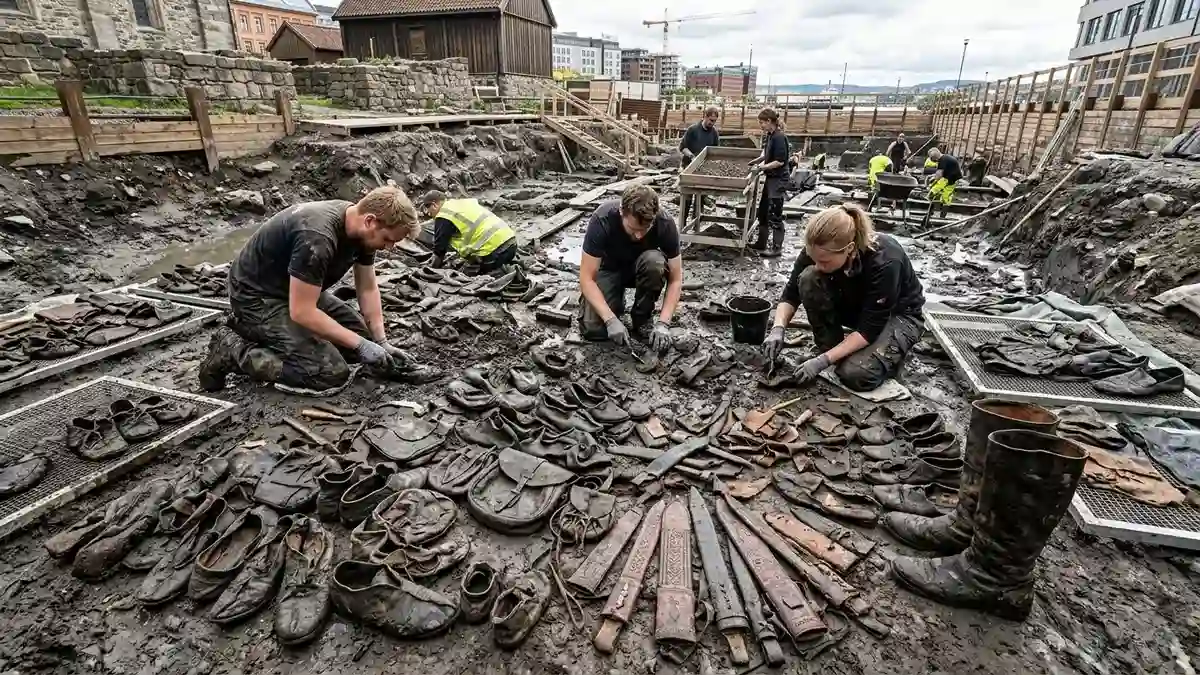
Deep beneath the bustling modern streets of Norway’s capital, a stunning historical archive has just been pulled from the muck. During a standard pre-construction excavation in Oslo’s historic Bjørvika neighborhood, archaeologists hit the scientific jackpot: a massive, waterlogged treasure trove containing more than 2,900 perfectly preserved medieval leather artifacts.
Dating back to the 13th and 14th centuries, these items—including hundreds of intricately stitched shoes, personal bags, and weapon sheaths—are providing historians with an incredibly intimate, unfiltered look at the daily lives, fashion trends, and economic habits of the Scandinavian people 700 years ago. It is a discovery that transforms anonymous historical data into a deeply personal narrative of the individuals who walked the streets of medieval Norway.

2,900 Medieval Leather Treasures Found in Oslo Unlock Ancient Secrets

The Muddy Time Capsule of Bjørvika
The spectacular find occurred on a plot of land originally slated for the construction of a new school building. Led by Marja-Liisa Petrelius Grue, a senior archaeologist at the Norwegian Maritime Museum, the field team was initially searching for signs of maritime history, such as historic shipwrecks or harbor infrastructure. Instead, they dug directly into a massive cultural layer encased in thick, oxygen-depleted clay.
This wet, dense mud provided the ultimate environment for preservation. Because destructive bacteria and fungi cannot thrive without oxygen, delicate organic materials like leather—which normally rot away completely within a few decades—remained virtually untouched for seven centuries.
Remarkably, leather makes up more than 80% of all the artifacts recovered from the site. While the team has already cataloged 227 distinct shoes, the high density of the find has led experts to predict that the total number of footwear items will easily surpass 1,000 as the excavation moves forward.
 Roman villa and advanced drainage systems unearthed in Aquileia during cycling path construction
Reading the Footprints of the Middle Ages
For the research team, the most moving aspect of the discovery is the sheer level of wear and tear visible on the footwear. These weren’t pristine, ceremonial garments hidden away in a treasury; they were the heavily utilized, everyday items of working-class citizens.
[ Timeline of a Medieval Shoe ]
 Hand-Stitched (Turnshoe) ──► Worn Heavily ──► Patched/Repaired ──► River Disposal
The collection showcases an incredible variety of styles, ranging from basic, low-ankle slippers fastened with simple straps to tall, knee-high boots decorated with elaborate embossed patterns. Almost every shoe recovered shows clear signs of a long, hard-fought lifecycle, featuring worn-down soles and multiple layers of historical patches.
A Personal Connection across Centuries
Archaeologists note that these unique wear patterns act like a physical footprint across time. The leather has permanently warped to match the specific foot shapes, gaits, and bunions of the long-dead individuals who wore them.

Among the most heartwarming discoveries are more than 40 distinct children’s shoes. Some of these tiny pieces of footwear are as small as a modern toddler’s size 22. Intriguingly, regardless of the shoe’s size, medieval cobblers utilized the exact same advanced materials and high-level stitching techniques for children’s footwear as they did for adult shoes, demonstrating the immense value placed on protecting young feet from the elements.
Inside the Workrooms of the Medieval Cobbler
During the 13th and 14th centuries, owning a pair of shoes was a substantial financial investment. In medieval Oslo, absolutely everyone walked, making high-quality footwear an essential commodity.
To create these durable goods, artisans utilized a specialized method known as the turnshoe technique. Cobblers would meticulously sew the leather pieces together completely inside out using tough animal sinew or waxed thread. Once the structural stitching was complete, the craftsman would painstakingly turn the entire wet shoe right-side out. This brilliant method ensured that the vulnerable seam threads were safely hidden inside the shoe, protecting them from being worn away by walking on rough stone streets.
The Stinky Science of Tanning
The discovery also sheds light on Oslo’s ancient industrial zoning. Near the ruins of the old Hallvard Cathedral, researchers previously uncovered specialized tools, scraps of raw leather, and even an intact wooden tanning vat.
Tanning—the chemical process of transforming raw animal hides into durable leather using natural wood tannins and organic acids—was a notoriously foul-smelling and toxic enterprise. Because of the overwhelming stench, medieval laws strictly regulated where tanners could operate, usually forcing them outside the urban city limits. However, the presence of these vats near cathedral workshops suggests that high demand kept some highly skilled leatherworkers operating surprisingly close to the heart of urban society.
Medieval Pockets: The Evolution of the Personal Bag
Beyond footwear, the Bjørvika excavation yielded at least 20 historic purses and bags, each displaying completely unique dimensions, leather thicknesses, and structural designs.
To a modern observer, these bags represent a vital piece of missing daily technology: pockets. During the Middle Ages, tailored clothing did not feature built-in pockets. Consequently, if an individual needed to carry coins, keys, fire-starting flints, or grooming tools, an external bag was an absolute necessity.
The Anatomy of Medieval Bags
Most bags were designed with integrated leather loops to be threaded directly onto thick waist belts, or meticulously tied to the bodices of women’s dresses. The styles varied wildly based on social status and function, ranging from simple, utilitarian drawstring pouches to heavily decorated leather satchels. One incredibly delicate bag, measuring a tiny 5×5 centimeters, was likely used to carry a protective religious amulet or a child’s precious toy.
Recycled Scabbards and Everyday Tools
The archaeological team also recovered dozens of leather sheaths designed for knives and swords. In medieval Norway, a knife was not viewed as a concealed weapon, but as an indispensable daily tool carried openly on the belt by men, women, and children alike. It was used constantly throughout the day for everything from eating meals to cutting rope and carving wood.
Many of these scabbards feature beautiful artistic decorations, including hand-stamped checkered grids and elegant leaf motifs embossed directly into the leather.
Crucially, the artifacts provide clear proof of a robust medieval recycling culture. Several large sword scabbards show distinct marks where they were deliberately cut down, resized, and resewn to fit smaller knives. Because high-quality leather was so expensive and labor-intensive to produce, nothing was casually wasted.
The River, the Rubbish, and the Spring Floods
How did thousands of precious leather goods end up concentrated in a single muddy patch of the Oslo harbor? Dr. Grue and her research team have formulated a highly probable scientific explanation.
During the Middle Ages, the Bjørvika area functioned as a navigable inlet of the Oslofjord, situated directly at the mouth of the Alna River. The data suggests that the local population used the banks of the river as a long-standing municipal refuse dump for centuries.
When a shoe or bag finally wore out beyond the point of repair, it was tossed onto these massive trash heaps. Every spring, as the mountain snows melted, the Alna River would experience violent seasonal flooding. This rushing water eroded the edges of the riverbank dump sites, scouring the heavy leather artifacts into the current and washing them downstream into the quiet waters of the harbor basin. Settling into the soft harbor floor, the items were quickly covered by protective layers of silt and clay, preserving them perfectly until modern archaeologists pulled them back into the light.
Frequently Asked Questions
What makes the Oslo leather discovery so unique?
The discovery is unique due to the incredible volume and state of preservation of the artifacts. Finding over 2,900 leather items—including hundreds of intact shoes—from 700 years ago is exceptionally rare, as organic materials like leather typically rot away completely over time.
How did the leather survive for 700 years without decaying?
The artifacts were preserved because they were buried in thick, waterlogged clay at the bottom of an ancient harbor inlet. This wet environment was completely devoid of oxygen, which naturally prevented the growth of the bacteria and fungi that cause organic materials to decompose.
What is the “turnshoe” technique used by medieval shoemakers?
The turnshoe technique was a medieval manufacturing method where a cobbler stitched the leather pieces of a shoe together completely inside out. Once the sewing was finished, the entire shoe was turned right-side out, which kept the structural stitching safe from the friction of walking.
Why did archaeologists find so many ancient bags and purses?
During the 13th and 14th centuries, clothing was manufactured without pockets. Personal bags and pouches were essential daily accessories that people attached to their belts or bodices to carry everyday items like money, keys, tools, or amulets.
How did all these personal items end up in the ancient harbor?
The items were originally discarded in public trash heaps along the banks of the Alna River. Violent seasonal spring floods regularly eroded these dump sites, washing the heavy leather garbage downstream into the harbor, where it sank and became buried under sediment.