
Table of Contents
- 1. The Fordingbridge Excavation: Uncovering a Lost Community
- 2. Inside the Village: The Architecture of the Late Iron Age
- 2.1. Designing for the Elements
- 3. Daily Life, Loom Weights, and a 1-in-100 Miracle Find
- 3.1. The Lifecycle of a Sacred Stone
- 4. The Industrial Revolution: From Farms to Roman Factories
- 4.1. Clues of Ancient Factories
- 5. Solving the New Forest Ceramic Mystery
- 6. Frequently Asked Questions
- 6.1. Where exactly was this ancient settlement discovered?
- 6.2. What did the Iron Age roundhouses look like?
- 6.3. Why is the imported quern stone considered a “1-in-100” find?
- 6.4. How did the settlement change during the Roman period?
- 6.5. What are pottery “wasters” and what do they prove?
Lost Iron Age Settlement Found in England Unlocks Ancient Novel Secrets
A hidden chapter of ancient British history has just been unearthed on the edge of a quiet English town. Ahead of a scheduled housing development project, a team of commercial archaeologists made an unexpected discovery: a sprawling, previously unknown rural settlement that traces the exact moment a traditional tribal society transitioned into a highly industrialized Roman community.
Spanning nearly an acre of an ancient river terrace, the site has yielded over 2,000 distinct historical features. From a massive cluster of prehistoric roundhouses to rare, perfectly intact tools and ancient factories, these ruins are providing historians with a captivating look at how everyday people adapted, thrived, and completely revolutionized their economy under the rule of the Roman Empire.
Lost Iron Age Settlement Found in England Unlocks Ancient Novel Secrets

The Fordingbridge Excavation: Uncovering a Lost Community
The monumental discovery occurred on the western boundary of Fordingbridge, a historic town situated in Hampshire, England. Operating just outside the borders of the famous New Forest National Park, a team of field researchers from Cotswold Archaeology was brought in to survey the land prior to construction by CALA Homes.
What they found completely shattered previous historical maps of the area. Scattered across 0.84 hectares of a high river terrace overlooking the Allen Brook and its network of tributaries, the team mapped a densely packed, multi-layered archaeological landscape. The sheer volume of postholes, ditches, and artifact deposits indicates that this location was continuously occupied from the Late Iron Age straight through the peak of the Roman occupation of Britain.
Inside the Village: The Architecture of the Late Iron Age
The most visually striking revelation from the early phases of the excavation is a dense cluster of at least 15 ancient roundhouses. These structures served as the literal foundations of community life during the Late Iron Age and Early Roman period.
Designing for the Elements
Each roundhouse measured an impressive 13 meters (roughly 42 feet) in diameter, representing a substantial engineering investment for an ancient family. The architectural designs display a highly consistent, practical template:
Solar Alignment: The vast majority of the home entrances faced directly toward the east or southeast. This deliberate placement allowed the first rays of morning sunlight to pierce the dark interiors, maximizing natural heat and light.
Porch Extensions: Several of the larger roundhouses featured structured postholes extending outward from the doorways, indicating the presence of covered front porches to protect the main living areas from cold winds and rain.

[ Ancient Roundhouse Template ]
      Diameter: 13 Meters
      Entrance: Facing East/Southeast
      Features: Covered Entry Porches
Crucially, the archaeological footprints show that many of these roundhouses physically overlapped one another. Rather than abandoning the site, generations of families lived, died, and rebuilt their homes directly on top of older foundations. Coupled with an extensive network of connecting trackways, internal cooking ovens, and deep boundary enclosure ditches, the structural data proves that this settlement was highly stable, wealthy, and growing over centuries.
Daily Life, Loom Weights, and a 1-in-100 Miracle Find
The early layers of the Fordingbridge settlement painted a vivid picture of a self-sufficient domestic economy centered around agricultural processing and traditional textile crafting.
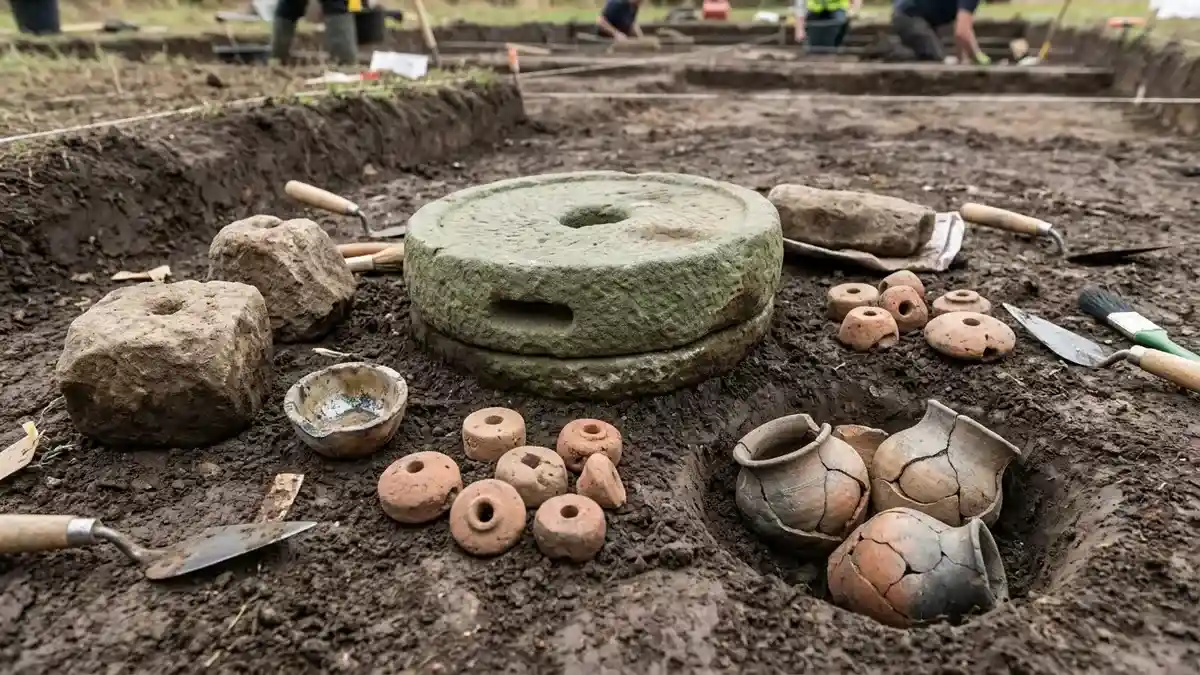
Scattered across the floors of the roundhouses, archaeologists uncovered numerous broken fragments of heavy quern stones, which were used daily by hand to grind harvested grain into flour. However, one specific discovery sent shockwaves through the research team: a completely unbroken, perfectly intact rotary quern stone.
The Lifecycle of a Sacred Stone
Crafted from high-grade green sandstone, the heavy stone was not a local product; the geological signature proves it was imported from a specialized manufacturing center miles away in Sussex, highlighting an active regional trade network.
According to Dr. Ruth Shaffery, a stone tool expert with Cotswold Archaeology, finding an intact quern is an incredibly rare archaeological event. Statistically, only about 1% of these heavy agricultural tools survive whole, as they were routinely broken up or discarded once they wore down.
A Lifetime of Reuse
This specific quern stone tells a deep story of ancient recycling. It began its long operational life as a heavy bottom grinding stone. After decades of friction flattened its surface, it was carefully reshaped and adapted to serve as a top stone. The ancient owner carved a specialized slot into the thicker side of the sandstone to fit a wooden handle, allowing it to be spun by hand. Both faces of the stone display smooth, deep grooves worn down by generations of grinding grain for the village’s daily bread.
Beyond agricultural processing, the team recovered numerous fired clay spindle whorls and heavy stone weights used for vertical weaving looms. These small, domestic artifacts prove that textile production was a vital part of the internal village economy, with women spinning wool and weaving garments for local use and external trade.
The Industrial Revolution: From Farms to Roman Factories
As the settlement marched into the Middle and Late Roman periods, its core function underwent a radical, dramatic transformation. The peaceful agricultural village morphed into a bustling, smoking local industrial center.
The entire layout of the community was aggressively reorganized. The old overlapping roundhouses were cleared away, replaced by a rigid grid system of deep drainage ditches, structured pathways, and industrial zoning.
Clues of Ancient Factories
The artifacts recovered from the later Roman layers shift completely from domestic weaving tools to heavy industrial waste. The Cotswold Archaeology team uncovered undeniable physical evidence of advanced mass manufacturing:
Metalworking: The team discovered a specialized melting crucible, a critical tool used by ancient smiths to melt down copper, bronze, or iron alloys for tool and weapon production.
Misfired Pottery “Wasters”: Large pits were found packed with distorted, cracked, and misfired ceramic pots. Known as “wasters,” these ruined pieces are the smoking-gun proof of on-site pottery kilns. In a fascinating display of resourcefulness, Roman potters used these ruined ceramic shards to pave and line the damp floors of storage pits.
Slag and Burnt Flint: Massive deposits of highly heated burnt flint and chunks of fired clay were uncovered, including one specific pit where hot, liquid clay had been dumped, cooling into a distinct, preserved domed shape.
Solving the New Forest Ceramic Mystery
The discovery of extensive pottery production at Fordingbridge has opened up a thrilling new investigation for British historians. During the Late Roman period, the neighboring New Forest region was world-famous for producing high-status, distinctively glazed ceramics that were traded all across Roman Britain.
Laboratory analysts are currently processing the chemical signatures of the Fordingbridge pottery “wasters” to see if they match the known clay recipes of the famous New Forest factories. If the signatures match, it means this newly found settlement was an official, major satellite outpost of the imperial Roman supply chain. If the recipes are unique, it proves the existence of a completely unstudied, independent manufacturing center operating right under the nose of the Roman authorities.
The Fordingbridge excavations are fundamentally rewriting our understanding of rural Roman Britain, showing that deep inside the countryside, ancient communities were highly adaptive, economically sophisticated, and fully capable of transitioning from quiet agricultural life to regional industrial powerhouses.
Frequently Asked Questions
Where exactly was this ancient settlement discovered?
The ruins were discovered by field archaeologists on the western edge of Fordingbridge, a town located in Hampshire, England. The site sits on a high river terrace directly above the Allen Brook, just outside the official boundaries of the New Forest National Park.
What did the Iron Age roundhouses look like?
The settlement contained at least 15 large roundhouses, each measuring roughly 13 meters (42 feet) in diameter. They were engineered with covered front porches and had entrances that systematically faced east or southeast to maximize the entry of natural morning sunlight and heat.
Why is the imported quern stone considered a “1-in-100” find?
Hand-powered quern stones used for grinding grain were heavily used and almost always fractured over time. Statistically, only about 1% of these ancient tools are recovered completely intact. This specific green sandstone quern was imported from Sussex and survived fully whole, showing clear marks of being heavily modified and reused over generations.
How did the settlement change during the Roman period?
Over centuries, the site shifted from a primarily domestic, agricultural farming village into a highly organized industrial manufacturing center. The old residential roundhouses were replaced with a planned network of ditches and paths designed around metalworking crucibles and mass-production pottery kilns.
What are pottery “wasters” and what do they prove?
“Wasters” are ceramic vessels that cracked, distorted, or misfired during the intense heating process inside a kiln, making them completely useless for trade or cooking. Finding large quantities of these ruined potsherds proves that the Fordingbridge site housed its own active, on-site ceramic factories.