
Table of Contents
**1,200-Year-Old Death Jar Holds Generations of Skeletons in Laos**
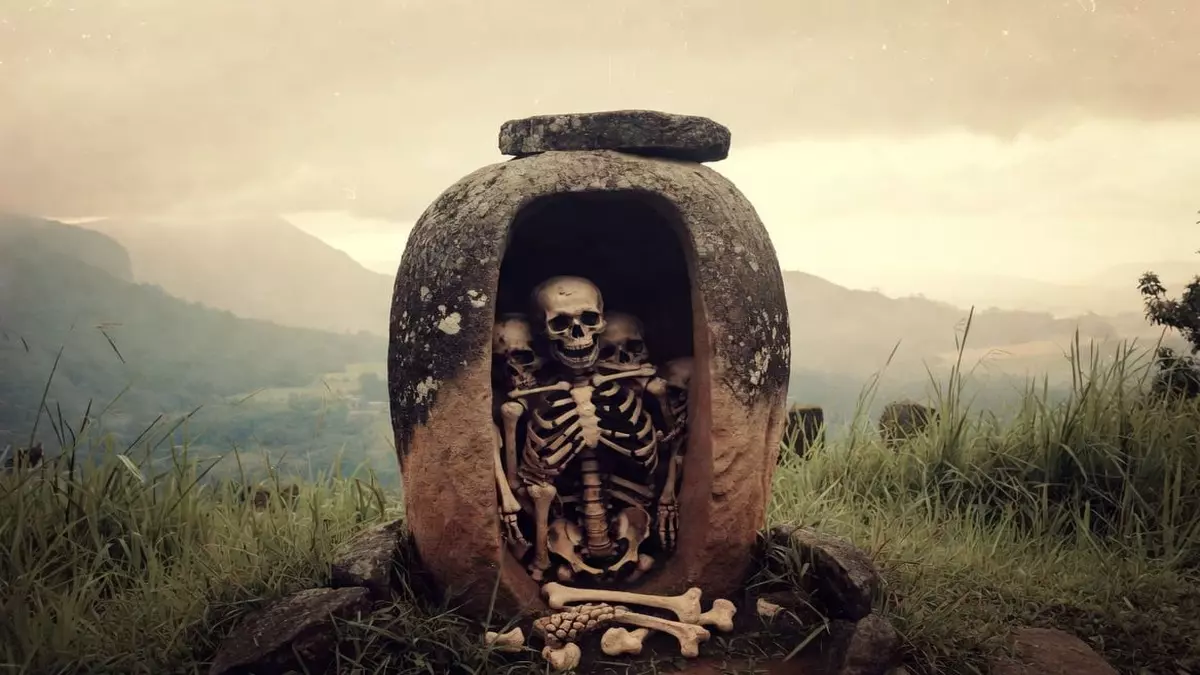
Archaeologists have confirmed that one of the giant stone jars on Laos’ mysterious Plain of Jars served as a communal “death jar,” holding the remains of multiple generations for over 270 years. This extraordinary find provides the first direct evidence that these massive vessels played a central role in ancient secondary burial rituals.
The discovery at Site 75 reveals a sophisticated mortuary tradition where families returned to the same jar over centuries to honor their dead, offering new insights into the spiritual and social practices of a little-understood Southeast Asian culture.
1,200-Year-Old Death Jar Holds Generations of Skeletons in Laos

### Giant Stone Jar Reveals Complex Burial Customs
The massive vessel, known as Jar 1, stands out among the more than 2,000 ancient stone jars scattered across the Xieng Khouang Plateau in northern Laos. Measuring 6.7 feet (2.05 meters) wide with unusually thick walls and a broad base, it contained an extraordinary quantity of human bones from dozens of individuals ranging from young children to adults.
Radiocarbon dating of teeth found inside the jar shows the remains were placed there at different times between approximately 890 and 1160 CE. Rather than a one-time burial, the jar functioned as a collective mortuary space used repeatedly across generations, likely by extended family or community groups.
This secondary burial practice involved allowing bodies to decompose elsewhere first, then carefully selecting and arranging bones inside the stone vessel. Skulls were positioned along the edges while arm and leg bones were grouped together, suggesting deliberate ritual placement rather than random deposition.
### First Confirmed Human Remains Inside a Plain of Jars Vessel
For decades, researchers speculated that the giant jars served funerary purposes, but direct evidence remained elusive. Many previous excavations found no human bones inside the vessels, leading to alternative theories about their use.
The excavation at Site 75, led by Nicholas Skopal of James Cook University and local heritage specialists, finally provides clear confirmation. The undisturbed state of the remains makes this the first documented case of human bones found in situ inside one of the iconic jars.
“The current evidence suggests this was a collective mortuary space used repeatedly over generations,” Skopal explained. The sheer volume of remains and the careful arrangement point to a long-standing tradition where the jar served as an ancestral repository rather than a primary burial site.
### Ritual Significance and Ancestral Veneration
The repeated use of Jar 1 over nearly three centuries highlights the deep cultural importance of these locations. Each new addition of bones would have been part of ceremonial practices that reinforced family ties and community identity.
Glass beads discovered among the remains add another layer of meaning. Many of these colorful beads originated from India, indicating participation in extensive trade networks that connected the Laotian highlands with distant regions across Southeast Asia and beyond.
“The concentration of beads and objects within Jar 1 suggests these items were likely important components of the final mortuary ritual and ancestral commemorative practices,” Skopal noted. The beads may have been placed as offerings or personal items accompanying the deceased into their collective resting place.
### The Enduring Mystery of the Plain of Jars
The Plain of Jars remains one of Southeast Asia’s most enigmatic archaeological landscapes. The massive stone vessels, some standing up to 10 feet (3 meters) tall and weighing several tons, were created along ancient trade routes between roughly 500 BCE and 500 CE. Yet many questions persist about the people who carved and positioned them.
This new evidence shows that the jars continued to hold spiritual significance long after their initial creation. While the main period of jar production occurred during the Iron Age, Jar 1 demonstrates their use in mortuary practices extended well into the early medieval period.
Researchers are now turning to ancient DNA analysis to explore biological relationships between the individuals. Such studies could reveal whether the jar primarily served a single extended family or a broader community group.
### Insights Into Ancient Southeast Asian Society
The discovery paints a picture of societies with strong ancestral veneration practices. Secondary burial rituals, where bones are collected and reinterred after decomposition, appear in various cultures across Asia and the Pacific. In this case, the durable stone jars provided a permanent, visible connection to ancestors in the landscape.
The presence of trade goods like Indian glass beads shows that highland communities were not isolated. They maintained connections with wider economic networks, acquiring prestige items that found their way into important ritual contexts.
This blend of local traditions and external influences reflects the dynamic cultural environment of the region during a time when powerful kingdoms and expanding trade routes were reshaping Southeast Asia.
### Challenges in Studying the Plain of Jars
Many jars have been disturbed over the centuries by natural processes, looting, or modern development. The exceptional preservation at Site 75 allowed researchers to document the positioning of bones and artifacts in detail, providing insights that would have been lost in less intact vessels.
Future work will likely focus on whether other jars served similar functions or if Jar 1 represents a specific local tradition. Broader excavations and comparative studies across the plateau will help determine the full range of mortuary practices associated with these monuments.
### Significance for Understanding Regional History
This find contributes substantially to our knowledge of pre-modern Southeast Asian societies. It demonstrates continuity in ritual practices across centuries and shows how communities adapted ancient monuments for ongoing spiritual needs.
The confirmation of secondary burial use also helps explain the absence of primary burials in many jars. Bodies were likely exposed or buried temporarily elsewhere before final interment in the stone vessels during communal ceremonies.
For the people of ancient Laos, these jars may have served as bridges between the living and the dead — tangible links to ancestry, territory, and cultural identity in a challenging mountainous environment.
### Modern Relevance and Cultural Heritage
Today, the Plain of Jars is recognized as a UNESCO World Heritage site, attracting researchers and visitors interested in its mysterious stone monuments. Discoveries like this one enhance appreciation for the sophisticated beliefs and practices of the region’s ancient inhabitants.
The research also highlights the importance of protecting these sites from modern threats while allowing careful scientific investigation. Collaborative projects between international archaeologists and Lao heritage specialists ensure that discoveries benefit both global knowledge and local cultural understanding.
As ancient DNA and other scientific techniques advance, researchers hope to uncover more personal stories about the individuals whose remains rested in Jar 1 — their relationships, health, and place within their society.
### The Human Story Behind the Death Jar
Behind the archaeological data lie generations of families who returned to the same stone jar to honor their loved ones. Parents placing the bones of children, adults adding elders, and communities gathering to remember those who came before them.
The careful arrangement of skulls and long bones, combined with offerings of glass beads, speaks to respect, continuity, and the belief that the dead remained part of the community. These rituals likely provided comfort and social cohesion in a world full of uncertainty.
The 1,200-year-old death jar stands as powerful evidence of humanity’s long tradition of creating meaningful ways to deal with loss and maintain connections across time.
### Conclusion
The excavation of the giant death jar at Site 75 on the Plain of Jars represents a breakthrough in understanding ancient Southeast Asian mortuary traditions. For the first time, researchers have clear evidence that these massive stone vessels served as communal repositories for generations of human remains.
This discovery not only confirms long-held theories about the jars’ purpose but also reveals a sophisticated, multi-generational ritual system that blended local beliefs with wider regional influences. The presence of Indian glass beads further emphasizes how even remote highland communities participated in extensive trade networks.
As analysis continues, including planned ancient DNA studies, we can expect even deeper insights into the lives and beliefs of the people who created and used these enigmatic monuments. The death jar at Site 75 transforms our view of the Plain of Jars from a mysterious collection of stone vessels into a landscape rich with ancestral memory and cultural continuity.
This remarkable find reminds us that across cultures and centuries, humans have developed creative and meaningful ways to honor the dead. In the hills of northern Laos, these ancient practices continue to speak to us today, bridging the gap between past and present through the enduring power of ritual and remembrance.
## FAQ
**How old is the death jar discovered in Laos?**
The jar was used for burials between approximately 890 and 1160 CE, making it about 1,200 years old.
**How many people were placed in the giant death jar?**
The remains represent multiple generations, including young children and adults, placed inside over roughly 270 years.
**What type of burial practice was used?**
It was a secondary burial tradition where bodies decomposed elsewhere before selected bones were collected and placed in the jar.
**Why were glass beads found inside the jar?**
The beads, many from India, were likely offerings or personal items included in the final mortuary rituals.
**Is this the first time human remains were found inside a Plain of Jars vessel?**
Yes. While suspected for decades, this is the first confirmed case of undisturbed human bones found inside one of the jars.
**What makes Jar 1 unique?**
Its large size, thick walls, extraordinary quantity of remains, and repeated use over centuries distinguish it from other excavated jars.
**Will ancient DNA analysis be conducted?**
Yes. Researchers plan to study DNA to explore biological relationships between the individuals buried in the jar.