
Table of Contents
- 1. The Shocking Rediscovery Inside Museum Storage
- 2. 360-Degree Views of 10th-Century Men’s Fashion
- 3. The King of the Board: A Royal Link to Harald Bluetooth
- 4. Luxury Materials and the Self-Image of the Norse Elite
- 5. Frequently Asked Questions
- 5.1. Where and when was the Viking ivory figurine originally found?
- 5.2. Why is this tiny game piece considered historically significant?
- 5.3. What does the artifact reveal about Viking hairstyles and grooming?
- 5.4. What material was used to create the miniature bust?
- 5.5. What was the original purpose of this tiny sculpture?
1,000-Year-Old Viking Game Piece Exposes Surprising Ancient Hairstyles
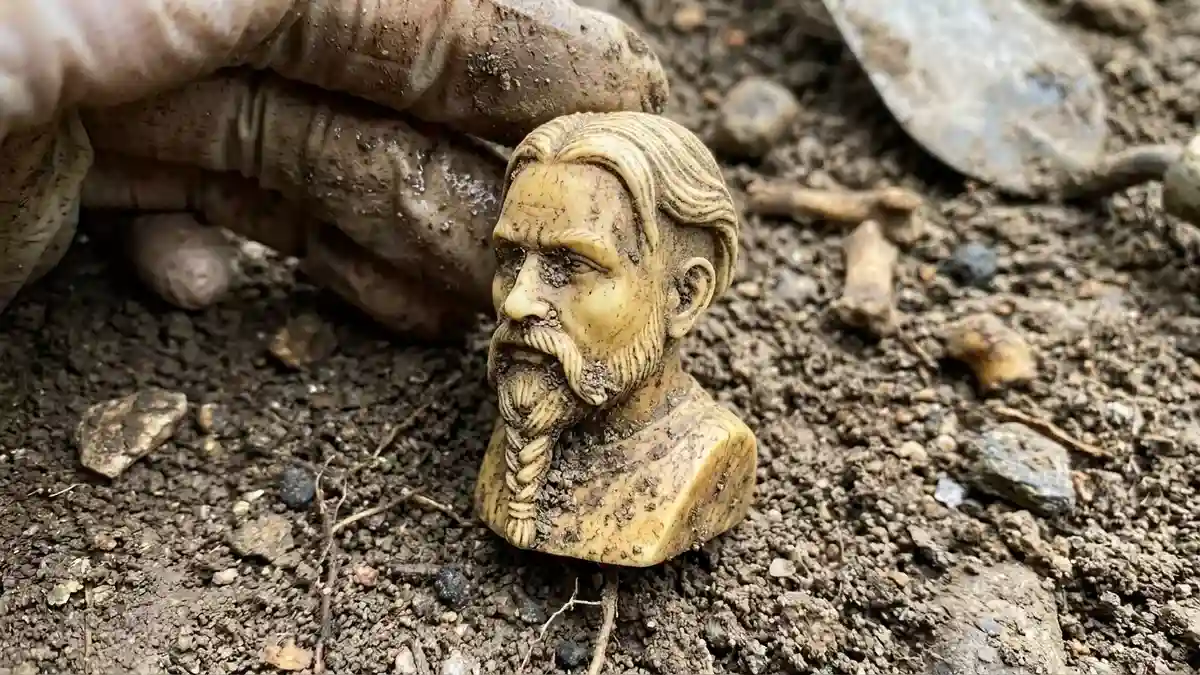
A tiny artifact carved more than ten centuries ago is completely transforming our modern understanding of Viking history, fashion, and personal identity. Measuring a mere three centimeters (roughly 1.2 inches) in height, this miniature sculpture provides what leading historians describe as the most authentic, lifelike representation of a real Viking ever found.
For generations, popular media has depicted Norse warriors as unkempt, wild-haired barbarians. However, this microscopic ivory masterpiece turns that stereotype upside down, revealing a culture that deeply valued complex hair styling, neat beard grooming, and precise facial aesthetics. Hidden away in museum vaults for over two centuries, the artifact is finally shedding light on the true appearance of the elite classes who dominated northern Europe during the early Middle Ages.
1,000-Year-Old Viking Game Piece Exposes Surprising Ancient Hairstyles

The Shocking Rediscovery Inside Museum Storage
The physical journey of this priceless artifact reads like a historical mystery novel. It was originally uncovered back in 1796 during an excavation of a wealthy equestrian burial mound in Viken, a region surrounding the scenic Oslofjord in southern Norway. Because it was found alongside high-status horse riding gear, archaeologists knew immediately that it belonged to a person of immense regional importance.
Following its excavation, the miniature bust was integrated into the collection of the National Museum of Denmark in Copenhagen. Registered under inventory number 589, it stands as one of the institution’s earliest acquired pieces. Despite its pedigree, the artifact was paradoxically forgotten, tucked away inside a nondescript storage box where it sat completely undisturbed for more than 200 years.
The modern breakthrough came when museum curator Peter Pentz was combing through deep storage while organizing an exhibition centered on Viking Age seeresses (völvas).

“When I encountered him in one of our storage rooms a few years ago, I was quite surprised. He just sat there, staring straight at me, and I had never before seen such a Viking. This is a miniature bust and as close as we will ever get to a portrait of a Viking.” — Peter Pentz, Museum Curator
360-Degree Views of 10th-Century Men’s Fashion
What makes this ivory carving an international sensation is the unprecedented level of physical detail preserved on its surface. Prior to this discovery, historical records regarding real Viking hair configurations were incredibly scarce, relying mostly on stylized stone carvings or vague textual descriptions from foreign travelers. This artifact marks the very first time historians have possessed a three-dimensional male Viking figurine whose hair and facial features are perfectly sculpted and visible from every conceivable angle.
The miniature portrait provides a detailed blueprint of late 10th-century grooming choices:

The Haircut: The man’s hair is neatly parted right down the center. On one side, the hair forms a distinct, sweeping wave that loops gracefully behind his head, deliberately exposing his ear. Most notably, a tiny, intricately carved curl sits right above the ear.
The Back: The hair at the back of the skull is shorn incredibly short, confirming a stylized undercut pattern.
The Facial Hair: The facial grooming is highly stylized, featuring a thick, manicured mustache paired with long, defined sideburns. The focal point is a long, meticulously braided goatee that drops from his chin.
These exquisite details demonstrate that high-ranking Norsemen did not let their hair grow wild. Instead, they utilized specialized combs, razors, and perhaps even early styling oils or waxes to maintain a highly specific, sharp aesthetic that signaled their position within the social hierarchy.
The King of the Board: A Royal Link to Harald Bluetooth
Beyond being a static piece of art, researchers have successfully identified the practical function of this miniature bust. Based on its physical dimensions, flat base, and thematic design, the artifact served as a primary piece in the classic Norse board game Hnefatafl (often referred to as Viking Chess).
Given its incredible detail and unmatched craftsmanship compared to standard geometric playing pieces, it undoubtedly functioned as the “King”—the most vital piece on the board, around which the entire game strategy revolved.
The shrewd, highly individualized expression carved into the ivory face has led some experts to speculate that this was not a generic character. Instead, it may be an authentic, localized portrait of an actual reigning monarch. The timeline of the burial places the object’s creation in the late 10th century, which aligns directly with the legendary reign of King Harald Bluetooth. As the famous monarch who successfully united Denmark, stabilized Norway, and introduced Christianity to the Scandinavian realm, Harald Bluetooth would have been the ultimate real-world inspiration for a grand master Hnefatafl King piece.
Luxury Materials and the Self-Image of the Norse Elite
The incredible precision of the piece stands out dramatically against the broader backdrop of surviving Viking Age art. Traditionally, Norse artisans favored abstract geometric patterns, knotwork, and highly stylized animal motifs. Authentic human portraits were exceptionally rare; when human faces did appear—such as on crude regional silver coins—they were flat, generic, and completely lacked personal identity.
The use of walrus ivory further underscores the extreme wealth and high political status of the object’s original owner. During the Viking Age, walrus tusk ivory was one of the most expensive and sought-after luxury commodities in the world. It had to be hunted in the hazardous waters of Greenland or the Arctic circle before being transported along vast maritime trade routes to be carved by elite urban craftsmen.
An object of this material, crafted with such meticulous individual portraiture, was a massive status symbol. It reveals that the Viking ruling class possessed a highly sophisticated self-image and utilized expensive, personalized art to showcase their authority during competitive social gatherings and strategic games.
Today, the tiny ivory king has finally been rescued from obscurity and is officially on public display at the National Museum in Copenhagen as part of a major exhibition titled The Wolf’s Warning. It continues to captivate thousands of visitors and researchers, serving as a powerful reminder that our understanding of ancient human cultures is never fully set in stone.
Frequently Asked Questions
Where and when was the Viking ivory figurine originally found?
The artifact was discovered in 1796 inside a wealthy equestrian burial mound located in Viken, near the Oslofjord in southern Norway. It dates back to the late 10th century.
Why is this tiny game piece considered historically significant?
It provides the closest thing to an authentic, three-dimensional personal portrait of a real Viking ever discovered. It is the first artifact that allows historians to view a detailed Viking hairstyle and beard configuration from all 360 degrees.
What does the artifact reveal about Viking hairstyles and grooming?
The carving proves that Vikings were highly meticulous about their appearance. The figurine displays a central part with hair swept behind the ear, an undercut back, a thick mustache, defined sideburns, and a long, braided goatee.
What material was used to create the miniature bust?
The piece was meticulously hand-carved from walrus ivory, a highly luxurious and expensive material during the Viking Age that was primarily sourced from Greenland and traded among royalty and high-ranking elites.
What was the original purpose of this tiny sculpture?
Archaeologists believe the figurine served as the central “King” piece in the traditional Scandinavian strategy board game Hnefatafl. Some experts speculate that its highly detailed features may have been modeled after a real ruler, such as King Harald Bluetooth.