
Table of Contents
- 1. Meet Homo Naledi: The Evolutionary Misfit
- 2. The Science of Tooth Enamel: How Proteomics Solved the Mystery
- 3. Cultural Burials or Genetic Anomaly? The Big Debate
- 3.1. Theory 1: Gender-Segregated Mortuary Practices
- 3.2. Theory 2: The Missing Chromosome Deletion
- 4. An Unexpected Genetic Link to a Massive-Faced Ancestor
- 5. Rewriting the Textbooks on Ancient Sex and Variation
- 6. Conclusion
- 7. Frequently Asked Questions
- 7.1. How old is Homo naledi and where was it found?
- 7.2. How did scientists discover that all the skeletons were female?
- 7.3. Does this prove that Homo naledi buried their dead based on sex?
- 7.4. What is the advantage of protein analysis over traditional DNA?
- 7.5. What connection was found between Homo naledi and Paranthropus robustus?
All-Female Skeletal Discovery Shakes the Foundation of Human Evolution
In a stunning breakthrough that has sent shockwaves through the global scientific community, anthropologists have made a mind-boggling discovery regarding Homo naledi—the mysterious, small-brained human relative that roamed South Africa roughly 300,000 years ago. Utilizing state-of-the-art genetic sequencing on fossilized teeth, an international team of researchers has revealed that every single known skeleton of this species found within a notorious cave system is biologically female.
This unprecedented finding, published in the prestigious journal Cell, marks the first time scientists have successfully extracted and analyzed genetic material from this enigmatic hominin. The absolute absence of male specimens within such a massive fossil collection has never been documented before in the history of human evolutionary studies, leaving leading experts scrambling to re-evaluate everything they thought they knew about early human behavior.
All-Female Skeletal Discovery Shakes the Foundation of Human Evolution

Meet Homo Naledi: The Evolutionary Misfit
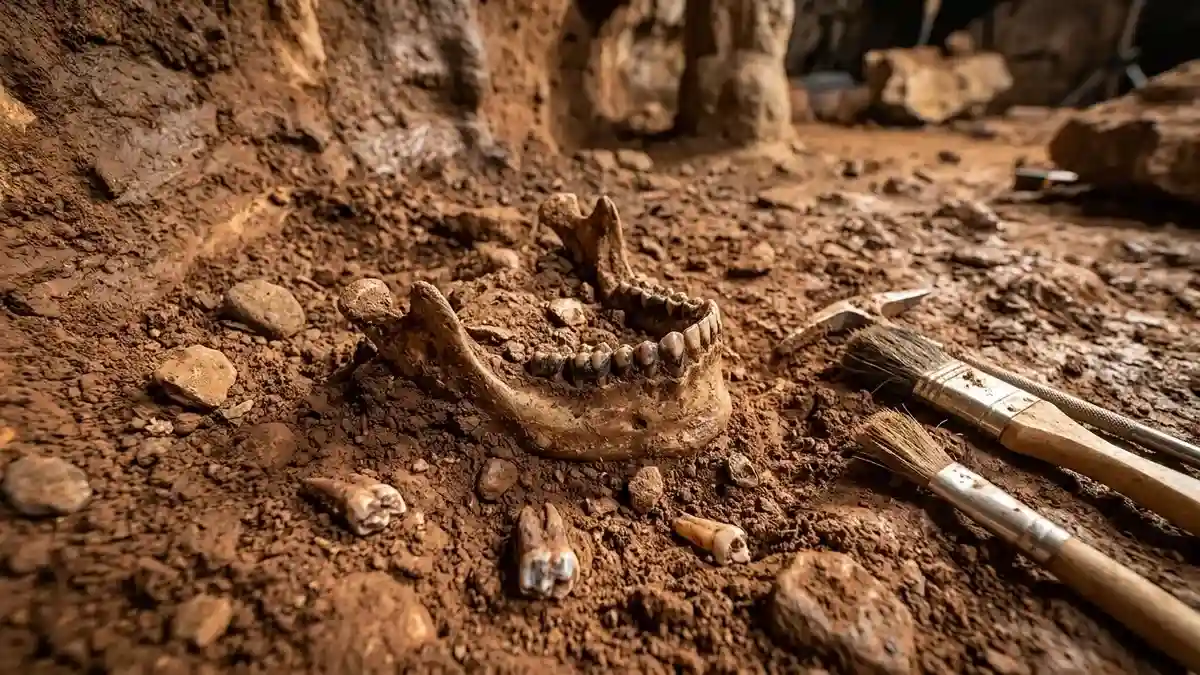
To grasp the magnitude of this discovery, one must look back at the bizarre nature of the species itself. First uncovered in 2013 within the treacherous Rising Star cave system—located in South Africa’s world-famous Cradle of Humankind—Homo naledi has always been an evolutionary paradox.
Led by renowned paleoanthropologist Lee Berger, researchers have spent more than a decade documenting nearly two dozen distinct skeletons. The species possessed a confounding anatomical mosaic:
Primitive Features: They had remarkably small brains and ape-like upper bodies reminiscent of early australopithecines like the famous “Lucy” fossil.
Advanced Features: Their faces, hands, and lower limbs were strikingly human-like, built for efficient upright walking and complex tool manipulation.

The species grew even more controversial in recent years. In 2023, excavation teams uncovered evidence suggesting these tiny-brained creatures intentionally used fire to navigate the pitch-black caverns. By 2025, the team advanced the revolutionary claim that Homo naledi deliberately buried their dead deep inside the cave—a highly abstract, empathetic behavior previously believed to belong exclusively to large-brained species like Neanderthals and Homo sapiens.
The Science of Tooth Enamel: How Proteomics Solved the Mystery
The latest breakthrough was made possible by the rapidly expanding field of paleoproteomics, the study of ancient proteins. Because traditional DNA degrades rapidly in the warm, humid environments of African caves, standard genetic testing was impossible. However, specialized proteins trapped within dense dental enamel can survive intact for hundreds of thousands of years.

Led by researcher Palesa Madupe, the team analyzed 20 isolated teeth using a groundbreaking, minimally destructive extraction technique. They focused their investigation on the amelogenin (AMEL) genes, which are responsible for coding the essential proteins that form teeth. These genes vary distinctly based on biological sex:
AMELX: A gene variant found on the X chromosome, meaning it is present in both biological males and females.
AMELY: A gene variant located strictly on the Y chromosome, serving as an undeniable biological marker for males.
When the laboratory data came back, the results were uniform. Across all 20 studied individuals, there was an abundance of AMELX proteins, but absolutely zero traces of the male-specific AMELY protein. This meant that high-profile, nearly complete skeletons like “Neo” and “DH1″—the primary specimen used to define the entire species, which scientists had universally assumed were male due to their larger physical size—were actually female.
Cultural Burials or Genetic Anomaly? The Big Debate
The total absence of male skeletons in the Rising Star cave has triggered two fiercely competing theories within the anthropological community, both of which have profound implications for our understanding of ancient hominins.
Theory 1: Gender-Segregated Mortuary Practices
The first, and perhaps most mind-blowing, explanation is that Homo naledi possessed a complex culture that practiced gender-segregated burials. If true, this heavily reinforces the theory that the Rising Star cave was an intentional, sacred cemetery rather than a random death trap.
In many past human societies, the dead were separated by sex or social role. Finding an exclusively female repository hints that Homo naledi intentionally selected this specific subterranean chamber as a resting place solely for women, suggesting a level of cultural organization, social identity, and symbolic thinking that is staggering for a creature with a brain the size of an orange.
Theory 2: The Missing Chromosome Deletion
Outside experts, including Elizabeth Sawchuk from the Cleveland Museum of Natural History, urge a more cautious, biological interpretation. She points out that a failure to detect the AMELY protein does not automatically mean males were not present in the cave.
In rare cases among modern humans and at least one documented Neanderthal male, a genetic mutation causes a deletion of the AMELY gene. If the specific population of Homo naledi living in the Cradle of Humankind carried this rare genetic deletion across their gene pool, a biological male would produce a protein profile that looks identical to a biological female. However, study co-authors point out that a systematic deletion across an entire population or even half of the 20 studied samples is highly improbable, making either scenario an absolute scientific marvel.
An Unexpected Genetic Link to a Massive-Faced Ancestor
The dental protein analysis yielded a second, entirely unexpected genetic curveball. The data exposed that Homo naledi shared a unique genetic variant related to collagen production with Paranthropus robustus, a heavily built human cousin characterized by a massive face, powerful jaws, and giant grinding teeth.
Paranthropus robustus lived in the exact same South African region roughly 1 million to 2 million years ago. Interestingly, this shared collagen gene variant is completely absent in modern humans, Neanderthals, and Denisovans. Because paleoproteomics is still in its infancy, scientists do not yet know if this genetic overlap means Homo naledi descended directly from Paranthropus, or if they simply shared a common African ancestor. To solve this puzzle, researchers must now gather protein samples from other elusive African fossils, such as Homo erectus and Australopithecus africanus.
Rewriting the Textbooks on Ancient Sex and Variation
The revelation that our entire understanding of Homo naledi is based exclusively on female anatomy changes how scientists must view the physical diversity of the species. When the hominin was named in 2015, researchers assumed the larger skeletons were male and the smaller ones were female, chalking the differences up to standard sexual dimorphism (size differences between sexes).
Now that science has proven even the largest individuals were female, that entire framework has collapsed. The variation in skeleton sizes was actually just natural diversity among women. As Lee Berger noted, the fundamental description of the species hasn’t been proven wrong—it’s just incomplete. Scientists have simply never seen a Homo naledi male, and when one is finally discovered, the history books will have to be expanded once again.
Conclusion
The pioneering work conducted on the Rising Star fossils has successfully proven that high-tech protein sequencing can unlock the deep secrets of ancient African evolution without destroying priceless, irreplaceable fossils. Whether the all-female composition of the cave represents a sophisticated cultural burial ritual or a fascinating genetic anomaly, it firmly establishes that Homo naledi was far more complex, mysterious, and human-like than anyone ever dreamed.
Frequently Asked Questions
How old is Homo naledi and where was it found?
Homo naledi is an extinct relative of modern humans that lived approximately 300,000 years ago. Its remains were discovered inside the Rising Star cave system within South Africa’s Cradle of Humankind.
How did scientists discover that all the skeletons were female?
An international research team extracted ancient proteins from the enamel of 20 fossilized teeth. They analyzed the amelogenin genes, which determine biological sex. They found plenty of female-associated AMELX proteins but a complete absence of the male-specific AMELY protein.
Does this prove that Homo naledi buried their dead based on sex?
It is a strong possibility. Many scientists believe the all-female sample suggests a cultural, sex-segregated burial practice. However, another theory suggests the population may have suffered from a rare genetic mutation that erased the male protein marker, making males look chemically identical to females.
What is the advantage of protein analysis over traditional DNA?
DNA degrades very quickly in warm, humid climates like those found in South African caves, often making it impossible to retrieve from ancient fossils. Proteins, especially those trapped inside hard tooth enamel, are much sturdier and can survive intact for millions of years.
What connection was found between Homo naledi and Paranthropus robustus?
The protein study revealed that both species shared a distinct genetic variant tied to collagen production. This specific variant is completely missing in modern humans and Neanderthals, suggesting a unique evolutionary connection between these two ancient South African hominins.