
Table of Contents
- 1. Unearthing a Prehistoric Mega-Trap on Aurlandsfjellet
- 2. Weapons, Wardrobes, and Mysterious Ancient Paddles
- 2.1. The Weapons Cache of the Iron Age
- 2.2. The Mystery of the Ornamented Paddles
- 2.3. A Lost Personal Treasure
- 3. From a Hiker’s Observation to an Archaeological Rescue
- 4. The Science of Glacial Preservation and Stabilization
- 5. Protecting the Plateau for Future Generations
- 6. Frequently Asked Questions
- 6.1. How old is the reindeer hunting system discovered in Norway?
- 6.2. Where exactly was this archaeological site found?
- 6.3. How did the ancient reindeer trap actually work?
- 6.4. Why did the wood and weapons remain preserved for so long?
- 6.5. What unusual items were found at the hunting site?
1,500-Year-Old Reindeer Trap Emerges from Melting Norwegian Ice
A spectacular archaeological discovery high on a mountain plateau in Vestland County, Norway, is fundamentally changing our understanding of Iron Age hunting strategies. As alpine ice patches rapidly retreat due to modern climate shifts, a team of researchers has uncovered a remarkably well-preserved, 1,500-year-old mass-hunting installation.
The joint investigation, spearheaded by the Vestland County Council and the University Museum of Bergen, has quickly risen to prominence as one of Northern Europe’s most significant historical finds. The thawing site on the Aurlandsfjellet plateau has exposed a complex network of ancient wooden structures that were frozen mid-use. This represents the first large-scale wooden trapping system ever found melting out of the ice in Norway, and potentially across the entire European continent.
1,500-Year-Old Reindeer Trap Emerges from Melting Norwegian Ice
Unearthing a Prehistoric Mega-Trap on Aurlandsfjellet
The sheer scale of the hunting installation has stunned the scientific community. The trap consists of hundreds of hand-carved wooden logs arranged into an elaborate, strategic configuration designed to exploit natural reindeer behavior.
The layout features two long, converging wooden fences that gradually narrow into a bottleneck funnel. This funnel led the migrating reindeer directly into a heavy timber enclosure where the animals could be easily trapped, surrounded, and dispatched by waiting hunters.
       [AURLANDSFJELLET REINDEER TRAPPING SYSTEM]

  \                                                   /
   \  [Converging Wooden Fence]   [Converging Fence] /
    \                                               /
     \                                             /
      └───>  || || Bottleneck Funnel || ||  <─────┘
                     │
                     ▼
         [HEAVY TIMBER KILL ENCLOSURE]
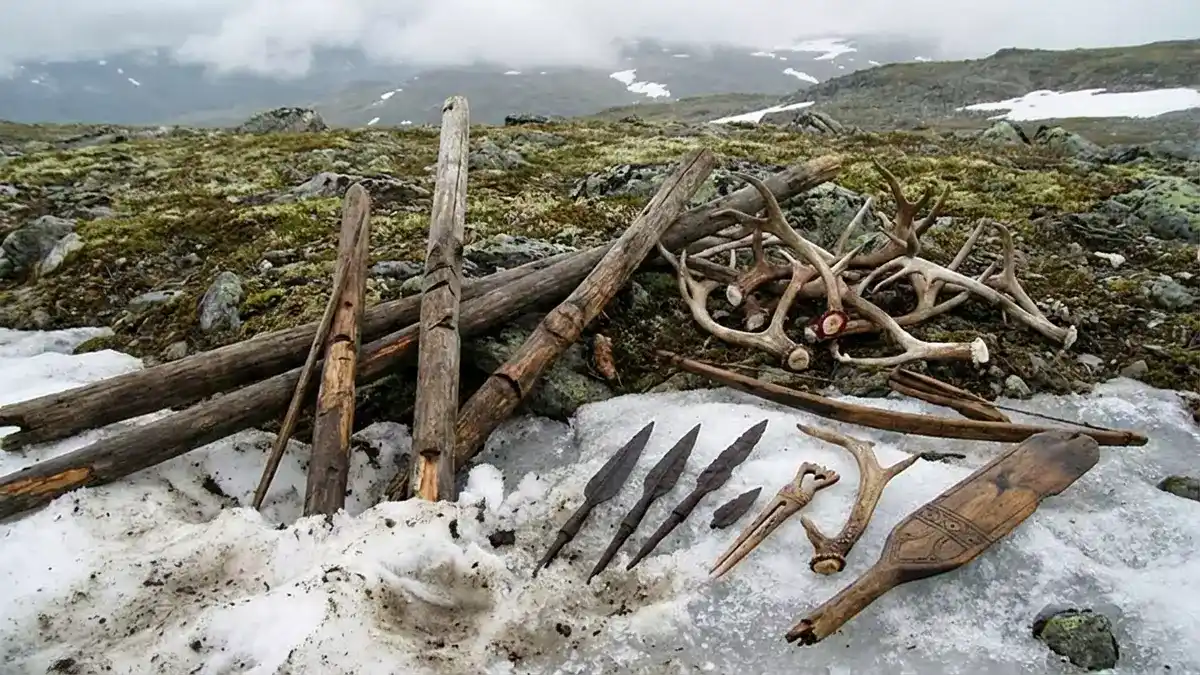
Directly adjacent to the primary trapping structure, archaeologists unearthed a massive cache containing hundreds of discarded reindeer antlers. A close examination of these biological remains revealed deep, distinct butchery cut marks. This evidence proves that the plateau was not merely a passive trapping checkpoint, but an intensive post-capture processing site where large herds were systematically butchered, butchered for meat, and stripped of hides and bone.

Experts date the primary activity of this massive operation to the mid-sixth century CE. Shortly after the trap was constructed, a severe and prolonged regional cooling phase swept across Scandinavia, encasing the entire wooden complex in deep ice and preserving it perfectly for fifteen centuries.
Weapons, Wardrobes, and Mysterious Ancient Paddles
The unique chemical and physical environment of the glacial ice patch provided museum-quality preservation that extended far beyond the structural timber walls. The excavation team successfully recovered a wealth of organic and metallic artifacts that offer an intimate look at the daily lives of Iron Age hunters.
The Weapons Cache of the Iron Age
Among the recovered hunting gear were several remarkably sharp iron spearheads, intact fragments of wooden bows, and ancient arrow shafts. The presence of these weapons indicates that while the timber enclosure did the heavy work of containing the herd, hunters still relied on traditional projectile technology to finish the cull.

+-------------------------------------------------------------+
|               ARTIFACT PRESERVATION SUMMARY                 |
|                                                             |
|   • Structural Timber:  Hundreds of carved fencing logs     |
|   • Weaponry:           Iron spearheads, bow/arrow fragments |
|   • Personal Items:     Finely crafted antler dress pin      |
|   • Cryptic Finds:      Ornamented wooden paddles            |
+-------------------------------------------------------------+
The Mystery of the Ornamented Paddles
While much of the gear was explicitly functional, a few objects have left researchers completely baffled. The team extracted several wooden paddles adorned with delicate, intricate carvings.
Because the site sits on a high, rugged mountain plateau devoid of navigable lakes or rivers, the presence of watercraft paddles is highly unusual. Scholars are currently investigating whether these items served a hidden symbolic, status-driven, or ritualistic purpose within the hunting community, or if they were modified to serve an alternative role in guiding the reindeer herd.
A Lost Personal Treasure
In addition to the tools of the trade, the ice yielded an exquisite, personal item: a beautifully crafted dress pin fashioned entirely from polished reindeer antler. Likely snapped off or dropped by a hunter during the chaotic rush of a mass harvest, this small personal accessory provides a direct, poignant human connection to the individuals who labored on the frozen peaks long ago.
From a Hiker’s Observation to an Archaeological Rescue
The road to saving this unique site began with the keen eyes of a local outdoor enthusiast. Helge Titland, an avid hiker who had long dedicated his personal time to mapping and documenting suspected ancient hunting locations in the region, noticed unusual, clearly carved pieces of wood protruding from a receding ice shelf in 2024.
Recognizing the potential historical value of the timber, Titland immediately filed a formal report with local authorities, prompting professional archaeologists to add the specific coordinate to their emergency monitoring list.
| Phase | Timeline | Site Status | Discoveries |
| Initial Discovery | Autumn 2024 | First timbers expose | Scattered carved logs noticed by hiker |
| Follow-Up Survey | Autumn 2025 | Major glacial retreat | Main funnel fences and kill enclosure exposed |
| Current State | 2026 | Completely secured | Artifacts moved to Bergen for active stabilization |
When the scientific team returned to the mountain plateau accompanied by Titland the following year, ongoing summer melting had exposed a massive portion of the underlying complex. The true, unprecedented scale of the ancient engineering project was finally visible to the human eye.
The Science of Glacial Preservation and Stabilization
The flawless preservation of the Aurlandsfjellet trap is an incredibly rare archaeological phenomenon. Because the site became inactive right at the start of a historic cold cycle, heavy snow accumulation rapidly sealed the fresh wood, bone, and metal under layers of compressed ice before natural atmospheric rot, insects, or fungal decay could compromise the materials.
For over a thousand years, the freezing, slightly humid, oxygen-deprived environment kept the organic materials pristine. However, this ancient protection has officially run out; modern climate warming is bringing these vulnerable relics to the surface at a pace that threatens to outrun preservation efforts.
+-------------------------------------------------------------+
|               THE GLACIAL DECAY EMERGENCY                   |
|                                                             |
|   Deep Freeze (550 CE) ──> Kept pristine for 1,500 years    |
|   Modern Thaw (2025+)  ──> Extreme risk of rapid dry rot    |
|   Museum Action        ──> Controlled slow-drying & anti-rust|
+-------------------------------------------------------------+
Once exposed to the modern air, ancient wood can experience catastrophic dry rot within weeks, and iron artifacts can oxidize and crumble rapidly. To prevent this loss, all materials recovered from Aurlandsfjellet were carefully packed into climate-controlled containers and transported to the specialized conservation laboratories at the University Museum in Bergen.
Teams of dedicated specialists are now executing long-term stabilization protocols. The ancient structural timbers must undergo an incredibly slow, monitored drying process to prevent warping and cracking, while the iron weaponry is subjected to intensive anti-corrosion treatments.
Protecting the Plateau for Future Generations
To ensure the long-term safety of the site from black-market looters and accidental tourist damage, the Norwegian government has officially placed the mountain area under the strict protection of the national Cultural Heritage Act.
As alpine ice sheets across the globe continue to recede, archaeologists recognize that they are locked in a race against time to document these fragile mountain histories before they vanish forever. The team hopes that the incredible artifacts pulled from the Aurlandsfjellet plateau will eventually form the centerpiece of a major international museum exhibition, permanently preserving the story, technology, and legacy of Norway’s ancient Iron Age reindeer hunters.
Frequently Asked Questions
How old is the reindeer hunting system discovered in Norway?
The trapping installation dates back approximately 1,500 years to the mid-sixth century CE, placing its construction and use firmly within the European Iron Age.
Where exactly was this archaeological site found?
The discovery was made high on an alpine mountain plateau located in Aurlandsfjellet, which sits within Vestland County, Norway.
How did the ancient reindeer trap actually work?
The system utilized hundreds of carved wooden logs arranged as two long, converging fences. These fences funneled migrating reindeer herds down a narrowing path into a heavy timber enclosure, where hunters could safely surround and harvest the animals.
Why did the wood and weapons remain preserved for so long?
The trap became buried precisely at the onset of a colder regional climate phase. Rapid snow and ice accumulation sealed the wood, metal, and antler in a freezing, low-oxygen environment, preventing decay until modern melting exposed them.
What unusual items were found at the hunting site?
Alongside iron spearheads and bows, archaeologists found a beautifully carved antler dress pin and several finely ornamented wooden paddles. The presence of paddles on a high mountain plateau remains a mystery and may suggest ritual practices or unique hunting methods.