
Table of Contents
Sacred Echoes: Archeologists Discover Rare Postclassic Altar at Abandoned Maya Site in Belize
For generations, the standard historical narrative surrounding the Maya civilization suggested a clean break: when the great political capitals of the Classic period collapsed, the cities were abandoned, and the jungle reclaimed them entirely. However, groundbreaking new archaeological research in northwestern Belize is upending this timeline.
Investigations at the ancient sites of Kaxil Uinik and Ayiin Winik have revealed that long after these cities lost their political power, Maya communities continued to make deliberate, long-distance pilgrimages back to the ruins. By repairing ancient monuments and establishing new ritual spaces, these visitors kept the sacred landscapes alive for centuries. Among the most remarkable discoveries of this campaign is the first Late Postclassic altar ever documented in this specific region of Belize—a rare physical testament to enduring spiritual devotion.
The study, published in the journal Latin American Antiquity by researchers V. A. Ingalls and Brett A. Houk, highlights a region previously thought to be largely deserted after the Terminal Classic period (around CE 750 to 900). Instead, the archaeological evidence tells a poignant story of ancestral memory, intentional reverence, and cultural continuity stretching deep into the Late Postclassic era (roughly CE 1200 to 1542).
Sacred Echoes Archeologists Discover Rare Postclassic Altar at Abandoned Maya Site in Belize
Resurrecting the Monuments of Kaxil Uinik
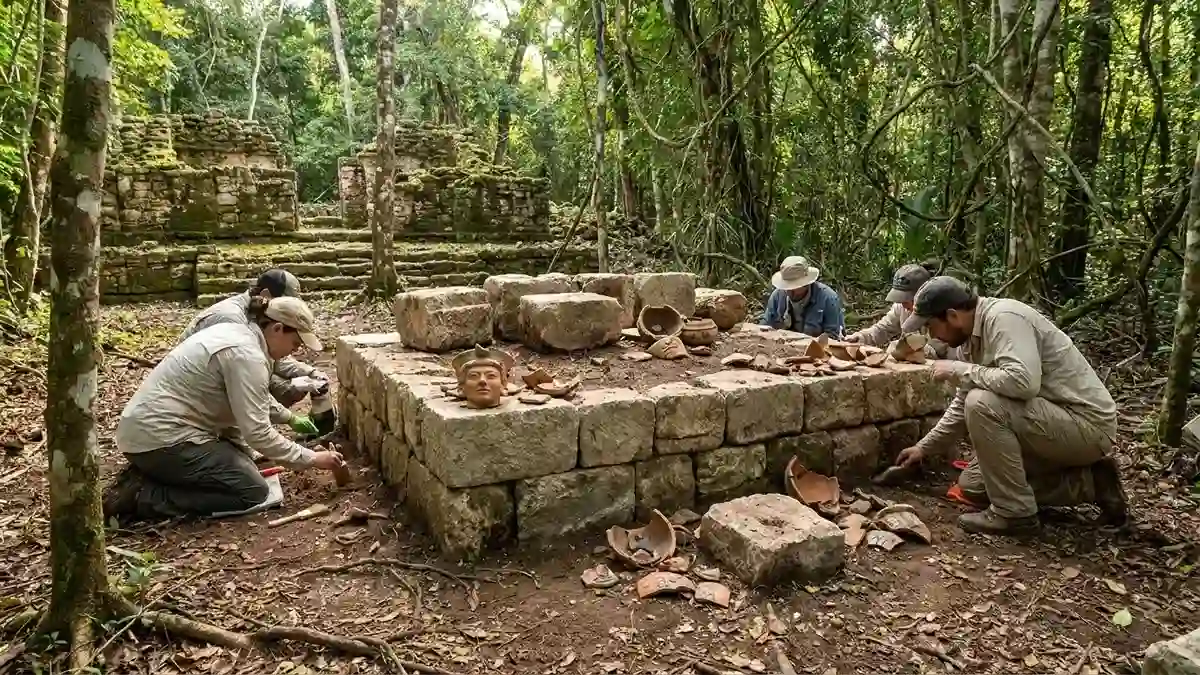
At the site of Kaxil Uinik, researchers focused their efforts on a prominent carved monument known as Stela 1, which was first recorded by archeologists nearly a century ago in 1931. Recent meticulous excavations around the base of the monument yielded fascinating clues about how later generations interacted with the site’s ancient history.
Telltale fragments of Chen Mul modeled incense burners—highly specific, decorated ceramic vessels used almost exclusively for religious offerings in the late pre-Columbian era—were found scattered around the monument pieces. One particularly striking artifact shard depicts a detailed human face.
The physical arrangement of the stela fragments suggests something deeply moving: centuries after the monument had broken and fallen, Postclassic visitors carefully reset and propped up the fractured stone sections before burning incense and leaving their ritual offerings at its base.
The Discovery of the Ayiin Winik Altar
An even more unprecedented find awaited the team at the neighboring site of Ayiin Winik. Here, archaeologists uncovered a small, low-lying ritual altar constructed from carefully squared limestone blocks. The nature of the stone suggests that the builders did not quarry new material; instead, they selectively harvested blocks from the crumbling ruins of the surrounding Classic-period buildings.
What firmly ties this structure to a much later era is the dense concentration of ceramic artifacts found directly on top of and immediately surrounding the limestone blocks.
Artifact Distribution at the Ayiin Winik Altar
├── 25 Fragments of Chen Mul Incense Burners (Late Postclassic)
└── 0 Other Artifact Types (No utilitarian pottery, tools, or domestic waste)
The absolute lack of everyday household items, combined with the fact that the incense burner shards rested directly on the stone surface rather than beneath it, proved that the altar was built exclusively for later ceremonial use. It was an isolated island of ritual activity within a ghost city.

A Rare Archeological Benchmark for Belize
Postclassic altars are exceptionally rare discoveries within the borders of modern Belize. Previously, only a handful of comparable examples had been identified at major sites like Chan in the Belize River Valley and the famous ruins of Xunantunich.
At those locations, just as at Ayiin Winik, later populations intentionally constructed new ritual platforms in close proximity to ancestral structures. The Ayiin Winik find is uniquely significant because it represents the very first Late Postclassic altar ever identified in the eastern Three Rivers Region of northwestern Belize, filling a massive geographic gap in our understanding of Postclassic religious geography.
The Logistics of Devotion: Long-Distance Pilgrimages
The geography of these ritual sites introduces a compelling layer of human effort to the discovery. Ayiin Winik is isolated, sitting roughly 50 kilometers (over 30 miles) away from the nearest known contemporaneous Late Postclassic settlements, such as Lamanai, Ka’kabish, or the populated centers of the Belize River Valley.
Moving through dense subtropical jungle for 50 kilometers requires immense planning, supplies, and clear intent. These were not casual, routine stopovers by passing travelers. They were deeply purposeful spiritual journeys.
Rather than expending resources to build massive new ceremonial complexes within their own crowded towns, these Postclassic communities chose to invest their energy into maintaining a physical and spiritual bridge to the past. They traveled back to the lands of their ancestors to re-consecrate the ruins, transforming decaying political centers into vibrant, regional shrines.
Redefining the Maya Timeline
The discoveries at Kaxil Uinik and Ayiin Winik align with an emerging pattern observed across the wider Maya lowlands: the end of a political dynasty did not equate to the death of a sacred space.
However, many questions regarding the exact timeline of these pilgrimages remain. Because archaeological dating in this heavily forested region relies significantly on cross-referencing ceramic styles, and because recent radiocarbon dating advancements elsewhere have shown that traditional ceramic timelines occasionally require calibration, future fieldwork will focus on establishing absolute dates.
For now, the rare limestone altar at Ayiin Winik stands as undeniable proof that the ancient cities of Belize remained profoundly alive in the hearts and minds of the Maya people, serving as monuments of veneration long after the kings who built them had been forgotten.
Frequently Asked Questions
What is the significance of the altar found at Ayiin Winik?
The altar found at Ayiin Winik is highly significant because it is the first Late Postclassic altar ever discovered in the eastern Three Rivers Region of northwestern Belize. It provides rare physical evidence that Maya communities were actively returning to and venerating abandoned cities centuries after the classic societal collapse.
What are Chen Mul incense burners and why do they matter?
Chen Mul modeled incense burners are a specific style of ceramic vessels used for religious ceremonies during the Late Postclassic period (CE 1200–1542). Finding these specific shards directly on top of older ruins allows archaeologists to date the ritual activities accurately and confirms the structures were being used exclusively for religious purposes.
How far did the Postclassic Maya travel to visit these sacred sites?
Archaeologists estimate that visitors traveled at least 50 kilometers (around 31 miles) from the nearest known active settlements, such as Lamanai or Ka’kabish, to reach Ayiin Winik. The sheer distance implies that these trips were highly organized religious pilgrimages rather than accidental or routine encounters.
Did the Maya rebuild the abandoned cities during the Postclassic period?
No, they did not reoccupy or rebuild the cities on a large scale. Instead, they practiced “monument veneration.” They cleared small areas, stood broken stone monuments back up, built small altars using salvaged stone blocks from the ruins, and left offerings without establishing permanent communities.
Why did the Maya return to these abandoned ceremonial centers?
They returned to maintain a deliberate connection to their ancestors and the historical landscape. Even though the sites had lost their political power and governing structures during the Terminal Classic collapse, the locations themselves retained their spiritual sanctity and cultural importance for generations.