
Table of Contents
- 1. Deciphering the Blueprint of the Walking Moai
- 2. Putting Physics to the Test: The 4-Ton Field Experiment
- 2.1. Why This Outperforms Old Theories
- 3. Ancient Roads and Mechanical Failures
- 3.1. Decoding the Roads as Moving Systems
- 4. Vindicated by Indigenous Oral Traditions
- 5. Conclusion
- 6. Frequently Asked Questions
- 6.1. Did the Easter Island statues really “walk”?
- 6.2. Why does this discovery disprove the ecological collapse theory?
- 6.3. How many people were needed to move a single statue?
- 6.4. Why were so many statues abandoned along the ancient roads?
- 6.5. What was unique about the ancient roads on Rapa Nui?
Physics Breakthrough Confirms Easter Island Statues Really Did Walk
For centuries, the isolated Pacific island of Rapa Nui—better known as Easter Island—has stood as one of the world’s most captivating archaeological enigmas. The primary source of fascination centers on the island’s iconic moai: colossal, monolithic stone statues carved by ancient Polynesians. How did an isolated society with modest resources and no draft animals transport hundreds of these multi-ton giants across miles of rugged, volcanic terrain?
A groundbreaking study combining rigorous physics, advanced 3D structural modeling, and real-world engineering experiments has finally delivered a definitive answer. The research confirms that the ancient islanders did not rely on complex mechanical cranes, heavy wooden rollers, or widespread deforestation to drag the monuments. Instead, they cleverly engineered the statues to “walk” upright in a controlled, rhythmic, side-to-side motion.
Physics Breakthrough Confirms Easter Island Statues Really Did Walk
Deciphering the Blueprint of the Walking Moai
The comprehensive scientific investigation, published in the Journal of Archaeological Science, was spearheaded by anthropologist Carl Lipo of Binghamton University alongside Terry Hunt from the University of Arizona. To test their hypothesis, the research team conducted a exhaustive analytical audit of nearly 1,000 moai statues across the island, paying close attention to 62 specific statues that were abandoned along ancient transport pathways.
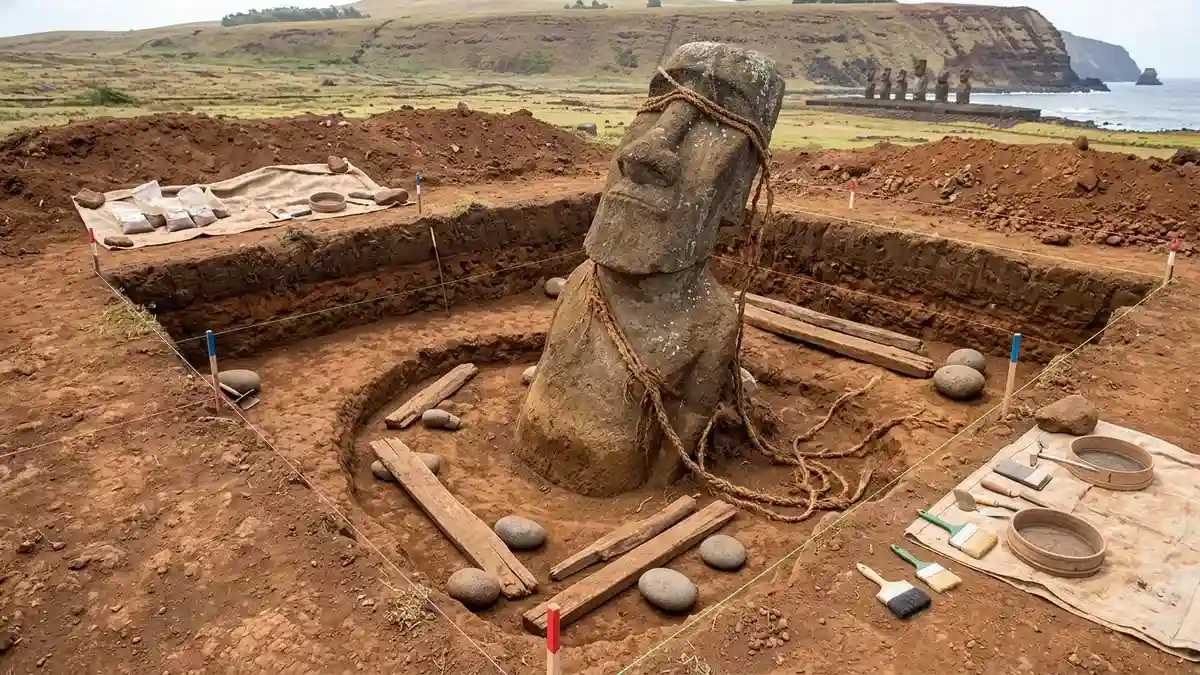
The structural data revealed a brilliant design pattern. The statues found left along the transit roads were fundamentally different in shape compared to those fully installed on their final ceremonial platforms, known as ahu. These transit statues featured two highly specific, intentional geometric anomalies:
A Weighted D-Shaped Base: The bottoms of the statues were not flat, but curved into a distinct, rounded “D” shape.
An Aggressive Forward Lean: The center of mass was intentionally engineered to tilt forward rather than standing perfectly vertical.

In the realm of physics, this specific center of gravity configuration means the statue is naturally unstable when left stationary. However, when manipulated with ropes, this exact instability becomes an engineering advantage. The forward tilt and rounded base allowed a small crew of workers to rock the monolithic structure from side to side. Each tilt forward and to the side caused the statue to swivel on its curved edge, effectively stepping forward in a highly controlled, zigzagging gait.
Putting Physics to the Test: The 4-Ton Field Experiment
To transition their hypothesis from mathematical models to undeniable physical reality, Lipo and Hunt constructed a full-scale, structurally identical replica of a transport-stage moai. The concrete-cast replica weighed an intimidating 4.35 tons, accurately mirroring the massive scale and physical proportions of the original ancient monuments.
The field experiment yielded astonishingly efficient results. Utilizing a simple network of heavy ropes and a modest crew of just 18 people, the team successfully “walked” the 4.35-ton monolith across a distance of 100 meters in a mere 40 minutes.
Why This Outperforms Old Theories
The success of the walking experiment shatters long-held conventional theories regarding the history of Rapa Nui. For decades, popular theories suggested that the islanders moved the statues horizontally by strapping them to flat wooden sleds or rolling them over hundreds of felled tree trunks.
Proponents of the rolling theory frequently argued that this massive transport operation caused catastrophic, widespread deforestation, leading to an ecological collapse and the eventual downfall of the island’s civilization. However, the new physical evidence proves that moving the statues upright required zero timber. This clean, elegant method required minimal physical labor and absolutely no reliance on the island’s forest resources, painting a fresh picture of the ancient islanders as sustainable, highly resourceful engineers.
Ancient Roads and Mechanical Failures
Beyond the physical experiment, the researchers utilized spatial analysis to decode the island’s geography, mapping out how the moai are distributed across the ancient road networks.
The data revealed that more than half of all broken, uninstalled, or unfinished statues were discovered within a tight two-kilometer radius of the Rano Raraku volcanic quarry—the birthplace where all moai were originally carved. As the distance from the quarry increased, the number of abandoned statues dropped off following a distinct mathematical pattern known as an exponential decay curve.
Decoding the Roads as Moving Systems
In mechanical engineering, this specific distribution pattern is a classic signature of transit-related failure. When a statue’s base chipped or its structural equilibrium was compromised during the walking process, it lost its ability to wobble effectively. Lacking the necessary geometry to continue walking, these damaged monoliths were simply abandoned where they fell.
Furthermore, the ancient road systems themselves were purpose-built to accommodate this unique transport method. Measuring roughly 4.5 meters (about 15 feet) wide, these pathways were engineered with a distinct concave, trough-like cross-section. This unique shape acted as a natural stabilizing track, helping to keep the walking statues balanced and preventing them from tipping over completely during their long journeys to the coast.
The Interrelated System: The research proves that the statues and the roads were part of a unified engineering project. Workers did not build roads first and statues second; instead, sections of the concave pathways were cleared, reinforced, and advanced gradually in tandem with each statue’s unique journey.
Vindicated by Indigenous Oral Traditions
One of the most profound aspects of this scientific breakthrough is how beautifully it validates the centuries-old oral histories of the indigenous Rapa Nui people. For generations, western explorers and scholars dismissed local legends, which consistently maintained that the giant stone ancestors simply “walked” to their ceremonial platforms under the power of a spiritual force called mana.
By proving that the statues were physically rocked into motion, the engineering study reveals that these oral histories were not magical myths, but literal, highly accurate descriptions of a sophisticated physical technique. The term “walking” was the exact mechanical definition of the process.
The study also systematically addresses and dismantles past criticisms leveled against the walking hypothesis. Critics had long claimed that the steep, uneven volcanic terrain of the island, coupled with the limitations of ancient rope tensile strength, would make an upright walking transport impossible.
However, the team’s comprehensive physics simulations demonstrate that the specialized D-shaped base and forward-tilted posture naturally absorbed and distributed kinetic energy safely. The moai design was not an aesthetic accident—it was a highly refined piece of ancient technology evolved specifically to conquer the unique geographic constraints of Easter Island.
Conclusion
By bridging the gap between indigenous memory and modern scientific analysis, researchers have finally lifted the veil on Easter Island’s greatest mystery. The moai did not move through brute force or destructive environmental exploitation. Instead, they moved through an elegant dance of physics, geometry, and human cooperation, securing the people of Rapa Nui their rightful place among history’s finest ancient engineers.
Frequently Asked Questions
Did the Easter Island statues really “walk”?
Yes, in a mechanical sense. New research confirms that the statues were intentionally carved with a rounded base and a forward-leaning tilt, allowing teams of workers using ropes to rock them side to side, creating a forward walking motion.
Why does this discovery disprove the ecological collapse theory?
Previous theories claimed the islanders chopped down all the island’s trees to use as wooden rollers to slide the statues horizontally, causing an environmental disaster. The walking method requires zero wood, proving the statues could be moved sustainably without causing deforestation.
How many people were needed to move a single statue?
In real-world field experiments, a team of just 18 people using simple ropes was able to successfully stabilize and walk a 4.35-ton replica statue across 100 meters in 40 minutes, proving the method was highly labor-efficient.
Why were so many statues abandoned along the ancient roads?
The distribution of broken statues follows a classic mechanical failure curve. If a statue’s rounded base fractured or wore down too much during transit, it lost the precise physical equilibrium required to rock forward, forcing the workers to abandon it.
What was unique about the ancient roads on Rapa Nui?
The ancient transit roads were roughly 4.5 meters wide and engineered with a distinct concave, curved shape. This trough-like design helped cradle the shifting base of the walking moai, preventing them from falling over on uneven ground.