
Table of Contents
- 1. Unearthing the Republican Roots of an Imperial Masterpiece
- 1.1. Rare Artifacts and Architectural Clues
- 2. Tracing the Landscape Transformation Through Time
- 3. Secrets of the Imperial Gardens Revealed
- 3.1. The Mechanics of Continuous Blooms
- 3.2. Structured Afforestation and Planting Pits
- 4. A New Chapter in Roman History
- 5. Frequently Asked Questions
Archaeologists Uncover Oldest Republican Structure at Hadrian’s Villa
The sprawling imperial complex of Hadrian’s Villa in Tivoli, Italy, has long been celebrated as a pinnacle of Roman architectural grandeur. However, a recent excavation has peeled back the layers of this UNESCO World Heritage site to reveal a history that predates the famous emperor himself. Archaeologists have discovered an underground structure dating back to the Roman Republic, marking what could be the oldest construction ever identified within the imperial palace grounds. This monumental find offers a rare glimpse into the site’s early history, transforming our understanding of how this historic landscape evolved centuries before becoming the ultimate retreat for Emperor Hadrian.
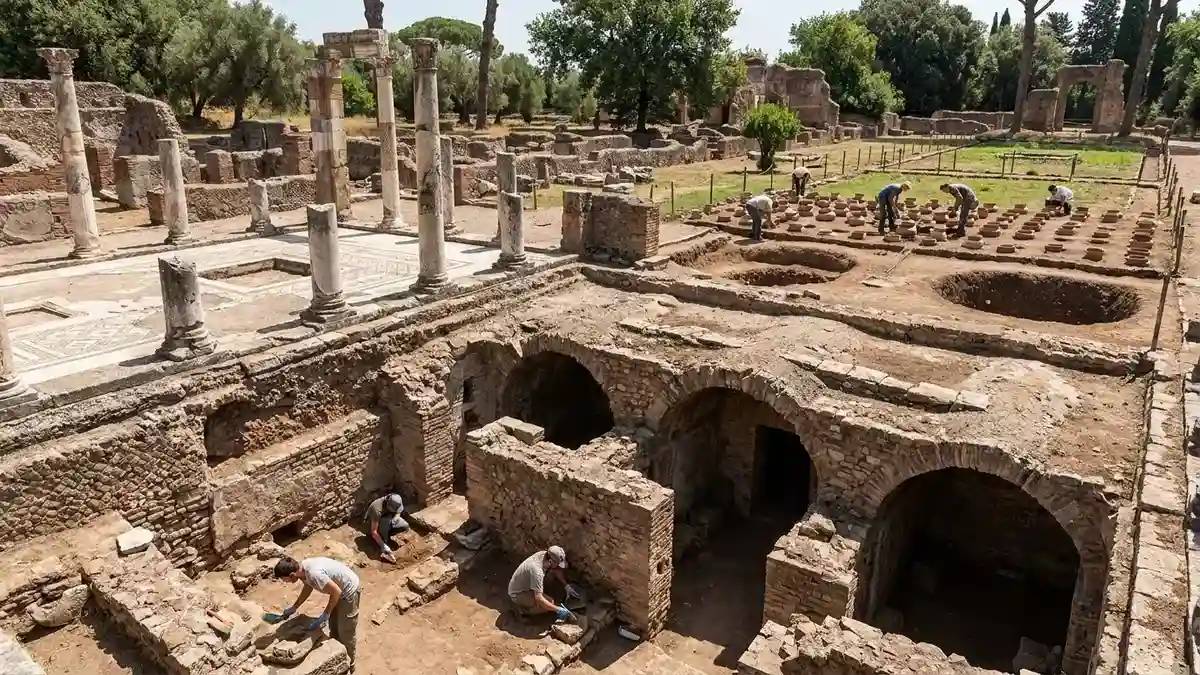
The remarkable discovery was made during a targeted excavation campaign conducted between April and May in the Palazzo sector, one of the residential hubs of the villa. Led by the Archaeology Seminar of Pablo de Olavide University (UPO) in Seville, Spain, the project was carried out in close collaboration with the Institute of Hadrian’s Villa and Villa d’Este. For more than two decades, researchers under the direction of Professor Rafael Hidalgo have been systematically investigating the site, but this latest season has yielded what might be their most significant historical breakthrough yet.
Archaeologists Uncover Oldest Republican Structure at Hadrian’s Villa
Unearthing the Republican Roots of an Imperial Masterpiece
To appreciate the scale of this discovery, one must look beneath the monumental architecture that defines Hadrian’s Villa today. The newly uncovered structure was found directly underneath one of the grand peristyles of the Palazzo sector. A peristyle, a continuous porch formed by a row of columns surrounding a courtyard or garden, was a central feature of high-status Roman residential life.
Beneath this imperial floor, however, lay the remains of a subterranean chamber known as a hypogeum. Archaeological evidence strongly suggests that this underground space originally functioned as a secure storage facility or a agricultural silo. What makes the hypogeum uniquely valuable to historians is the manner in which its history was preserved. During the late Republican period, well before Hadrian began his massive building campaign in the second century CE, the chamber was decommissioned, abandoned, and partially filled with a thick layer of contemporary construction debris and household pottery.
By sealing the chamber with debris during the Republican era, ancient workers inadvertently created a time capsule. This intact stratigraphic layer has provided modern researchers with a pristine, unadulterated look at life on the property during its earliest phases of occupation.
Rare Artifacts and Architectural Clues
The debris cleared from the hypogeum has yielded a wealth of material culture that is currently undergoing rigorous laboratory analysis. Among the most notable recoveries are numerous architectural terracottas featuring intricate animal motifs. These molded clay tiles were traditionally used to decorate the roofs and eaves of prominent buildings, protecting wooden structures from the elements while showcasing artistic craftsmanship.
In addition to the decorative terracottas, the excavation team recovered a diverse assemblage of ceramic vessels and domestic pottery fragments. These artifacts are of paramount historical importance because they represent the only securely identified, firmly dated Republican-era archaeological context ever documented within the boundaries of Hadrian’s Villa.
For years, historians hypothesized that a modest Republican-era estate occupied the land prior to the second century, but concrete material proof remained elusive. The discovery of the hypogeum and its contents confirms this theory, proving that Emperor Hadrian did not simply choose a barren hillside for his palace; instead, he completely transformed, expanded, and built directly on top of an existing aristocratic country estate.

Tracing the Landscape Transformation Through Time
The presence of the Republican hypogeum underneath the imperial Palazzo confirms that the older complex was not entirely obliterated during Hadrian’s construction boom. Instead, Roman engineers and architects appear to have selectively demolished portions of the older Republican villa while incorporating other elements into the foundations and layout of the new imperial palace.
This spatial continuity gives archaeologists an unprecedented opportunity to map out the long-term evolution of Roman elite architecture. By analyzing where the Republican structures end and the imperial modifications begin, researchers can trace changing tastes in luxury, shifts in engineering capabilities, and the dramatic ways in which the Roman elite reshaped natural landscapes to project political power.
Secrets of the Imperial Gardens Revealed
The latest archaeological campaign at the Palazzo sector was not confined to underground chambers. On the surface, the research team continued their meticulous investigation of the vast gardens associated with the palace complex, gaining a remarkably clear picture of how these ancient landscaped spaces were designed, organized, and meticulously maintained by a small army of imperial gardeners.
Roman gardens were far more than passive collections of greenery; they were highly sophisticated extensions of the living quarters, designed to blend seamless architecture with nature. The UPO team’s work in the peristyle courtyards has shed light on the exact horticulture techniques used to keep the villa looking pristine for the imperial court.
The Mechanics of Continuous Blooms
One of the most fascinating discoveries in the Palazzo gardens was the confirmation of a perimeter flowerbed lined with tightly packed rows of ceramic flowerpots. These pots were intentionally embedded directly into the borders of the garden walkways.
Archaeologists believe this specific arrangement was part of a highly organized, seasonal rotation system. Instead of planting flowers directly into the ground, where they would eventually wither and leave unsightly gaps in the landscape, imperial gardeners grew plants in individual ceramic containers. When a particular plant’s blooms began to fade, a gardener could quickly lift the pot out of the ground and replace it with a fresh, vibrant specimen cultivated elsewhere on the estate. This ingenious method ensured that the emperor and his guests were greeted by an unbroken, continuously stunning floral display regardless of the time of year.
Structured Afforestation and Planting Pits
Beyond the flowerbeds, the excavation revealed a series of large, systematically arranged planting pits designed for larger vegetation, such as ornamental shrubs and trees. The sharp, uniform spacing of these pits points to a rigid, highly planned landscape design.
Rather than allowing trees to grow naturally, the villa’s designers integrated the greenery directly into the geometry of the surrounding architecture. The trees were positioned to frame specific views, cast strategic shade across open walkways, and mirror the rhythm of the stone columns that enclosed the courtyards. These new findings enrich previous discoveries in the Palazzo sector, where researchers previously uncovered a remarkably well-preserved group of completely intact ceramic planting pots, cementing the villa’s reputation as a marvel of ancient landscape engineering.
A New Chapter in Roman History
The discoveries made by Pablo de Olavide University and the Institute of Hadrian’s Villa remind us that even the most famous archaeological sites in the world still hold profound secrets. By digging beneath the opulence of Hadrian’s imperial palace, researchers have opened a new chapter on the Republican origins of the site, while simultaneously showing the incredible level of detail that went into maintaining the villa’s daily aesthetic appeal. As analysis of the ceramics and terracottas continues, historians look forward to a much clearer understanding of the people who lived and worked on this historic hillside long before it caught the eye of an emperor.
Frequently Asked Questions
What is the historical significance of the latest discovery at Hadrian’s Villa?
The discovery is highly significant because it identifies an underground structure, a hypogeum, dating to the Roman Republican period. This represents the oldest known construction ever found within the imperial complex and provides the first definitive archaeological context confirming that a substantial Republican estate existed on the site before Emperor Hadrian built his palace.
What was the purpose of the newly discovered underground structure?
Archaeologists believe the underground chamber, or hypogeum, originally functioned as a secure storage facility or agricultural silo for the older Republican-era villa that occupied the land before the imperial palace was constructed.
What kind of artifacts were recovered from the underground chamber?
The excavation team recovered architectural terracottas decorated with distinctive animal motifs, along with a wide variety of ceramic fragments and pottery. Because these items were sealed within an intentional deposit of construction debris during the Republican era, they offer a clean, unmixed snapshot of the site’s early history.
How did the ancient Romans keep the gardens at Hadrian’s Villa blooming year-round?
Gardeners utilized an ingenious rotation system involving ceramic flowerpots packed tightly into perimeter flowerbeds. Instead of planting directly in the earth, flowers were kept in pots so that when a bloom faded, the entire pot could be quickly swapped out for a fresh, flowering plant, maintaining a flawless visual display across different seasons.
Who led the excavation campaign that uncovered these structures?
The excavation was carried out by the Archaeology Seminar of Pablo de Olavide University (UPO) based in Seville, Spain, working in tandem with the Institute of Hadrian’s Villa and Villa d’Este. The long-term research project has been directed by Professor Rafael Hidalgo since 2003.