
Table of Contents
- 1. The Regalia of an Iron Age Elite
- 2. An Ultra-Rare Chariot Burial in Hessen
- 3. The Mediterranean Connection: Etruscan Treasures
- 4. High-Tech Laboratory Analysis
- 5. Conclusion
- 6. Frequently Asked Questions
- 6.1. What was the La Tène period?
- 6.2. How do archaeologists know it was a warrior’s grave if no bones survived?
- 6.3. Why did the Celts bury people with chariots?
- 6.4. What is an Etruscan beaked jug?
- 6.5. What is micro-excavation of soil blocks?
2,500-Year-Old Celtic Warrior Tomb with Chariot and Gold Found in Germany
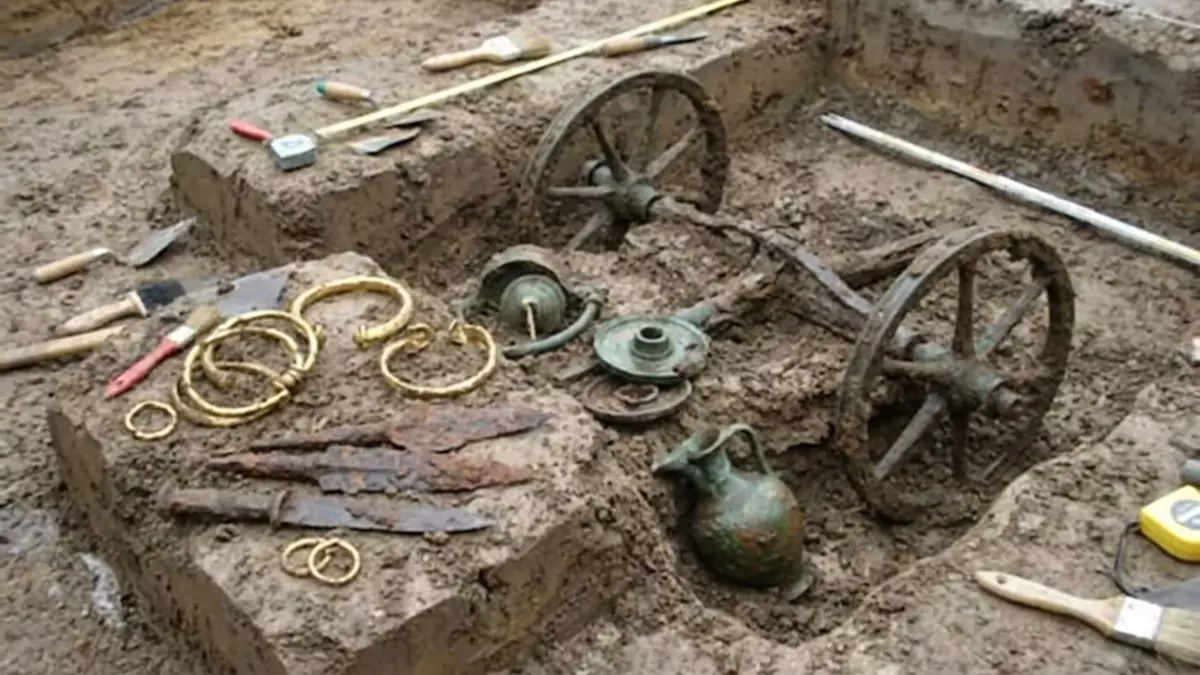
A spectacular archaeological discovery in central Germany has brought to light the 2,500-year-old grave of an elite Celtic warrior. Unearthed near Bad Camberg in the state of Hessen, the burial provides definitive, physical proof of a powerful local ruling class during the early La Tène period of the Iron Age.
The ancient tomb was identified during routine cultural resource management surveys conducted ahead of the construction of a new solar energy park. What began as a standard environmental assessment quickly evolved into one of the most significant Iron Age excavations in the region’s history, revealing a wealth of gold jewelry, advanced weaponry, and imported Mediterranean luxury goods.
2,500-Year-Old Celtic Warrior Tomb with Chariot and Gold Found in Germany
The Regalia of an Iron Age Elite
Although the highly acidic subsoil completely dissolved the warrior’s physical bones and teeth over the millennia, the collection of high-status military and personal artifacts allows researchers to confidently reconstruct his identity as a prominent male noble and combatant.
 The Archaeology of Portugal Fellowship
The excavation team recovered a stunning collection of personal adornments made of solid gold, including rings meticulously crafted to be worn on the fingers, arms, and neck. In early Celtic society, gold neck rings (often referred to as torcs) were not merely decorative items—they functioned as sacred symbols of political authority, military rank, and divine protection.
               [Celtic Elite Burial Assemblage]
 ___________________________________________________________
| Personal Status: | Solid gold finger, arm, and neck rings |
| Martial Prowess: | Heavy iron spearheads and a combat knife|
| Mobility/Rank:   | Two-wheeled war/ceremonial chariot     |
| Global Trade:    | Imported Etruscan bronze beaked jug    |
 ___________________________________________________________
Buried alongside these precious metal ornaments was an array of combat weaponry. The first object pulled from the soil was a heavily oxidized iron spearhead, followed closely by secondary spear points and a specialized fighting knife. The pairing of elite jewelry with formidable weaponry underscores the dual role of the Celtic upper class, where political leadership was directly tied to battlefield prowess.
An Ultra-Rare Chariot Burial in Hessen
The most surprising revelation from the Bad Camberg site was the presence of a complete, two-wheeled chariot buried directly with the warrior. While chariot burials are documented in other regions of the Celtic world, they are exceptionally rare within the state of Hessen.

While the wooden frame of the vehicle had rotted away, its durable metallic infrastructure survived intact:
Wheel Hub Fittings: Decorative and functional bronze and iron sleeves that encased the wooden wheel centers.
Axle Caps: Heavy fasteners that secured the wheels firmly to the main axle tree.
Iron Wheel Rims: Complete outer metallic bands that wrapped around the wooden wheels to provide traction and structural longevity.
The presence of a chariot indicates an immense expenditure of wealth and labor for a single funeral, proving that the individual possessed the social capital to command elite transport in both life and the afterlife.
The Mediterranean Connection: Etruscan Treasures
Among the non-local artifacts recovered, the most historically significant is an imported Etruscan beaked jug. Manufactured hundreds of miles away in what is now Tuscany, Italy, this bronze vessel represents a highly coveted luxury item within Iron Age European society.
[Etruscan Workshops (Tuscany)] ---> Alpine Trade Routes ---> [Celtic Elite (Hessen)]
The presence of this exotic jug proves that the communities living in ancient Hessen were not isolated tribal factions. Instead, they were active participants in sophisticated, long-distance luxury trade networks that crossed the Alps to link the continental European interior with the affluent cultures of the Mediterranean world.
Similar vessels have previously been documented at Glauberg, one of Germany’s most famous “princely” Celtic seats. The Bad Camberg find demonstrates that this specific warrior belonged to a peer network of local lords who shared the same high-end tastes and trade access as the legendary Glauberg rulers.
This discovery provides direct, undeniable proof of a structured Celtic aristocracy operating in the Bad Camberg region during the fifth century BCE—a historical reality archaeologists had long suspected but lacked the physical evidence to confirm.
High-Tech Laboratory Analysis
To prevent halting the renewable energy project, a specialized team from SPAU GmbH executed the physical excavation of the primary grave site in just two weeks, carefully cutting out large, intact blocks of soil containing fragile artifacts. This method allowed the solar park construction to proceed on schedule while shifting the delicate recovery process into a controlled laboratory setting.
Currently under the care of the Hesse State Office for the Preservation of Monuments, these soil blocks are undergoing advanced X-ray and CT (Computed Tomography) scanning. This non-destructive technology has already revealed several additional hidden metal objects encased deep within the dirt blocks. Over the coming months, conservators will slowly micro-excavate these items, revealing further insights into the craftsmanship and funerary rituals of the early La Tène culture.
Conclusion
The Bad Camberg warrior burial marks a major milestone in Central European Iron Age archaeology. By combining elite local craftsmanship, such as the golden torcs and war chariot, with continental imports like the Etruscan jug, this single grave site maps out a complex web of social stratification, ritual devotion, and intercontinental trade. It proves that 2,500 years ago, the rolling hills of Hessen were governed by a sophisticated, well-connected warrior elite who helped shape the cultural landscape of ancient Europe.
Frequently Asked Questions
What was the La Tène period?
The La Tène period was a distinct cultural phase of the European Iron Age, lasting roughly from 450 BCE until the Roman conquests in the 1st century BCE. It is characterized by highly sophisticated, stylized geometric and animal-based art styles, advanced iron metallurgy, and the expansion of Celtic-speaking populations across Europe.
How do archaeologists know it was a warrior’s grave if no bones survived?
High soil acidity frequently destroys organic materials like bone, collagen, and tooth enamel over centuries. However, archaeologists can confidently determine the sex and social role of the deceased based on the “grave goods”—in this case, an exclusively masculine set of elite combat weapons (spearheads and a fighting knife) paired with traditional male aristocratic jewelry.
Why did the Celts bury people with chariots?
In ancient Celtic society, a chariot was a supreme symbol of prestige, wealth, and military command, akin to an elite sports car or armored vehicle today. Burying a leader with their chariot served a dual purpose: it honored their high earthly status during the funeral ritual and provided them with elite transport for their journey into the afterlife.
What is an Etruscan beaked jug?
An Etruscan beaked jug is a specialized bronze or ceramic wine-pouring vessel manufactured by the Etruscan civilization in pre-Roman northern Italy. Characterized by a distinct upward-pointing spout, these jugs were exported across Europe as luxury items and were used by Celtic elites during elite, ritualized feasting ceremonies.
What is micro-excavation of soil blocks?
Micro-excavation is a precise laboratory technique where large sections of an archaeological site are removed in solid blocks of earth rather than dug up in the wind and rain of the field. Back in a sterile lab, scientists use CT scans to see inside the dirt and use dental tools and microscopes to safely extract fragile, highly degraded artifacts without damaging them.