
Table of Contents
- 1. The Mystery of the “Tab Figurine”
- 2. Deciphering the 11-Dot Pattern
- 2.1. Pushing Back the Mesoamerican Timeline
- 3. Connecting Numbers, Calendars, and the Body
- 3.1. The Power of Names and the 260-Day Calendar
- 3.2. Linguistic Clues: Face and Identity
- 4. Secure Context in an Era of Symbols
- 5. What Did the Dots Mean?
- 6. Frequently Asked Questions
- 6.1. How old is the clay figurine found in Guatemala?
- 6.2. Where exactly was the artifact discovered?
- 6.3. What do the 11 dots on the figurine look like?
- 6.4. Why do archaeologists think the dots represent numbers rather than decoration?
- 6.5. What is a “tab figurine”?
Ancient Guatemala Figurine Pushes Back Origin of Mesoamerican Writing
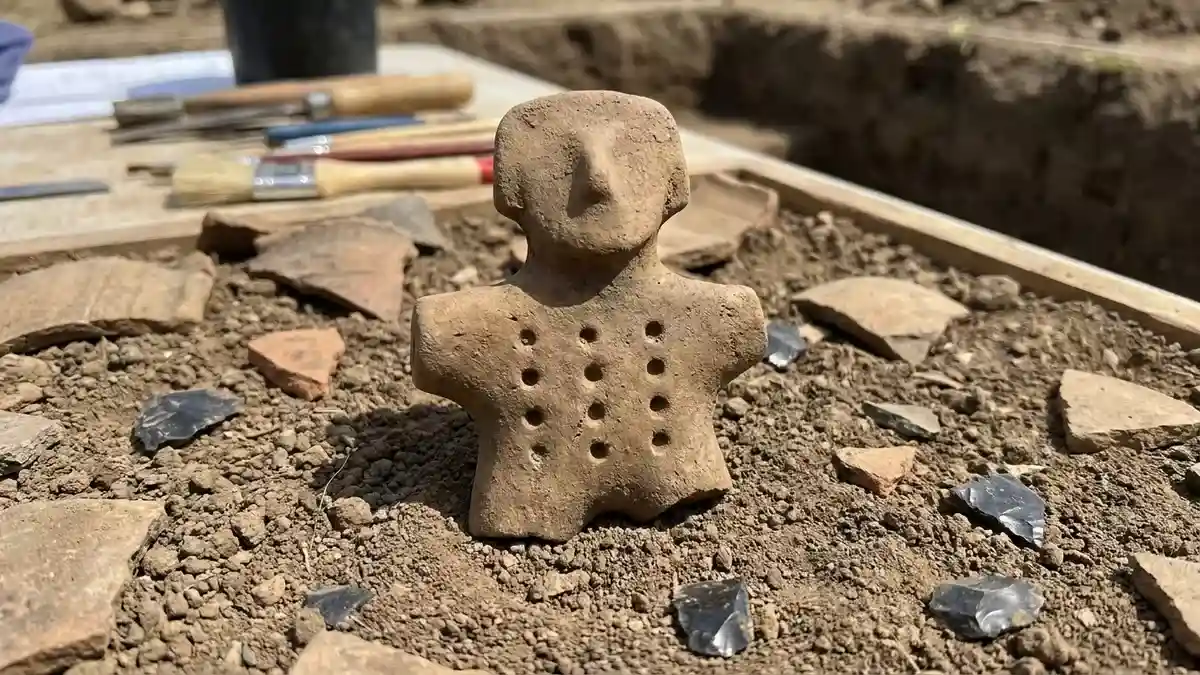
A tiny, broken clay artifact unearthed on the Pacific coast of Guatemala is reshaping our understanding of when and how ancient civilizations in the Americas first developed mathematics and writing. Dating back to between 750 and 650 BCE, the palm-sized figurine features a highly deliberate pattern of 11 pressed dots on its head. Researchers suggest this find represents the earliest documented evidence of a numerical notation system in Mesoamerica, predating complex monumental inscriptions by several centuries.
The discovery, published in the journal Latin American Antiquity, provides an extraordinary glimpse into a transitional era when early urban societies began experimenting with symbolic communication.
Ancient Guatemala Figurine Pushes Back Origin of Mesoamerican Writing
The Mystery of the “Tab Figurine”
The artifact was recovered during controlled scientific excavations at La Blanca, a major Middle Preclassic urban center located in San Marcos, Guatemala. At its peak, La Blanca was an influential regional capital characterized by clear social hierarchy and some of the largest earthen architecture of its time.
Among the thousands of artifacts recovered from domestic trash heaps and structural fill at the site, archaeologists have identified more than 300 specimens belonging to a category known as “tab figurines.”
Unlike traditional statues that mimic realistic human features, tab figurines are deeply abstract:
The Body: Features an identifiable anthropomorphic lower body and torso.
The Head: Completely lacks a naturalistic face. Instead, the head tapers upward into a smooth, tongue-like flat tab.
Identity Indicators: Despite the absence of eyes, noses, or mouths, many of these figurines feature sculpted headbands, earrings, or geometric accents, proving that ancient artisans placed a heavy symbolic emphasis on the head area to convey personal identity.
What sets this specific fragment apart from all other discoveries at La Blanca is a highly precise arrangement of 11 small circular impressions stamped into the clay before it was fired in a kiln.

Deciphering the 11-Dot Pattern
The 11 dots on the La Blanca figurine are not random indentations or accidental blemishes. The artisan pressed them into the soft clay with a clear blueprint in mind, arranging them into three distinct, structured vertical columns:
Left Column: 3 dots
Center Column: 4 dots
Right Column: 4 dots
  ●   ●   ●
  ●   ●   ●
  ●   ●   ●
      ●   ●
This strict, orderly layout strongly supports a mathematical interpretation rather than a purely decorative purpose. Furthermore, the final total of 11 marks an odd number. Had the artist sought a symmetrical aesthetic design to frame a blank face, an even number of dots would be expected. The intentional choice of an asymmetrical, odd total points directly toward a numeric or counting intent.
Pushing Back the Mesoamerican Timeline
In later, well-documented writing systems of the Maya, Zapotec, and Isthmian cultures, numerical values were recorded using a standardized bar-and-dot notation. In those systems, a single dot represented one unit, while a solid horizontal bar represented five. Some regional cultures used exclusively dot configurations to count values up to 13.
While the 2,700-year-old La Blanca figurine does not feature any bars, the 11 dots align perfectly with the concept of early dot-only numeration. If verified, this portable household item pushes back the timeline of symbolic notation in the region by hundreds of years, showing that numbers were part of everyday life long before the construction of sweeping stone monuments.
Connecting Numbers, Calendars, and the Body
To understand why an ancient civilization would stamp numbers onto an abstract human head, researchers look to the deep linguistic and cultural traditions that defined later Mesoamerican societies.
The Power of Names and the 260-Day Calendar
In later centuries, Mesoamerican daily life revolved around a sacred 260-day ritual calendar. A person’s date of birth within this calendar determined their name, predicted their fate, and established their broader social identity. Because numerical values were intrinsically tied to personal names, marking a number on a figurine’s head could quite literally be an early method of writing down an individual’s name or birth date.
Linguistic Clues: Face and Identity
Ancient Indigenous languages further reinforce the intersection of human anatomy, numbers, and personhood:
In the K’iche’ Maya language, the word winik translates simultaneously to both “person” and the number “twenty”—a direct mathematical reference to the combined 20 fingers and toes of human anatomy.
In the Kaqchikel language, terms associated with destiny, luck, and personal character are linguistically rooted in words for the human face.
By utilizing the blank head of a tab figurine as a canvas for numeric dots, the people of La Blanca were highlighting the head as the primary site of human identity and spiritual consciousness.
Secure Context in an Era of Symbols
One of the reasons the La Blanca figurine is causing such excitement in the archaeological community is its impeccable preservation context. Many potential examples of early writing in Central America come from unprovenanced sources—artifacts found on the surface, moving through private collections, or discovered out of context, making them difficult to date accurately.
The La Blanca artifact, discovered in the Joyas Group settlement roughly one kilometer northwest of the city’s main ceremonial core, was unearthed at a controlled depth of 70 to 80 centimeters. It rested securely beside an ancient household floor amidst domestic pottery shards, obsidian blades, and architectural debris. This secure placement allowed scientists to establish an ironclad date range of 750–650 BCE.
Other discoveries within elite residences at La Blanca suggest that the city was a hotbed for early symbolic experimentation. Archaeologists have found various ceramic fragments bearing specialized incisions that mirror later formal calendar glyphs. The community was actively searching for novel visual ways to record abstract data, numbers, and ownership during a time of rapid urbanization.
What Did the Dots Mean?
While the scientific community agrees that the 11 dots represent a calculated script, the exact message remains open to interpretation. Scholars have proposed three leading theories:
A Calendrical Date or Birth Name: The dots could represent an individual’s birthdate or name drawn from an early variant of the sacred 260-day calendar.
A Record of Social Status: The markings may have denoted a specific political rank, lineage tie, or membership in a distinguished clan within La Blanca’s elite.
Supernatural Identity: The pattern might indicate a connection to a specific deity, protective spirit, or ritual assignment.
While a definitive translation may never be achieved from a single broken artifact, the La Blanca figurine provides a vital baseline for Mesoamerican history. It proves that long before the rise of massive stone hieroglyphs, early urban societies were already using simple numbers to map out the complexities of the human soul.
Frequently Asked Questions
How old is the clay figurine found in Guatemala?
The figurine dates back to the Middle Preclassic period, specifically between 750 and 650 BCE. This makes the artifact approximately 2,700 years old.
Where exactly was the artifact discovered?
The artifact was discovered during professional excavations at the archaeological site of La Blanca, an early urban center located on the Pacific coast of Guatemala in the San Marcos region. It was found near a residential floor in an area called the Joyas Group.
What do the 11 dots on the figurine look like?
The 11 dots are circular indentations impressed into the damp clay before the object was fired. They are meticulously arranged into three vertical columns: one column of three dots and two columns of four dots, spanning the head area of the figurine.
Why do archaeologists think the dots represent numbers rather than decoration?
The arrangement is structured and orderly rather than random. Additionally, the total number of dots is an odd number (11). If the design were purely decorative, an even, symmetrical pattern would be expected to frame the head.
What is a “tab figurine”?
A tab figurine is a common type of Preclassic ceramic object found at La Blanca. These figures possess stylized bodies but completely lack realistic facial features like eyes or a mouth. Instead, the head is represented by a flat, tongue-like tab that often carries hairstyles, headbands, or symbolic markings.