
Table of Contents
**Ancient DNA Confirms Golden Horde Elites’ Mongolian Roots**
Archaeologists and geneticists have uncovered compelling evidence about the rulers of the Golden Horde, the powerful western branch of the Mongol Empire. Ancient DNA from elite burials in central Kazakhstan reveals deep ancestral ties to the Mongolian Plateau, confirming that the highest levels of this medieval state remained closely connected to their eastern origins even as they governed vast territories across Central Eurasia and Eastern Europe.
This groundbreaking study, published in the *Proceedings of the National Academy of Sciences*, provides rare direct genetic insight into the ruling class of one of history’s most formidable empires. The findings illuminate how Genghis Khan’s descendants maintained their identity while adapting to new lands, reshaping our understanding of Mongol power structures and legacy.
Ancient DNA Confirms Golden Horde Elites’ Mongolian Roots
### The Golden Horde: A Vast Eurasian Empire
In the early 13th century, Genghis Khan united the Mongol tribes and launched conquests that created the largest contiguous land empire in history. After his death in 1227, the empire divided among his sons. Jochi, the eldest, received the western territories. His descendants established the Golden Horde, which dominated the steppes from the 13th to 15th centuries, controlling key trade routes along the Silk Road and influencing regions from the Black Sea to Siberia.
The Golden Horde blended Mongol military organization with local customs, fostering a cosmopolitan society that included Turkic, Slavic, and other groups. Yet questions remained about how closely the ruling elite retained their Mongolian ancestry amid generations of rule far from the homeland.

The Ulitau region in central Kazakhstan, home to several important mausoleums, has long been linked to this history. Local tradition even associates one site with Jochi himself. While the new study does not confirm specific identities, the genetic data firmly places these elites within the broader Mongol imperial family tree.
### Elite Burials Yield Ancient DNA Breakthrough
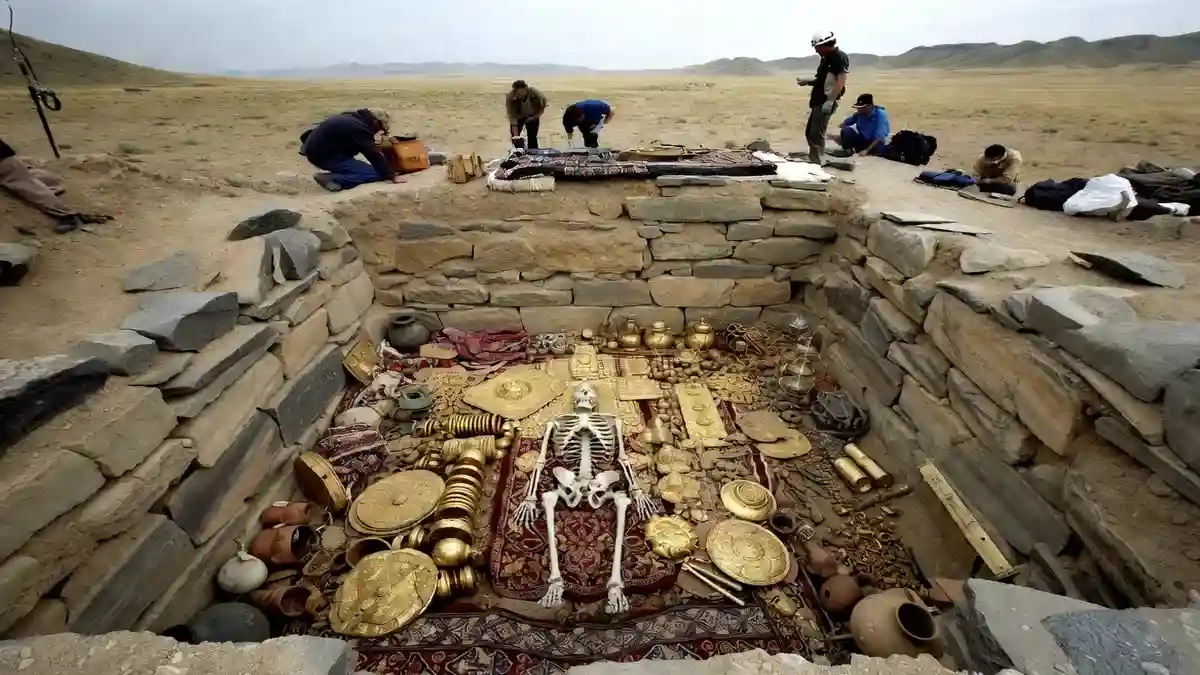
Researchers analyzed DNA from four individuals—three men and one woman—buried in monumental mausoleums at Ulitau. These high-status graves reflect the wealth and power of the Golden Horde’s leadership. The well-preserved remains allowed scientists to extract and sequence high-quality genomes, a challenging feat with medieval samples.
The results are striking. The three men share a common paternal lineage belonging to Y-chromosome haplogroup C3, a genetic marker strongly associated with populations from the Mongolian Plateau. This haplogroup gained fame two decades ago when studies suggested that roughly one in 200 men worldwide carries a related lineage tied to the Mongol expansions—likely descendants of Genghis Khan and his close male relatives.
This new research refines that picture. The Ulitau men belong to a specific sub-branch within C3. While related lineages appear in modern populations, the exact variant in these ancient elites is less common today, highlighting how ancient DNA can distinguish fine-scale relationships that modern genomes blur.
The woman’s genome adds further depth, showing similar Northeast Asian ancestry. Overall, the individuals derive most of their genetic makeup from Ancient Northeast Asian sources, with smaller contributions from Ancient North Eurasian and steppe populations, including groups related to the Scythians and Kipchak Turks who inhabited the region before and during Mongol rule.
### Genetic Ties to the Mongolian Heartland
Using advanced identity-by-descent analysis, the team identified direct genetic connections between the Ulitau elites and medieval populations from the Mongolian Plateau. These links demonstrate ongoing biological and cultural exchange between the western territories and the Mongol homeland, even centuries after the initial conquests.
This evidence supports historical accounts of Mongol rulers sending family members and loyalists to administer distant khanates while maintaining ties to the imperial center. It also aligns with archaeological finds: the mausoleums blend traditional Mongol elements with local architectural and artistic influences, reflecting a ruling class that preserved eastern roots while engaging with subject populations.
The genetic profile suggests strategic marriages and alliances with local steppe groups. Such integration helped legitimize Mongol rule and facilitated governance over diverse peoples, creating a hybrid elite culture characteristic of the Golden Horde.
### Broader Implications for Mongol History
The study provides the first direct ancient DNA from confirmed high-status Golden Horde burials. Previous genetic work focused more on commoner populations or broader steppe migrations. These elite genomes narrow the possible lineages of the ruling family and strengthen claims about the spread of haplogroup C3 during the Mongol era.
Genghis Khan’s own tomb has never been located, preventing direct comparison. However, the Ulitau results offer a valuable reference point for future studies. They also raise intriguing questions about succession, kinship, and how power was maintained across the empire’s branches.
The Golden Horde’s influence extended far beyond military conquest. It facilitated trade, spread technologies, and shaped the demographic landscape of Eurasia. Genetic evidence of continuity with Mongolia underscores that the empire was not simply a loose collection of conquered territories but retained strong familial and cultural cohesion at the top.
### Life and Legacy of the Golden Horde
At its peak, the Golden Horde controlled prosperous cities like Sarai, engaged in diplomacy with European powers, and played a key role in the medieval world economy. Elites enjoyed luxury goods, maintained mobile courts, and patronized arts and scholarship. The mausoleums in Ulitau, with their monumental scale, reflect this wealth and the desire to project power even in death.
The integration of local elements in burials shows pragmatic adaptation. Mongol rulers often incorporated Turkic and Islamic influences, especially after the conversion of the Horde to Islam in the 14th century. This cultural blending created a unique society that left lasting impacts on Russian, Central Asian, and Caucasian histories.
Modern populations in the region still carry traces of this legacy. The widespread distribution of related C3 lineages reflects the demographic ripples of the Mongol expansions, though the specific elite branch identified here appears rarer today.
### Challenges and Future Research Directions
Ancient DNA research in steppe environments faces difficulties, including degradation and contamination risks. The successful sequencing from Ulitau highlights advances in laboratory techniques and careful site selection. Future studies may analyze more individuals across different social classes and time periods to create a fuller genetic portrait of the Golden Horde.
Comparing these genomes with those from other Mongol khanates, such as the Ilkhanate in Persia or the Yuan Dynasty in China, could reveal patterns of divergence and unity within the larger empire. Isotopic analysis and additional archaeological work would further illuminate diet, mobility, and health among the ruling class.
As more ancient DNA becomes available, researchers hope to explore questions of disease, adaptation to new environments, and the genetic impact of the Pax Mongolica—the period of relative stability that boosted Eurasian connectivity.
### Why These Findings Matter Today
This research connects modern Central Asian nations with their medieval past, reinforcing cultural heritage and national identity. In Kazakhstan, sites like Ulitau are important symbols of history and attract scholars and tourists alike.
Globally, the study enriches understanding of how empires form, endure, and transform. The Mongol Empire’s genetic legacy demonstrates the long-term effects of large-scale migrations and elite networks. It also serves as a reminder of humanity’s interconnected history across continents.
In an era of advancing genetic technologies, such discoveries bridge archaeology, history, and biology, offering nuanced views of the past free from earlier biases or incomplete records.
**Conclusion**
Ancient DNA from the Ulitau mausoleums confirms that Golden Horde elites maintained strong Mongolian ancestry while ruling over a vast, multicultural domain. The shared paternal lineage, Northeast Asian genomic roots, and connections to the Mongolian Plateau paint a picture of continuity amid adaptation—a powerful dynasty that shaped Eurasia for centuries.
These findings refine our knowledge of the Mongol Empire’s internal dynamics and the enduring impact of Genghis Khan’s descendants. As research continues, the Golden Horde’s story will grow even clearer, revealing more about the leaders who built one of history’s greatest empires and the people who lived under their rule.
The elites buried in Ulitau, with their gold-adorned graves and eastern genetic signatures, remind us that the past is never truly lost. Through science and scholarship, their legacy continues to illuminate the complex tapestry of human history.
### FAQ
**What is the Golden Horde?**
The northwestern division of the Mongol Empire, established by Jochi and his descendants in the 13th century, controlling much of Central Asia, Russia, and Eastern Europe.
**What did the ancient DNA reveal about the elites?**
The individuals showed strong ancestry from the Mongolian Plateau, with the men sharing a specific branch of Y-chromosome haplogroup C3 linked to Mongol expansions.
**Does this prove one tomb belongs to Jochi?**
No. While local tradition links a mausoleum to Jochi, the study confirms general elite Mongolian ancestry but does not identify specific historical figures.
**How common is haplogroup C3 today?**
Related lineages appear in many Central Eurasian men, with some estimates linking them to Mongol-era expansions, though specific sub-branches vary in frequency.
**What other ancestries were found in the genomes?**
A smaller portion traces to Ancient North Eurasian and local steppe groups like the Kipchaks, reflecting alliances and integration with regional populations.
**Why is this study important?**
It provides the first direct genetic data from Golden Horde ruling-class burials, clarifying ancestry, kinship, and cultural blending in the Mongol Empire.
**Where can I learn more about the discovery?**
Visit the Proceedings of the National Academy of Sciences for the full paper or explore Kazakhstan’s archaeological sites and museums dedicated to Mongol history.