
Table of Contents
- 1. The Dawn of a United Egyptian State
- 2. The Enigmatic Legacy of King Scorpion
- 3. Dangerous Animals and Earthly Deputies of Divine Power
- 4. “Pharaoh-Fashioning” Through Graphic Violence
- 5. Digital Mapping and the Future of the Frontier
- 6. Frequently Asked Questions
- 6.1. How old is the Egyptian rock art found near Aswan?
- 6.2. Who was King Scorpion?
- 6.3. Why did early Egyptian kings name themselves after dangerous animals?
- 6.4. What does “pharaoh-fashioning” mean?
- 6.5. How did scientists read the eroded inscriptions?
Ancient Egyptian Rock Art Unlocks Secrets of Early Kingship
An extraordinary collection of rock inscriptions discovered in the desert east of Aswan is revolutionizing our understanding of ancient Egyptian history. Carved into the rugged stone faces of the Wadi el Malik region and its adjacent valleys, these ancient canvases contain early hieroglyphs, ferocious animal symbols, and shocking depictions of graphic violence. Together, they offer an unprecedented look at how the world’s very first territorial state cemented its power more than 5,000 years ago, using visual propaganda to dominate an empire.
The newly analyzed carvings reveal a complex system of political messaging used by pre-dynastic rulers to justify their sovereignty. Long before the construction of the Great Pyramids or the establishment of the famous pharaonic dynasties, these early leaders used the natural landscape as a billboard to showcase their authority, combining fearsome martial power with claims of divine backing.
Ancient Egyptian Rock Art Unlocks Secrets of Early Kingship

The Dawn of a United Egyptian State
To understand the historical weight of these desert carvings, one must look back to the late fourth millennium BCE—a volatile era when the unified Egyptian state was first emerging. According to Egyptologist Prof. Dr. Ludwig Morenz of the University of Bonn, this formative period saw Egypt rapidly expand into a vast territorial empire stretching nearly 800 kilometers (approx. 500 miles) from north to south.
While the fertile Nile Valley served as the demographic and agricultural core of this new empire, the arid expanses of the Aswan Eastern Desert remained on the socio-cultural periphery. Yet, this desert frontier was far from empty. The Wadi el Malik functioned as a critical transit route for trade caravans, a source of precious mineral wealth, and a rich hunting ground during wetter climatic spells.
To assert their dominance over this remote but economically vital borderland, early Egyptian rulers marched into the desert and left their permanent marks on the stone cliffs. They effectively transformed the desolate landscape into a massive, highly visible “royal rock art tableau” designed to intimidate travelers and project state power to the very edges of the civilized world.
The Enigmatic Legacy of King Scorpion
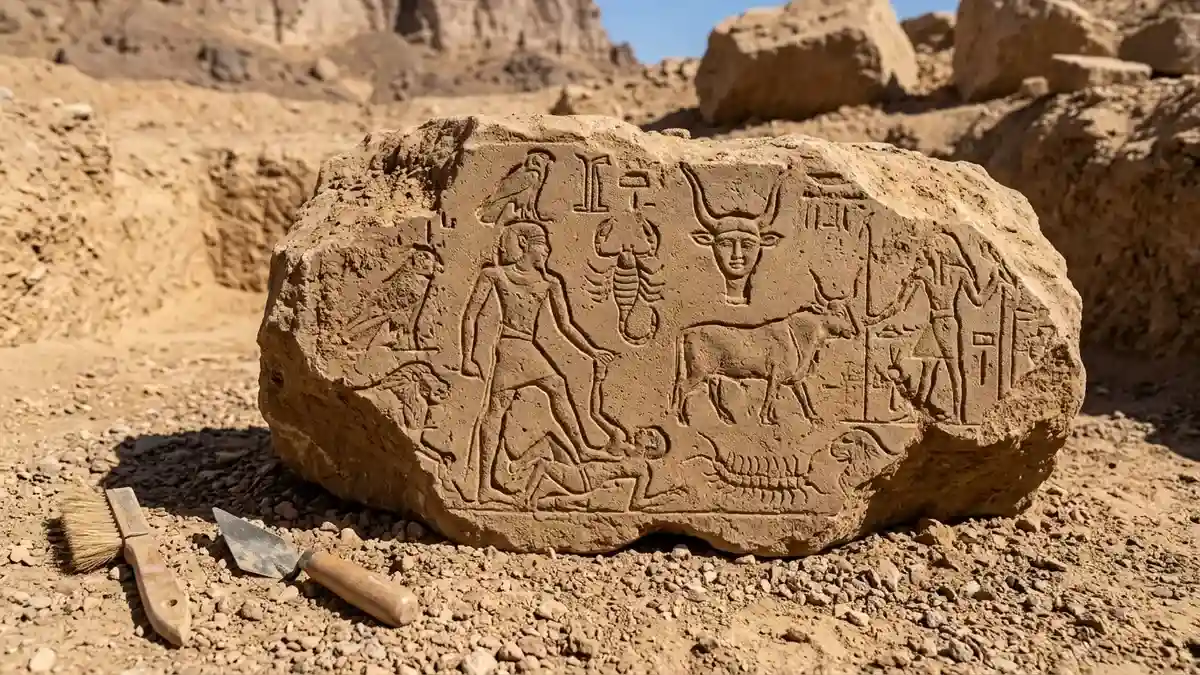
At the heart of this ancient propaganda network is a legendary, shadowy ruler known to history as King Scorpion. One of the most groundbreaking inscriptions recovered from a rock face in the nearby Wadi Abu Subeira reads clearly: “Domain of the Horus King Scorpion.”
Dr. Morenz identifies this specific carving as the oldest known geographical place name sign anywhere in the world. Rather than just a piece of primitive graffiti, the inscription served as an official state boundary marker or a tax-collection checkpoint, explicitly warning all who entered that the surrounding territory belonged entirely to the crown.
In their comprehensive book, Culture and Power in Pre-Pharaonic Egypt, written alongside Egyptian scholar Mohamed Abdelhay Abu Bakr, Morenz argues that these carvings demonstrate a highly structured, centralized administrative system operating centuries earlier than previously assumed.
Dangerous Animals and Earthly Deputies of Divine Power
A fascinating pattern emerged as researchers documented the sequence of rulers carved into the stone walls of Wadi el Malik. Early kings like Horus-Falcon, King Bull, and a ruler named Scolopendra—after a notoriously venomous, giant desert centipede—deliberately rejected soft, human titles. Instead, they named themselves after lethal predators.
This animal symbolism was a calculated political move. By adopting the names of apex predators, the rulers emphasized their raw physical authority and deadly capabilities. However, the iconography reveals an important theological distinction: these early pre-dynastic kings did not claim to be literal gods on Earth. Instead, the art portrays them as the chosen earthly deputies of divine forces, executing the will of the heavens.
The inscriptions reveal a sophisticated early pantheon where the king acted as the mediator between two powerful, balancing deities:
Bat: A celestial cow goddess associated with maternal protection, fertility, and the lush, life-giving agricultural lands along the Nile riverbanks.
Min: A powerful, primeval god of the open desert, directly associated with hunting, wilderness survival, and the exploitation of mineral resources.
Together, Bat and Min formed a divine couple that represented the totality of the Egyptian universe. By aligning himself with both deities, King Scorpion signaled to his subjects that he possessed the cosmic authority to rule over both the civilized heartland of the Nile and the chaotic, dangerous peripheral regions of the desert.
“Pharaoh-Fashioning” Through Graphic Violence
Beyond religious iconography, the rock art contains deeply unsettling depictions of extreme martial violence. One particularly gruesome relief discovered in the wadi depicts a towering ruler actively trampling a defeated enemy. Positioned directly in the background are two perfectly round, circular shapes that modern imaging has revealed are not random balls or decorative spheres, but rather the cleanly severed heads of executed prisoners.
Dr. Morenz refers to this artistic process as “pharaoh-fashioning.” It represents the deliberate, systematic creation of the concept of absolute kingship through terrifying imagery. By portraying the ruler as an unstoppable force capable of crushing rebellion and decapitating enemies, the state established a psychological monopoly on violence. These bloody scenes were meant to convey a clear message to local nomadic tribes and foreign traders: obedience to the pharaoh meant life, while resistance resulted in swift, absolute destruction.
The reliefs also shed light on peaceful religious processions that helped bind the distant frontiers to the capital. Another large-scale engraving depicts a massive boat being physically pulled across the desert sands by a team of 25 men. This image likely records a sacred journey or an actual festival, where royal and divine symbols were transported from the Nile Valley out into the desert outposts, creating a shared cultural and religious identity across the empire.
Digital Mapping and the Future of the Frontier
Many of these priceless engravings have suffered severe erosion over the past 5,000 years, battered by desert winds, extreme temperature shifts, and sandstorms. To unlock their secrets, the research team utilized cutting-edge digital imaging methodologies and high-resolution 3D scanning technology. These advanced digital tools allowed scientists to peer through layers of weathering and uncover faint, microscopic grooves entirely invisible to the naked human eye, bringing lost details of the carvings back to life.
Dr. Morenz believes that archaeologists have only scratched the surface of what the Aswan Eastern Desert has to hide. He has issued an urgent call for more international archaeological missions to document the endangered site before it is lost to time or development. Furthermore, he hopes to see the remote wadi transformed into an official heritage site equipped with managed tours and a modern visitor center to educate the public on the true, violent origins of the pharaonic state. For now, the silent stone walls of Wadi el Malik stand as a stark monument to a time when early human kings first learned to weaponize art, transforming a barren wilderness into an eternal canvas of political ambition.
Frequently Asked Questions
How old is the Egyptian rock art found near Aswan?
The rock inscriptions date back to the late fourth millennium BCE, making them over 5,000 years old. They originate from the Pre-Dynastic period, an era during which the first centralized Egyptian state was actively forming.
Who was King Scorpion?
King Scorpion was an enigmatic, early Egyptian ruler who reigned during the transition into the first official dynasties. He is famous for utilizing sophisticated boundary markers and state propaganda, including the world’s oldest known place name sign.
Why did early Egyptian kings name themselves after dangerous animals?
Pre-dynastic rulers adopted names like Bull, Falcon, Scorpion, and Centipede to embody raw physical power, authority, and danger. This symbolism reinforced their roles as the ultimate guardians of the land and the earthly deputies of divine power.
What does “pharaoh-fashioning” mean?
“Pharaoh-fashioning” refers to the deliberate use of structured, often violent imagery—such as rulers trampling enemies or displaying severed heads—to create, market, and legitimize the cultural and political concept of an absolute, all-powerful king.
How did scientists read the eroded inscriptions?
The international research team utilized advanced digital imaging technologies and high-resolution 3D scanning. These specialized methods allowed them to detect faint, ancient tool marks and engravings that had been worn away by centuries of desert weather and were invisible to the naked eye.