
Table of Contents
- 1. Prehistoric Origins on Thorney Island
- 2. Rediscovering the Medieval Lesser Hall
- 3. A Chronological Treasury of Everyday Artifacts
- 3.1. Medieval Splendor and Commemorative Objects
- 3.2. Roman and Victorian Layering
- 4. Mitigating Risk Through Modern Geoarchaeology
- 5. Conclusion
- 6. Frequently Asked Questions
- 6.1. What makes the flint tools found at Westminster so important?
- 6.2. What was Thorney Island?
- 6.3. How did parts of the medieval Lesser Hall survive the 1834 fire?
- 6.4. Who is conducting these excavations?
- 6.5. What will happen to the artifacts and ancient structures after the study?
6,000 Years of History Discovered Beneath Houses of Parliament
A comprehensive archaeological investigation beneath the Palace of Westminster has completely reshaped our understanding of London’s prehistoric timeline. Excavations carried out under the UK’s parliamentary estate have uncovered evidence of human occupation spanning nearly six millennia, demonstrating that the site was a thriving hub of human activity long before monumental ancient structures like Stonehenge were built.
Conducted as part of the Houses of Parliament’s multi-year Restoration and Renewal initiative, the excavations have yielded a remarkably layered sequence of history. From Mesolithic flint tools to hidden medieval palace walls and Victorian relics, these findings offer an unprecedented look at how an isolated prehistoric riverside ecosystem evolved into the modern epicenter of British political power.
6,000 Years of History Discovered Beneath Houses of Parliament
Prehistoric Origins on Thorney Island
The oldest and perhaps most surprising discoveries were recovered from deep, undisturbed sand deposits beneath the palace foundations. Archaeologists from MOLA (Museum of London Archaeology) uncovered more than 60 struck flint flakes, including a meticulously shaped hand tool.

Typological analysis indicates these artifacts date back to the Late Mesolithic or Early Neolithic period, approximately 4300 BCE. This timeline places active human habitation at the site thousands of years before the construction of Egypt’s pyramids or the standing stones of Wiltshire.
During this prehistoric era, the area that now accommodates the Houses of Parliament was a low-lying gravel island known historically as Thorney Island. Surrounded by the braided marshes of the River Thames, this elevated landmass offered a highly strategic location for early hunter-gatherer communities.
The pristine preservation of these flints within untouched prehistoric sands provides vital data on how these early populations utilized the micro-environment:
Resource Gathering: The surrounding wetlands provided a reliable supply of reeds, waterfowl, and wild plants.
Fishing Operations: Proximity to the Thames allowed communities to exploit seasonal fish migrations.
Tool Manufacturing: The presence of discarded flint flakes indicates that the island served as a temporary workshop where tools were knapped, maintained, and repaired.
Rediscovering the Medieval Lesser Hall
Among the historical architectural remains, the most significant milestone occurred in August 2025, when excavation teams exposed substantial structural foundations of the medieval Lesser Hall, also widely known as the White Hall.
                       [Timeline of the Lesser Hall]
  _______________________________________________________________________
 | 1167:           | Constructed under royal decree as an elite dining hall  |
 | 13th-18th C.:   | Transitioned into administrative and parliamentary use |
 | 1834:           | Massive fire sweeps Westminster; hall assumed destroyed|
 | 1940s:          | Survives Nazi Blitz bombardments while buried          |
 | 2025:           | Foundations rediscovered intact during restoration      |
 |_________________|_____________________________________________________|
Constructed in 1167 during the high medieval period, the Lesser Hall originally functioned as an exclusive dining hall for the royal court. Over the centuries, as the English monarchy shifted its administrative apparatus, the building was adapted for statecraft, eventually housing both chambers of Parliament at different stages of its operational life.
For nearly two centuries, historians and architects assumed that the Lesser Hall had been completely obliterated during the catastrophic fire of 1834, which destroyed most of the old medieval palace complex. However, the newly exposed stone masonry reveals a completely different narrative.
Sections of the robust 12th-century stone walls not only survived the 1834 inferno but were hastily repaired and integrated into mid-19th-century structural renovations. Remarkably, these buried remnants also managed to survive the German aerial bombardments of the Second World War intact, providing a tangible link to London’s resilient architectural heritage.
A Chronological Treasury of Everyday Artifacts
Beyond the monumental stone walls, the ongoing MOLA excavations across nine key locations—including Black Rod’s Garden, Old Palace Yard, Victoria Tower Gardens, and the Thames foreshore—have yielded an extensive array of artifacts that document the daily lives of the site’s past inhabitants.
Medieval Splendor and Commemorative Objects
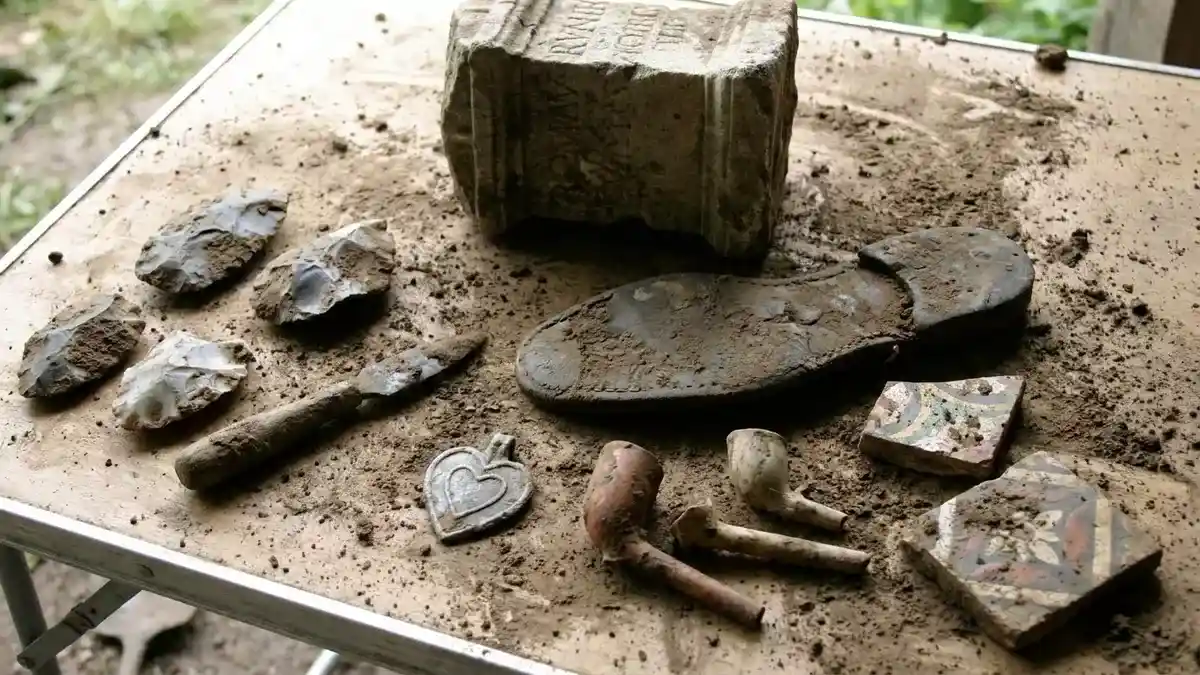
Archaeologists recovered a beautifully preserved collection of medieval leather footwear, including a mostly intact boot and several thick shoe soles, illustrating the everyday attire worn by palace servants and visitors roughly 800 years ago.
Additionally, teams discovered a highly detailed, decorated medieval floor tile. The geometric and floral motifs on this tile are particularly significant, as they directly inspired the neo-Gothic encaustic tile designs chosen by architect Charles Barry during the 19th-century reconstruction of the palace. Another notable find was a 14th-century lead badge shaped like a flowering heart, a popular emblem of religious devotion or personal sentiment during that era.
Roman and Victorian Layering
The deep stratification of the site is further emphasized by the discovery of a heavily weathered fragment of a Roman altar dating back more than two millennia. The artifact appears to have been salvaged and repurposed as structural rubble by later medieval builders, a common practice in post-Roman London.
Moving forward into the industrial era, archaeologists pulled numerous fragments of elaborately molded clay tobacco pipes from the post-1834 fire debris layers. These pipes were almost certainly discarded by the small armies of stonemasons, carpenters, and laborers who spent decades rebuilding the modern Palace of Westminster.
The social life of these workers is further illustrated by the recovery of a massive, five-pint Victorian ceramic beer jug. Stamped with the name of a historic London tavern keeper, the vessel highlights the thriving network of local pubs that serviced the construction crews during the Victorian building boom.
The Palace of Westminster sits entirely within a Tier 1 Archaeological Priority Area, a designation reflecting its unparalleled historical density and national significance.
Mitigating Risk Through Modern Geoarchaeology
The primary objective of this expansive subsoil mapping campaign is to directly inform the engineering and architectural designs of the upcoming Palace Restoration and Renewal program. By systematically charting the exact locations, depths, and preservation states of these ancient structures, heritage specialists can ensure that future foundational repairs do not inadvertently damage London’s subterranean history.
By the conclusion of the current investigative phase, engineering teams and archaeologists will have completed:
14 Trial Pits: Targeted excavations designed to evaluate structural intersections and soil stability around existing foundations.
10 Geoarchaeological Boreholes: Deep core samples used to reconstruct the ancient environmental and geological shifts of the Thames basin.
Foreshore Surveys: Extensive low-tide examinations of the exposed riverbank to identify discarded medieval or prehistoric structures.
The fieldwork is scheduled to continue through 2026, with specialists transitioning to full-scale laboratory analysis, conservation, and formal reporting by 2027.
Conclusion
The ongoing discoveries beneath the Palace of Westminster serve as a powerful reminder that the modern seat of British democracy is built upon thousands of years of human convergence. Long before King Canute established a royal residence on the site, or the iconic Big Ben clock tower came to define the London skyline, ancient hunters, Roman builders, and medieval monarchs left their indelible marks in the sand. This research ensures that as the palace is modernized for future generations, its deep historical foundations are fully understood, respected, and preserved.
Frequently Asked Questions
What makes the flint tools found at Westminster so important?
The discovery of over 60 struck flint flakes dating back to 4300 BCE proves that human communities were actively processing resources, hunting, and manufacturing tools at this specific location nearly 6,000 years ago. This establishes human activity at Westminster long before the construction of iconic monuments like Stonehenge.
What was Thorney Island?
Thorney Island was a natural, elevated gravel bank formed by the confluence of the River Thames and the now-lost River Tyburn. Before modern embankments and drainage systems narrowed the Thames, this dry island provided a safe, strategic, and resource-rich sanctuary for prehistoric hunter-gatherers amidst an expansive marshland.
How did parts of the medieval Lesser Hall survive the 1834 fire?
While historical records suggested the 1167 Lesser Hall was completely obliterated in the great fire of 1834, the physical evidence shows that its lower stone foundations and walls were sturdy enough to withstand the heat. Instead of being cleared away, these surviving sections were stabilized, repaired, and incorporated into subsequent 19th-century buildings.
Who is conducting these excavations?
The archaeological investigations are being meticulously executed by MOLA (Museum of London Archaeology). Their team of field specialists and geoarchaeologists is working in tandem with the Palace of Westminster’s Restoration and Renewal Delivery Authority.
What will happen to the artifacts and ancient structures after the study?
To ensure their long-term survival, the fragile architectural foundations and medieval walls are carefully mapped, documented, and safely reburied to protect them from environmental degradation during construction. Small portable artifacts, such as the Roman altar fragment, leather shoes, clay pipes, and coins, are undergoing conservation and cataloging, with many slated for future public display.