
Table of Contents
**Rare Adena Stone Cache Found Under Ohio Golf Course**
A remarkable discovery on a quiet Ohio golf course is challenging archaeologists to rethink ancient tool-making traditions and ceremonial practices in the American Midwest. The Joshua Cache, consisting of 11 pristine stone bifaces, was unearthed during routine grading work and now stands as one of the most intriguing recent finds linked to the Early Woodland Adena culture. This unexpected hoard deepens the mystery surrounding why ancient people buried unused tools and what they reveal about life 2,000 years ago.
The chance find highlights how modern development can intersect with hidden chapters of North American prehistory. What began as a casual observation by a local resident quickly evolved into a salvage excavation that yielded high-quality artifacts offering fresh insights into Adena craftsmanship and resource networks.
Rare Adena Stone Cache Found Under Ohio Golf Course

### The Accidental Discovery on Sugar Creek Golf Course
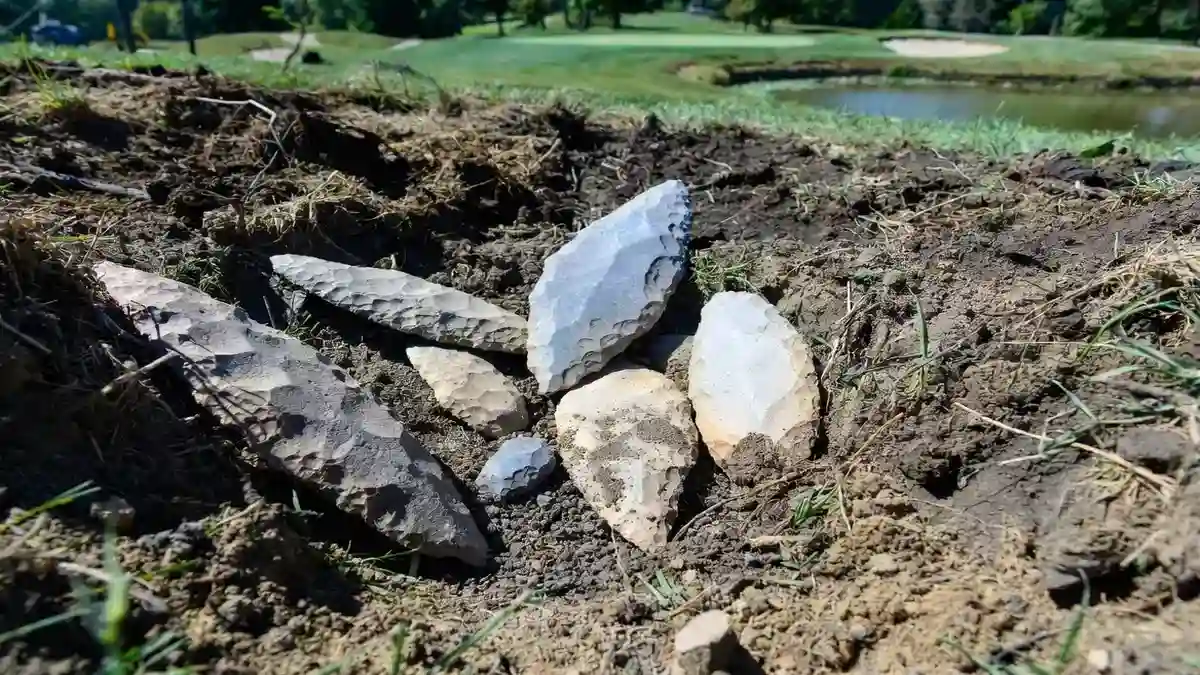
In January 2021, Joshua Fetter spotted a distinctive leaf-shaped stone object near a pond on the Sugar Creek golf course in Sugarcreek, Ohio. Construction crews had been grading the area for future housing, disturbing the soil and bringing buried treasures to light. Fetter searched the immediate vicinity and recovered several more pieces before alerting experts at Kent State University through family connections.
Archaeologists responded swiftly the following day. In a compact area of roughly one square meter, they excavated two additional bifaces found slightly deeper than the surface finds. Small charcoal fragments lay beneath the tools, though later analysis would complicate their use for dating. The entire collection was carefully documented and donated to the Cleveland Museum of Natural History for preservation and further study.

This rapid salvage effort was essential, as ongoing construction left little time for comprehensive investigation. The Joshua Cache now serves as a prime example of how citizen science and professional archaeology can collaborate to rescue significant heritage before it is lost forever.
### What Makes the Joshua Cache Special
The cache contains eleven finely crafted lanceolate bifaces — elongated, leaf-shaped stone tools worked on both sides. Each piece demonstrates exceptional symmetry, with straight edges and organized flake scars that reflect the hand of skilled artisans. Microscopic analysis revealed no signs of actual use: no edge wear from cutting, scraping, or hunting. Instead, polished areas on raised surfaces suggest the tools rubbed against each other while being transported or stored together.

This pristine condition sets the Joshua Cache apart from typical everyday tool finds. The bifaces appear to have been intentionally prepared and then deliberately buried, raising questions about their role in ancient societies. Were they preforms for future projectile points, stored hunting equipment, or objects with deeper ceremonial meaning? The lack of use-wear strongly supports intentional deposition rather than accidental loss.
### Scientific Analysis and Dating Challenges
Dating the cache proved particularly difficult. Radiocarbon analysis of charcoal fragments produced dates from the mid-12th to mid-13th century CE. These results clash dramatically with the stylistic features of the bifaces, prompting researchers to question the association. Heavy machinery had already disturbed the site, and natural processes like animal burrowing or root movement could have introduced younger charcoal into older layers. For these reasons, the radiocarbon dates are not considered reliable indicators of the tools’ age.
To resolve the chronological puzzle, the research team turned to advanced geometric morphometric analysis. They compared the Joshua Cache bifaces to 322 similar artifacts from various periods across North America. Digital shape measurements and statistical modeling placed the cache most closely with tools from the Early Woodland Adena tradition, which flourished in Ohio and surrounding regions between approximately 2,500 and 1,900 years ago.
This affiliation aligns with known Adena biface characteristics: long, narrow forms, refined pressure flaking creating central ridges, and overall elegance in design. Earlier speculation about a much older Paleoindian connection (around 13,000 years ago) was ruled out through detailed comparisons, though the similarities underscore how stone tool shapes can converge across time due to practical needs.
### Material Sourcing and Ancient Trade Networks
Portable X-ray fluorescence (pXRF) analysis determined that most bifaces were made from Upper Mercer chert, a high-quality material with outcrops located 43 to 45 kilometers south of the discovery site. This distance indicates deliberate procurement and transport of raw stone or finished tools, pointing to established exchange networks or seasonal movement by Adena groups.
Upper Mercer chert was prized for its workability and durability, making it a preferred material for fine bifaces. The effort invested in acquiring it suggests the cache held significant value, whether practical, social, or symbolic.
### Understanding the Adena Culture
The Adena people represent one of the earliest mound-building cultures in eastern North America. They constructed impressive earthen burial mounds, often containing elaborate grave goods, and engaged in long-distance exchange of exotic materials like copper, mica, and marine shells. Their society combined hunting, gathering, and early horticulture, with emerging social hierarchies reflected in differential burial treatments.
Biface caches like the Joshua find are relatively uncommon but not unknown in Adena contexts. Such deposits may have served as offerings to spirits, markers of territory, or stockpiles for important communal events. The careful burial of unused, high-quality tools hints at ritual or symbolic behavior rather than purely utilitarian storage.
The Early Woodland period marked important transitions in the Ohio River Valley, including increased sedentism, experimentation with domesticated plants like squash and sunflower, and the spread of new ceremonial practices. Discoveries like this one help archaeologists trace these developments at the local level.
### Broader Implications for Ohio Archaeology
The Joshua Cache underscores ongoing challenges in interpreting stone tool assemblages. Similar forms can appear in different cultural periods because humans repeatedly solved similar problems with similar solutions. Without strong contextual evidence, shape alone can be misleading. This find encourages greater caution and the use of multiple analytical techniques when assigning cultural affiliations.
It also highlights the vulnerability of archaeological resources in rapidly developing areas. Golf courses, housing projects, and agricultural fields often overlay ancient landscapes. Incidents like this one demonstrate the importance of monitoring construction and encouraging public awareness of local heritage.
Ongoing laboratory work continues to examine the bifaces for microscopic residues, manufacturing techniques, and additional clues about their history. Future regional surveys may locate related sites that provide better context for understanding why these particular tools were cached here.
### Why This Discovery Captivates Researchers and the Public
Stories of ancient treasures emerging from ordinary places resonate deeply. The image of pristine stone tools hidden for two millennia beneath a modern golf course blends the familiar with the mysterious. For residents of Ohio and the Midwest, it connects everyday landscapes to a rich indigenous heritage that predates European settlement by thousands of years.
The cache also contributes to wider conversations about Native American history and the stewardship of cultural resources. By studying these artifacts respectfully and sharing findings through academic channels, researchers honor the descendants of the Adena people whose ingenuity shaped the region long ago.
### Technological Advances in Modern Archaeology
The study of the Joshua Cache showcases contemporary archaeological methods at their best. From rapid salvage excavation and pXRF sourcing to geometric morphometrics and careful microscopic analysis, these tools allow deeper understanding even from disturbed contexts. Such approaches are increasingly vital as development pressures mount on archaeological sites nationwide.
The publication of results in the *Journal of Archaeological Science: Reports* ensures the data remains available for future researchers, contributing to cumulative knowledge about Woodland period societies.
**Conclusion**
The Joshua Cache stands as a testament to the surprises still waiting beneath our feet and the enduring mysteries of ancient North America. These 11 beautifully crafted bifaces, likely created by Adena artisans over 2,000 years ago, remind us of the skill, planning, and ritual dimensions of prehistoric life in Ohio. While many questions remain about their exact purpose and circumstances of burial, this discovery enriches our appreciation for the complexity of Early Woodland cultures and the value of preserving the past amid modern progress.
As analysis continues and new finds emerge across the region, the Joshua Cache will undoubtedly spark further discussion and inspire renewed interest in America’s ancient heritage. It serves as a powerful example of how one observant individual and a dedicated team of archaeologists can illuminate hidden chapters of human history.
### FAQ
**What is the Joshua Cache?**
It is a collection of 11 unused stone bifaces discovered beneath a golf course in Sugarcreek, Ohio, in 2021, most likely associated with the Early Woodland Adena culture.
**How old are the bifaces in the cache?**
Stylistic and morphometric analysis dates them to the Adena period, roughly 2,500 to 1,900 years ago. Radiocarbon dates from charcoal are considered unreliable due to site disturbance.
**Why were the tools buried unused?**
Possible reasons include ritual offering, storage for future use, or ceremonial deposition. Their pristine condition and clustered burial suggest intentional, non-utilitarian placement.
**What material were the bifaces made from?**
Most were crafted from Upper Mercer chert, sourced approximately 43-45 kilometers away, indicating organized procurement and transport networks.
**Who found the Joshua Cache?**
Local resident Joshua Fetter discovered the first pieces during construction grading and worked with Kent State University archaeologists for professional recovery.
**Where are the artifacts now?**
The bifaces were donated to the Cleveland Museum of Natural History, where they are preserved for research and potential public education.
**Will more caches like this be found in Ohio?**
Continued monitoring of development sites and public reporting of finds increase the chances. Similar Adena-related discoveries could provide additional context for this intriguing cache.
(Word count: 1,278)