
Table of Contents
- 1. Manure, Cattle, and the Neolithic Diet
- 2. The Corded Ware Migration: A Shifting Landscape
- 3. The Millet Revolution and Social Boundaries
- 4. Subtle Clues to Social Hierarchy
- 5. Continuity in a Changing World
- 6. Frequently Asked Questions
- 6.1. Why is isotope analysis better than standard archaeology for this region?
- 6.2. Did the arrival of new groups change the diet of locals?
- 6.3. What is the significance of manuring in this study?
- 6.4. What does “foot-to-foot” burial tell us?
- 6.5. Were these communities equal?
3,000 Years of Survival: Prehistoric Diet and Farming in Poland
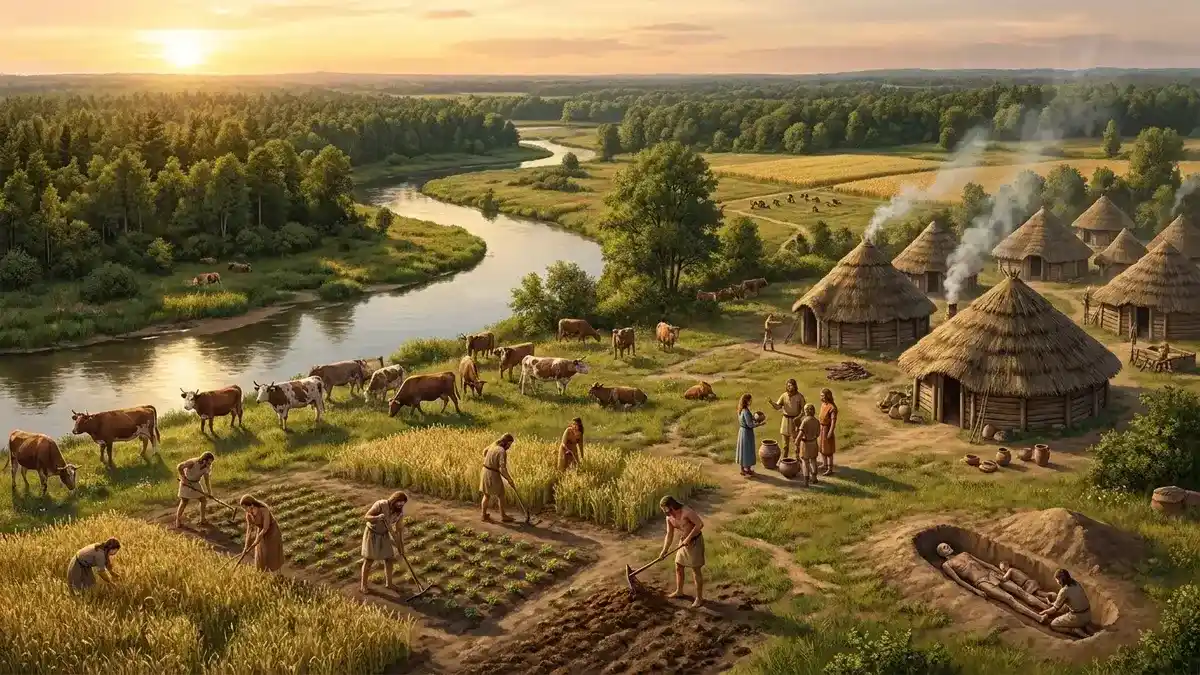
For three millennia, the ancient communities of Kuyavia, north-central Poland, navigated a world of shifting climates, incoming migrations, and evolving social structures. While the region’s archaeological record is often faint—thanks to wooden homes that rotted away and acidic soil that eroded organic remains—a new study has unlocked the secrets of these prehistoric people. By analyzing the bones of 84 individuals and examining ancient plant life, researchers have reconstructed a 3,000-year history of how these early farmers fed themselves and their cattle from 4100 to 1230 BCE.
3,000 Years of Survival Prehistoric Diet and Farming in Poland
Manure, Cattle, and the Neolithic Diet
During the Middle and Late Neolithic periods, the inhabitants of Kuyavia were dedicated farmers. However, our past assumptions about their reliance on meat were likely skewed. By analyzing nitrogen isotopes in charred cereals, scientists discovered that these farmers used intensive manuring to boost their crop yields. This practice significantly raised the nitrogen signatures in their food, which previously led archaeologists to overestimate how much animal protein these people consumed.
The study also revealed the strategic choices made by early herders. Cattle isotopes show that livestock were not just kept in open pastures; they were grazed in a diverse mix of woodland environments and wet river valleys. This suggests a highly adaptive herding strategy, where farmers utilized a wide variety of ecological niches to keep their herds healthy.

The Corded Ware Migration: A Shifting Landscape
Around 2800 BCE, the region experienced a major cultural shift with the arrival of the Corded Ware groups. Initially, these new arrivals kept to their own path, herding their livestock in forest edges and river valleys that had been ignored by the region’s previous agriculturalists.
However, the isotope data reveals a story of gradual integration. Over the course of several centuries, the dietary signatures of the Corded Ware descendants began to align more closely with their long-term agricultural neighbors. This shift serves as a biological record of social assimilation, proving that these once-distinct groups eventually shared farming land and herding practices.
The Millet Revolution and Social Boundaries
The arrival of broomcorn millet around 1200 BCE triggered one of the most visible changes in the archaeological record. Millet is a “C4” plant with a distinct carbon signature, making it easily detectable in ancient human bone chemistry.
The researchers found that the adoption of this crop was far from universal:
Dietary Inequality: Some Bronze Age communities became heavy millet consumers, while others barely touched the crop.
Funerary Divergence: This difference in diet correlated with burial customs. Some groups preferred traditional communal tombs, while others adopted the distinct practice of burying individuals in pairs, placed foot-to-foot in elongated pits.
Marking Boundaries: These dietary and ritual differences suggest that the adoption of millet wasn’t just about food—it was a way for different groups to define their social boundaries and cultural identity within the same landscape.

Subtle Clues to Social Hierarchy
Even in periods where burials seem egalitarian—lacking the “prestige” objects like gold or weapons often found in wealthier societies—the isotope data exposes hidden social inequalities.
Nitrogen variation among individuals during the Early Bronze Age points to significant differences in access to animal protein. These variations demonstrate that social status was not always signaled by grave goods; instead, it was often reflected in the kitchen. Some individuals enjoyed a protein-rich diet, while others did not, suggesting that social stratification was baked into the daily lives of these prehistoric people, even if it wasn’t shouted from their graves.
Continuity in a Changing World
Across the three millennia studied, the people of Kuyavia proved that they were not merely passive followers of European trends. While they maintained a continuity of mixed farming—relying on a blend of cereals and cattle—they adapted to their unique environment of river valleys and forests with remarkable ingenuity.
By looking past the decaying wooden structures and the lack of spectacular grave goods, isotope analysis has provided a detailed look at a resilient, adaptive society. These ancient communities were constantly negotiating their relationships with the land, their neighbors, and each other, leaving behind a diary of their lives etched into their very bones.
Frequently Asked Questions
Why is isotope analysis better than standard archaeology for this region?
In Kuyavia, wooden structures have decayed and soils are harsh, which means very few artifacts or organic remains survive. Bone chemistry (isotopes) acts as an “internal archive,” preserving the history of what an individual ate and where they lived, regardless of how many pots or tools were buried with them.
Did the arrival of new groups change the diet of locals?
Yes and no. While Corded Ware groups initially used different grazing lands, they eventually shared herding practices and dietary habits with earlier farmers. Later, the arrival of millet created new dietary “factions” that defined social boundaries.
What is the significance of manuring in this study?
Earlier studies mistakenly concluded that high nitrogen levels meant these people ate massive amounts of meat. The new analysis proves these levels were actually due to intensive manuring of fields, which absorbed the nitrogen into the plants.
What does “foot-to-foot” burial tell us?
This specific burial style, when found alongside a specific diet (millet consumption), suggests that the people of the Bronze Age were using these customs to distinguish themselves from other groups living nearby. It is a sign of community identity.
Were these communities equal?
Not entirely. While their graves might look simple, the chemical analysis of their bones shows that some people had much better access to high-quality protein than others, confirming that social hierarchies existed throughout their history.