
Table of Contents
- 1. Inside the Copper Cauldron: An Unprecedented Discovery
- 2. Tracing the Royal and Religious Legacy of King Knut Eriksson
- 2.1. The Coins of King Knut (“KANUTUS”)
- 2.2. Rare Ecclesiastical Imagery: The Bishop’s Coins
- 3. A Snapshot of History: Burying Wealth Before Stockholm Existed
- 3.1. Buried Amid Medieval Geopolitical Unrest
- 4. Preservation, Law, and the Future of the Silver Treasure
- 4.1. Sweden’s Cultural Environment Act
- 5. Conclusion
- 6. Frequently Asked Questions
- 6.1. How much does the medieval silver hoard weigh?
- 6.2. Who was King Knut Eriksson, and when did he rule?
- 6.3. What are “bishop’s coins” and why are they important?
- 6.4. Was Stockholm an established city when the treasure was buried?
- 6.5. Will the person who found the silver get to keep it?
Fishing Worm Hunt Leads to Discovery of Massive Medieval Silver Hoard
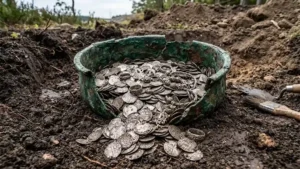
While searching for fishing worms near his summer house in the Stockholm archipelago, a local resident made the discovery of a lifetime. Buried just beneath the surface of the earth lay a massive early medieval treasure trove weighing roughly six kilograms (13 pounds). Comprising up to 20,000 pristine silver coins, along with elegant rings, elaborate pendants, and silver beads, this staggering collection represents one of the most substantial historical hoards ever brought to light in Scandinavia.
Recognizing the immense historic value of the find, the individual immediately contacted the Stockholm County Administrative Board. State archaeologists quickly mobilized to secure the area and initiate a meticulous, scientific excavation of the site. Experts have already characterized the treasure as an exceptionally rare, well-preserved window into northern Europe’s tumultuous medieval past.
Fishing Worm Hunt Leads to Discovery of Massive Medieval Silver Hoard

Inside the Copper Cauldron: An Unprecedented Discovery
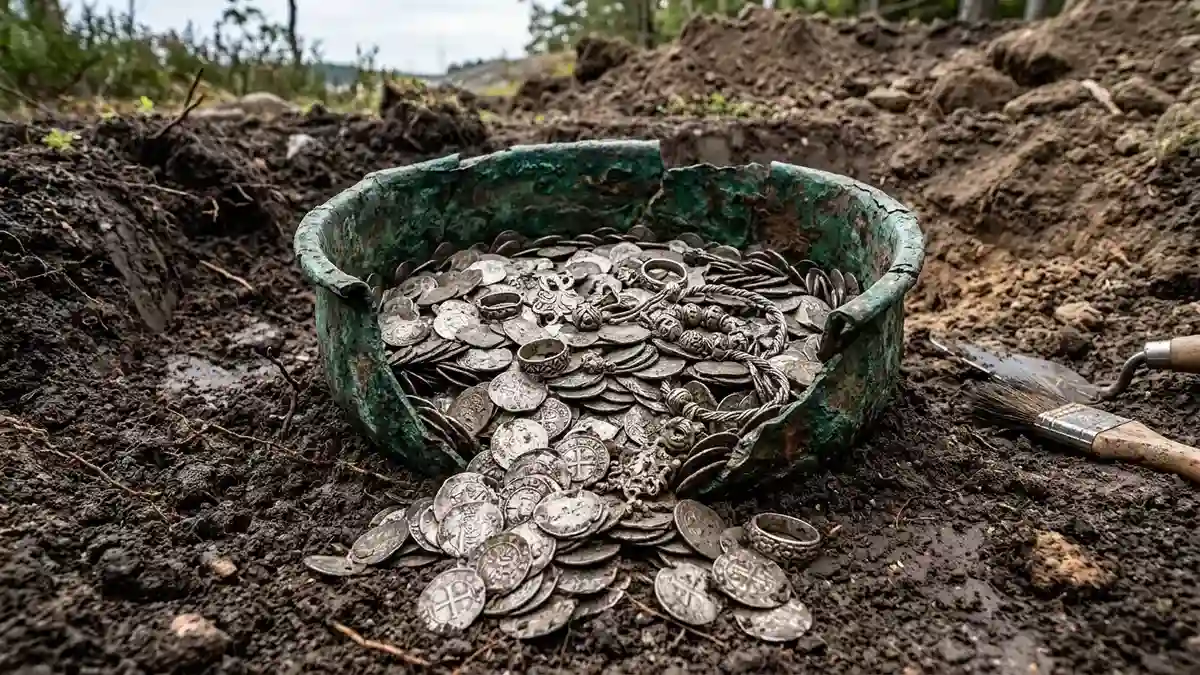
The initial assessment of the find reveals that the thousands of silver pieces were originally packed into a heavy copper cauldron before being committed to the earth. While the copper vessel itself has largely decomposed and corroded into the soil over the course of more than eight centuries, its metal walls successfully shielded the internal silver artifacts from severe damage.
According to Sofia Andersson, a senior antiquarian leading the investigation for the Stockholm County Administrative Board, the scale of this discovery is hard to overstate. While the team is still painstakingly separating and cleaning the individual pieces, the preliminary coin count is projected to reach an astonishing twenty thousand units. This vast quantity places the find among the absolute largest early medieval silver hoards in Swedish history.
The sheer volume of wealth concentrated in a single spot suggests that this was not a casual personal savings cache. Instead, it likely represented the communal treasury of a powerful regional leader, a wealthy merchant guild, or a major ecclesiastical estate.

Tracing the Royal and Religious Legacy of King Knut Eriksson
An initial analysis of the coin faces has provided historians with an incredibly precise chronological timeline for the treasure. A vast majority of the recovered currency dates directly back to the late 12th century, a transformative era in the consolidation of the early Swedish kingdom.
The Coins of King Knut (“KANUTUS”)
Several of the silver pieces feature the stamped Latin inscription “KANUTUS.” This marks them as official state currency minted during the prosperous yet volatile reign of King Knut Eriksson, who ruled Sweden from 1173 until his death in approximately 1195. Knut’s reign was characterized by extensive efforts to strengthen the domestic economy, formalize trade relations, and expand the influence of the Swedish crown. Seeing his direct royal mark on a cache of this magnitude offers tangible evidence of how widely his currency circulated.
Rare Ecclesiastical Imagery: The Bishop’s Coins
Beyond the standard royal mints, the collection features a significant number of highly coveted “bishop’s coins.” In medieval Sweden, certain powerful religious leaders were granted the special authority to strike their own independent regional currency.

These specialized specimens typically display an intricate engraving of a high-ranking bishop grasping a stylized crosier—the hooked pastoral staff that served as the primary symbol of his sacred and administrative office. The inclusion of these rare, religiously backed coins heavily implies that the hoard may have been tied directly to the church’s regional network of power, wealth, and taxation.
A Snapshot of History: Burying Wealth Before Stockholm Existed
One of the most fascinating geographic elements of the discovery is its proximity to modern Sweden’s capital. When this fortune was buried deep in the ground, the city of Stockholm did not even exist.
The official founding of Stockholm by Birger Jarl did not occur until 1252—well over half a century after these coins were minted—and the settlement did not grow into Sweden’s primary urban metropolis until the late 13th century. Instead, the area where the hoard was found would have been a rural, strategically positioned coastal landscape near vital waterways connecting the Baltic Sea to inland trade routes.
Buried Amid Medieval Geopolitical Unrest
Why was such an unimaginable fortune abandoned in a copper pot? Archaeologists point directly to the intense political and military instability plaguing Sweden during the closing decades of the 12th century. This specific window of time saw the Swedish kingdom launching aggressive crusades and military campaigns across the Baltic Sea to establish territorial dominance over Finland.
With domestic resources stretched thin and regional coastal raids a constant threat, the owner of this silver likely buried it as a desperate emergency measure to protect it from invading forces or rival political factions. For reasons that will remain forever shrouded in mystery, the individual who hid the treasure never returned to claim it.
Preservation, Law, and the Future of the Silver Treasure
To protect the integrity of the ongoing archaeological investigation and prevent illegal looting or trespassing, the Stockholm County Administrative Board is strictly withholding the exact geographic coordinates of the summer house find until the field study is completely finalized.
The entire collection is currently undergoing rigorous documentation, stabilization, and metal analysis in specialized preservation laboratories. The administrative board will formally submit its detailed findings to the Swedish National Heritage Board.
Sweden’s Cultural Environment Act
The honest actions of the worm-hunting citizen have received widespread praise from cultural officials. Under the strict terms of Sweden’s Cultural Environment Act (Kulturmiljölagen), any individual who discovers an ancient artifact fashioned from precious metals like silver or gold is legally obligated to immediately report it and offer the Swedish state the initial opportunity to acquire the objects.
The law ensures that irreplaceable historical treasures remain in the public domain for research and museum display rather than being sold off into private collections. In return for his compliance and transparency, the government will officially appraise the total material value of the six-kilogram silver cache and provide the finder with a substantial, legally mandated financial compensation package.
Conclusion
The accidental discovery near Stockholm serves as a potent reminder that history is often waiting just beneath our feet. By transforming a mundane bait-hunting trip into a major historical breakthrough, this massive silver hoard has opened a new chapter in Scandinavian medieval research. As scientists continue to clean the individual coins and decode the intricate jewelry patterns, this ancient treasure will illuminate the economic networks, religious dynamics, and political struggles that helped shape the modern kingdom of Sweden.
Frequently Asked Questions
How much does the medieval silver hoard weigh?
The entire hoard weighs approximately six kilograms, which is equivalent to about 13 pounds of pure historical silver.
Who was King Knut Eriksson, and when did he rule?
King Knut Eriksson was a powerful medieval ruler who governed Sweden from 1173 until roughly 1195. Coins bearing his Latinized name, “KANUTUS,” make up a significant portion of the discovered treasure.
What are “bishop’s coins” and why are they important?
Bishop’s coins were specialized medieval currencies struck under the direct authority of religious leaders rather than the king. They are easily recognizable because they feature an image of a bishop holding a ceremonial crosier (pastoral staff). Their presence proves a strong link between the hoard and the medieval Church’s wealth.
Was Stockholm an established city when the treasure was buried?
No, Stockholm did not exist when this silver was hidden. The treasure was buried in the late 12th century, whereas Stockholm was not officially founded until several decades later, in the year 1252.
Will the person who found the silver get to keep it?
Under Sweden’s Cultural Environment Act, ancient precious metal discoveries must be handed over to the state to protect national heritage. However, the Swedish National Heritage Board will legally compensate the finder for the full, officially appraised value of the treasure.