
Table of Contents
- 1. The Rare Mystery of Sweden’s Standing Swords
- 2. The Monumental Pyres of Rallsta: A Final Pagan Sunset
- 3. Reclaiming Lineage at Munktorp Parish
- 4. The Equestrian Elite and the Horse Sacrifices of Sylta
- 5. Behind the Shields: The Rhythms of Domestic Farm Life
- 6. Mapping a Culture in Motion
- 7. Frequently Asked Questions
- 7.1. What major historical project was carried out along the E18 motorway?
- 7.2. Why is finding swords standing upright in graves significant?
- 7.3. What did the excavations at Rallsta reveal about ancient funerals?
- 7.4. Why did the Vikings build graves inside older Vendel Period mounds?
- 7.5. What is unique about the horse burials found at the Sylta cemetery?
9 Viking Discoveries Reveal Secrets of Ancient Sweden
A series of major highway developments in central Sweden has unexpectedly opened an extraordinary window into the twilight of the Viking Age. While conducting extensive excavations ahead of a massive expansion of the E18 motorway between Köping and Västerås, a team of specialized researchers uncovered a sprawling network of ancient human activity.
Managed by Arkeologerna—the expert archaeological unit attached to the Swedish History Museums—the multi-year fieldwork campaign targeted nine distinct historical sites across the province of Västmanland. The resulting discoveries span more than a millennium of human history, documenting a critical cultural crossroads. The artifacts and burial practices show a highly sophisticated Scandinavian society navigating an intense transition away from ancient pagan traditions and toward the arrival of early medieval Christianity.

9 Viking Discoveries Reveal Secrets of Ancient Sweden
The Rare Mystery of Sweden’s Standing Swords
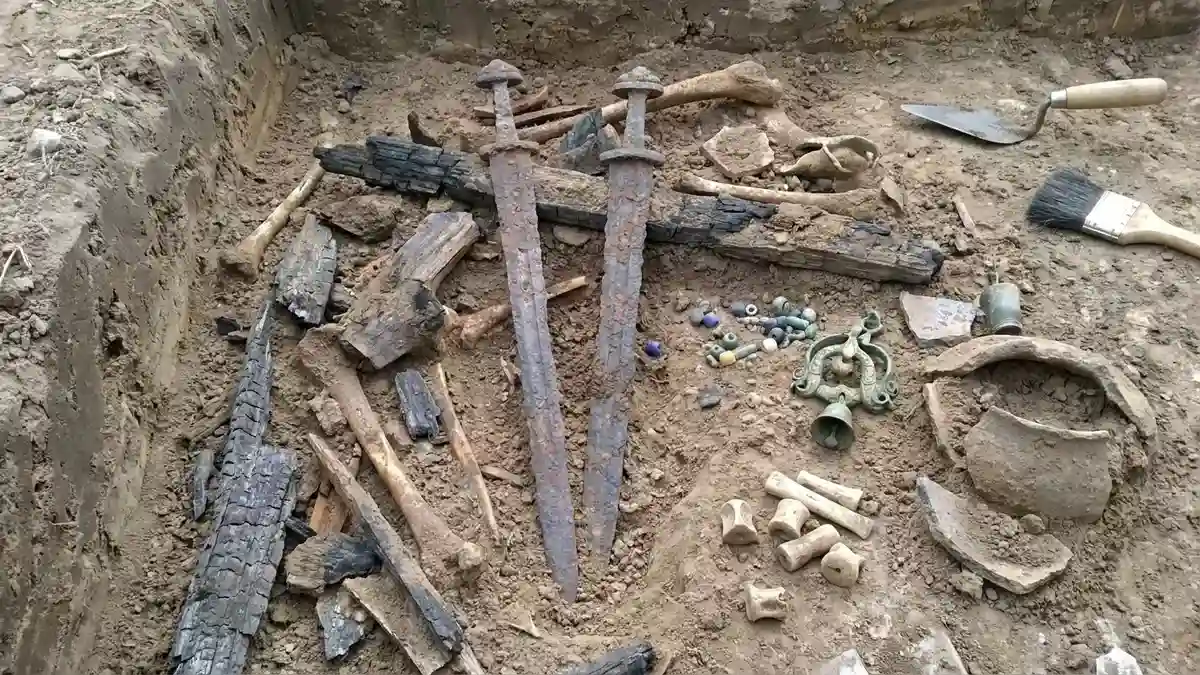
Among the most visually striking and structurally unusual finds of the entire campaign were two beautifully preserved iron swords uncovered within elite warrior graves. Rather than being laid flat alongside the deceased in accordance with standard Norse custom, these weapons were intentionally driven vertically into the earth, standing completely upright within the burial chambers.
This particular configuration is exceptionally rare within the broader archaeological record of Scandinavia. Historians believe that plunging a sword vertically into a grave served a dual symbolic purpose:
The Pillar of Power: It acted as a highly visible, permanent marker of the deceased individual’s supreme social status, authority, and military rank.
Spiritual Safeguards: It functioned as a protective metaphysical barrier, anchoring the spirit of the deceased warrior safely within the afterlife while shielding the living community from malevolent spiritual forces.
The recovery of these weapons provides a direct, tangible connection to the elite military class that steered the political fortunes of Västmanland. Alongside the swords, researchers pulled a wealth of high-status personal possessions from the soil, including colorful glass beads, intricate fragments of gold sheet metal, and highly stylized equestrian gear.
The Monumental Pyres of Rallsta: A Final Pagan Sunset
Further east along the motorway route near the town of Hallstahammar, archaeologists targeted a prominent, isolated hill known as Rallsta. The team discovered that during the Late Viking Age, this natural landform had been systematically reshaped and elevated through intensive manual labor to serve as a massive, public cremation theater.
Excavations on the hilltop exposed the foundational charcoal footprints of two immense funeral pyre installations. Because of the hill’s open geography, the roaring fires of these elite cremations would have been visible across vast distances, drawing thousands of spectators from surrounding regional networks to participate in grand public send-offs for fallen chieftains and celebrated military commanders.
                  [THE SCANDINAVIAN RELIGIOUS TRANSITION]
                                     │
            ┌────────────────────────┴────────────────────────┐
            ▼                                                 ▼
   OLD NORSE PAGANISM                               EARLY MEDIEVAL CHRISTIANITY
 • Monumental hilltop cremations                  • Flat, underground inhumation
 • Weaponry & livestock sacrifices               • Absence of material grave goods
 • Public displays of ancestral ties             • Centralized churchyard burials
The Rallsta hilltop represents one of the latest known examples of large-scale, open-air cremation practices ever documented on Swedish soil. The site operated at a time when the traditional Norse pantheon was actively clashing with Christian missionaries pushing northward from continental Europe. While southern regions were slowly adopting underground Christian burials, the communities of Västmanland doubled down on their ancestral fire rituals, using monumental public displays to honor their heritage during a period of deep cultural anxiety.
Reclaiming Lineage at Munktorp Parish
In the historic parish of Munktorp, at the adjoining sites of Viby and Norrtuna, excavations revealed a sophisticated strategy of political and ancestral validation. Here, late Viking Age communities deliberately constructed their new graves directly into the sloping sides of much older, pre-existing burial mounds dating back to the Vendel Period (circa 550–750 CE).
This systematic reuse of ancient sacred spaces was a highly calculated move designed to project political legitimacy. By physically embedding their dead into the earthworks of long-forgotten rulers, local dynasties could claim a direct, unbroken lineage to the legendary figures of the past, thereby securing their legal rights to local lands, water routes, and agricultural taxes.
+-------------------------------------------------------------+
|               THE VIBY-NORRTUNA DOUBLE BURIAL               |
|                                                             |
|   • Structural Context: Built directly into an older mound  |
|   • Occupants:          One adult male and one adult female |
|   • Key Weaponry:       Iron swords and elite dynamic armor |
|   • Pastime Relics:     Whalebone & fired clay gaming pieces |
+-------------------------------------------------------------+
One of the most intriguing graves within this sector contained a man and a woman interred side by side within a single chamber. While their exact biological or social relationship remains a matter of ongoing research, the inclusion of premium weaponry confirms their shared connection to an elite household.
Buried alongside this prominent couple was a complete collection of gaming pieces meticulously fashioned from polished whalebone and fired clay. These gaming relics emphasize that intellectual board games, such as Hnefatafl, were a staple of courtly life, symbolizing tactical brilliance and mental sharpness among the Norse aristocracy.
The Equestrian Elite and the Horse Sacrifices of Sylta
At the western boundary of the E18 project, near the town of Köping, sits the ancient cemetery of Sylta. This site represents one of the longest-lived cremation and stone-setting burial grounds in central Sweden, remaining in continuous, active use from the dawn of the 9th century all the way until approximately 1200 CE.
The most dramatic phase of the Sylta cemetery dates to the 11th century, a window that yielded nearly 30 individual graves containing the charred remains of domestic horses cremated directly alongside their human owners. The sheer volume of horse sacrifices at a single location underscores the profound spiritual and social value attached to equestrian culture in late Viking society.
| Excavation Site | Primary Feature Type | Chronological Range | Key Artifact Recovery |
| Rallsta | Reshaped Cremation Hill | Late Viking Age | Monumental pyre foundations, status charcoal |
| Viby / Norrtuna | Reused Vendel Mounds | 6th to 11th Century CE | Upright iron swords, whalebone gaming pieces |
| Sylta | Stone-Setting Cemetery | 9th to 1200 CE | 30 cremated horses, ornate harness bells |
| Häljesta | Domestic Farmstead | Multi-Period Settlement | Bread-baking ovens, slag pits, rock carvings |
The horses of Sylta were not common work animals; they were highly trained, premium mounts equipped with lavishly decorated bronze harness fittings, intricate metallic pendants, and stylized jingling bells. When these horses moved, the acoustic chime of their gear signaled the approach of an elite household. Including these prized animals in the funeral pyre guaranteed that the deceased—whether a high-status man or a prominent woman—would ride into the spiritual realm with the full prestige of their earthly rank intact.
Behind the Shields: The Rhythms of Domestic Farm Life
While the monumental graves, upright swords, and slaughtered stallions capture the grand public mythology of the Viking Age, the E18 project was equally successful in exposing the quiet, daily domestic realities of the people who worked the land. Interspersed between the cemeteries, archaeologists exposed the posthole footprints of sprawling, multi-generation agrarian farmsteads.
Excavations at these domestic sites produced concrete evidence of standard daily survival and localized manufacturing. Soil samples pulled from ancient hearths yielded charred grains and heavy stone ovens used for the routine baking of flatbreads. Nearby, clusters of discarded iron slag, furnace lining fragments, and specialized anvils proved that these rural households were fully self-sufficient, smelting raw bog iron to manufacture their own nails, rivets, plowshares, and household tools.
                  [THE RURAL AGRAIAN ECOSYSTEM]
                                │
         ┌──────────────────────┼──────────────────────┐
         ▼                      ▼                      ▼
  DOMESTIC HEARTHS       IRON SMELTING PITS     ROCK CARVING PATHS
Baking of daily bread   Forging farm utilities   Connecting to past lore
Near the village of Häljesta, researchers uncovered a preserved Viking farmstead sitting directly adjacent to Västmanland’s largest known prehistoric rock carving site. This physical proximity demonstrates that medieval settlers were living alongside much older Bronze Age petroglyphs, actively incorporating these sacred ancient landscapes into their daily farming routines and seasonal boundary markings.
Mapping a Culture in Motion
To share these monumental insights with the global community, the comprehensive data collected during the two-year excavation has been officially compiled into a major newly published volume titled People, Meetings and Memories – Archaeology along the E18 in Västmanland. Fully funded by the Swedish Transport Administration (Trafikverket), the publication maps the complete structural transformation of Västmanland’s historic population.
Ultimately, the E18 highway project has proven that the Viking Age was not a static era defined exclusively by sudden maritime raids and frozen traditions. Instead, the ground of Västmanland has revealed a dynamic, highly artistic society in deep transition—a culture that fiercely honored its ancestral lineages, successfully navigated the complex spiritual shifts of a new faith, and left an indelible material mark that continues to define the modern Swedish landscape today.
Frequently Asked Questions
What major historical project was carried out along the E18 motorway?
Between 2021 and 2022, archaeologists from Arkeologerna executed extensive excavations along the E18 motorway in Västmanland, Sweden. Ahead of a road expansion between Köping and Västerås, they discovered nine historic sites containing ancient settlements, elite burials, and massive cremation grounds.
Why is finding swords standing upright in graves significant?
Uncovering iron swords driven vertically into the ground of a burial chamber is an incredibly rare archaeological phenomenon in Scandinavia. This practice is believed to have served as a bold public statement of the deceased’s elite military power and a spiritual safeguard to protect the grave.
What did the excavations at Rallsta reveal about ancient funerals?
At Rallsta, researchers discovered a natural hill that was manually reshaped to host monumental public cremations during the Late Viking Age. The massive pyres were designed to be visible across vast distances, serving as high-profile funeral gatherings for chieftains during the dawn of Christianization.
Why did the Vikings build graves inside older Vendel Period mounds?
At sites like Viby and Norrtuna, late Viking Age communities built graves directly into ancestral mounds from the earlier Vendel Period. This intentional architectural choice allowed rising local dynasties to visually and physically link themselves to ancient rulers to legitimize their claim to local lands.
What is unique about the horse burials found at the Sylta cemetery?
The cemetery at Sylta was used from the 9th century up until roughly 1200 CE. Investigators discovered nearly 30 graves from the 11th century where elite horses were cremated alongside their owners, complete with ornate bronze harness fittings, pendants, and musical bells that showcased their high status.