
Table of Contents
- 1. Anatomy of an Ice Age Travel Kit
- 1.1. Multi-Functional Survival Tools
- 2. Snapshot of a Short-Term Ice Age Campsite
- 2.1. Evidence of an Active Processing Station
- 3. extreme Resourcefulness and Ancient Trade Networks
- 3.1. Mapping the Ancient Supply Chain
- 3.2. The Art of Paleolithic Recycling
- 4. Balancing Art and Utility in the Gravettian Culture
- 5. Conclusion: The Ultimate Test of Human Endurance
- 6. Frequently Asked Questions
- 6.1. How old is the personal toolkit discovered at Milovice IV?
- 6.2. What specific tools were found inside the collection?
- 6.3. What was the Gravettian culture?
- 6.4. How do archaeologists know the stones came from far away?
- 6.5. Why did the hunter keep broken tool fragments?
30,000-Year-Old Personal Toolkit Reveals Lives of Stone Age Hunters
An extraordinary archaeological excavation in the Czech Republic has uncovered a flawlessly preserved set of prehistoric hunting gear. This 30,000-year-old discovery offers an unprecedented, intimate glimpse into the survival strategies of Ice Age humans.
Unearthed at the renowned Paleolithic site of Milovice IV, this rare find consists of a highly specialized selection of stone implements. Researchers believe this assembly represents the personal, portable toolkit of a single prehistoric hunter-gatherer belonging to the ancient Gravettian culture. Unlike typical archaeological discoveries that contain mixed debris from generations of human camp life, this specific hoard acts as a pristine time capsule. It captures a lone hunter’s movements, resourcefulness, and daily struggles during a brutally harsh period in European prehistory.
30,000-Year-Old Personal Toolkit Reveals Lives of Stone Age Hunters

Anatomy of an Ice Age Travel Kit
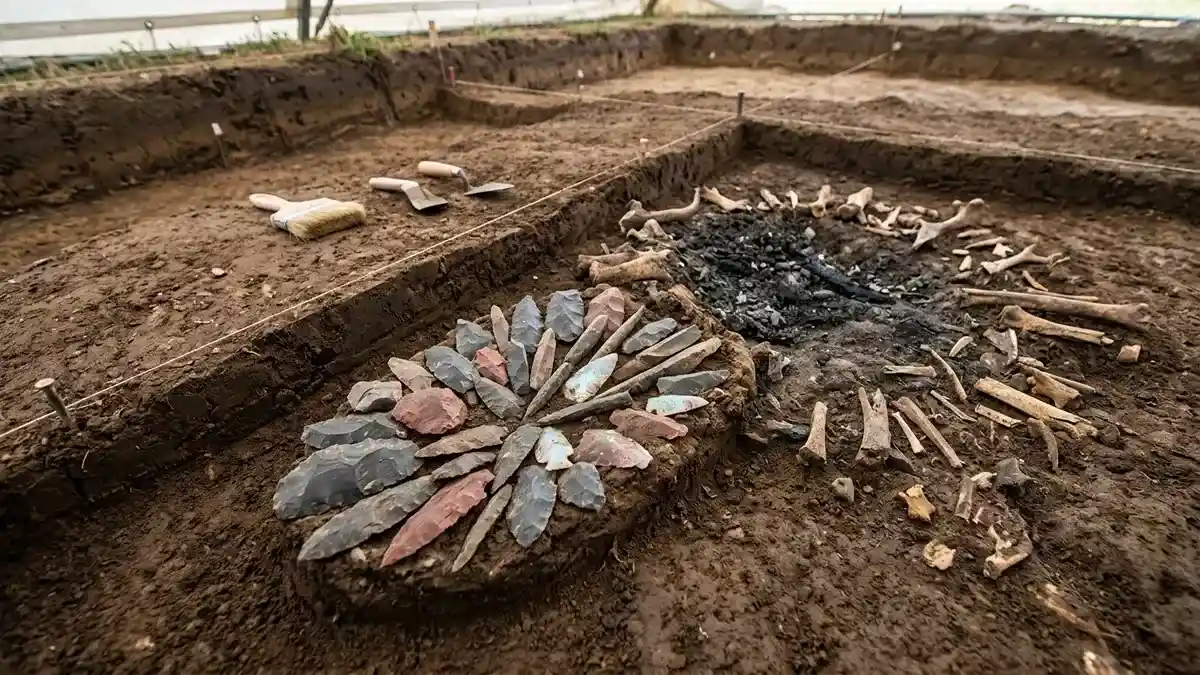
The centerpiece of the discovery is a tightly clustered group of 29 stone blades and micro-blades (bladelets). Because of the compact, overlapping way these artifacts were found nested together in the soil, scientists concluded they did not accumulate naturally over time. Instead, they were intentionally gathered and stored inside a specialized pouch or container made from organic, perishable materials—such as animal hide, woven bark, or sinew—that rotted away millennia ago.
Multi-Functional Survival Tools
Advanced microscopic analysis and use-wear studies have allowed researchers to reconstruct exactly how this Stone Age hunter utilized their gear. Far from being random pieces of sharp stone, each blade was selected or modified for specific, specialized survival tasks:
Projectile Points: Several blades exhibit distinct impact fractures at their tips, a clear signature showing they were launched as the business ends of hunting spears or darts.
Processing Equipment: Other stone edges display microscopic wear patterns consistent with butchering animal meat, scraping thick hides for clothing, and slicing organic matter.
Heavy Crafting: A few rugged pieces functioned as drills and awls, used to pierce hard materials like wood, bone, or antler.

The scientific analysis also revealed unmistakable evidence of hafting. Microscopic residue and structural alterations show that many of these stone tips were actively mounted onto wooden shafts using primitive adhesives and bindings. This design dramatically increased the hunter’s mechanical leverage and lethal reach.
Snapshot of a Short-Term Ice Age Campsite
What makes the Milovice IV discovery truly exceptional is the flawless clarity of its archaeological context. Most Paleolithic excavation sites are highly complex and chaotic, containing overlapping layers of trash, tools, and dirt left behind by various groups moving across the landscape over thousands of years.
In contrast, this personal toolkit was discovered within a remarkably narrow, undisturbed soil layer securely dated to between 30,250 and 29,550 years ago.
Evidence of an Active Processing Station
The toolkit was uncovered in direct association with a preserved prehistoric hearth (fireplace). Radiating outward from this ancient charcoal center were scattered fragments of animal bones, primarily belonging to wild horses and reindeer—the primary megafauna targets for Gravettian hunting parties.
The spatial layout of the camp tells a clear story: this was not a permanent village or a long-term winter basecamp. Instead, it was a temporary, tactical campsite established by a mobile hunter. The site was used to build a fire, repair damaged weapons, butcher freshly killed game, process hides for warmth, and rest briefly before pushing onward through an unforgiving terrain.
extreme Resourcefulness and Ancient Trade Networks
Beyond providing a look at daily survival, the chemical and physical composition of the stones reveals a surprising amount of detail regarding the hunter’s mobility, geographic range, and broader social connections across Ice Age Europe.
Mapping the Ancient Supply Chain
Geological testing of the 29 stone artifacts revealed that the hunter did not source their raw materials locally. In fact, the stones trace back to an astonishingly diverse array of distant geographic origins:
| Material Type | Distance to Source | Geographic Origin |
| High-Quality Flint | ~130 kilometers (~80 miles) | Northern deposits |
| Radiolarite | Varies | Western Slovakia |
| Precious Opal | ~135 kilometers (~84 miles) | Regional volcanic deposits |
This massive geographic footprint proves that Gravettian hunter-gatherers were incredibly mobile. To acquire these premium materials, this lone hunter either embarked on epic, long-distance seasonal treks across hundreds of miles of frosty terrain or participated in a highly sophisticated, interconnected trade network with neighboring nomadic bands.
The Art of Paleolithic Recycling
The toolkit also contained a fascinating sub-collection of recycled stone flakes, spalls, and broken tool fragments. The hunter had carefully saved these shattered remnants to reshape them into smaller, makeshift cutting edges.
This extreme level of conservation highlights a brilliant, deeply practical approach to resource management. When moving out of familiar territories and pushing into unfamiliar, potentially hostile landscapes where high-quality stone outcrops were scarce or hidden beneath sheets of snow, every scrap of tool-grade stone was precious. The hunter could not afford to waste a single millimeter of workable material.
Balancing Art and Utility in the Gravettian Culture
The Gravettian culture, which flourished across Europe during the Upper Paleolithic period, is widely celebrated in modern art history textbooks for its rich symbolic and spiritual expressions. The regions surrounding Milovice are famous for yielding breathtaking examples of prehistoric art, most notably the iconic “Venus figurines”—small, stylized sculptures of the female form carved from ivory or baked clay that hint at complex fertility rituals and spiritual worldviews.
However, while the Venus figurines highlight the artistic and ritualistic side of prehistoric human minds, this newly recovered toolkit grounds us firmly in the raw, gritty realities of everyday physical survival. It serves as a reminder that behind the beautiful cave art and symbolic carvings was an incredibly disciplined, highly technical lifestyle driven by the absolute necessity of securing food, maintaining shelter, and outsmarting the elements in an environmentally stressful era.
Conclusion: The Ultimate Test of Human Endurance
The historic discovery at Milovice IV, recently detailed in the Journal of Paleolithic Archaeology, fundamentally enriches our collective understanding of Upper Paleolithic societies. It reframes our view of ancient humans, moving away from the image of primitive cavemen wandering aimlessly and replacing it with a portrait of highly skilled, technologically sophisticated, and deeply resourceful survival specialists.
By carefully curating a lightweight, multi-functional, and highly mobile set of gear, this ancient hunter managed to successfully navigate and dominate the changing landscapes of Central Europe. Over 30,000 years later, their lost pouch of stones stands as a timeless testament to the enduring ingenuity, adaptability, and resilience of the human spirit.
Frequently Asked Questions
How old is the personal toolkit discovered at Milovice IV?
The toolkit is approximately 30,000 years old. It was recovered from a distinct, narrow archaeological layer that has been securely radiocarbon dated to between 30,250 and 29,550 years ago, placing it squarely within the Upper Paleolithic period.
What specific tools were found inside the collection?
The collection consists of 29 highly specialized stone blades and bladelets. Microscopic analysis shows that these stone tools were used as projectile tips for hunting spears, sharp edges for butchering meat and processing animal hides, and tough drills or awls for piercing materials like wood or bone.
What was the Gravettian culture?
The Gravettian culture was a prominent phase of the European Upper Paleolithic era, flourishing roughly between 33,000 and 21,000 years ago. They are well-known for their advanced blade-tool technology, nomadic hunting strategies targeting large game like horses and mammoths, and their iconic, carved “Venus” fertility figurines.
How do archaeologists know the stones came from far away?
Geologists used mineralogical tracing to match the stone tools to known raw material deposits across Europe. The analysis revealed that the high-quality flint came from deposits over 130 kilometers to the north, the radiolarites originated in what is now western Slovakia, and a rare piece of opal was carried from a source 135 kilometers away.
Why did the hunter keep broken tool fragments?
The presence of recycled spalls and broken fragments indicates that the hunter practiced strict resource conservation. In stressful environments or unfamiliar territories where finding high-quality tool stone was difficult, the hunter would carefully save and re-chip broken pieces to maximize their utility and extend the life of their mobile gear kit.