
Table of Contents
- 1. Luxury Living in the Medieval Outer Bailey
- 2. Redrawing the Castle’s Complex Defensive Lines
- 3. Toys and Luxury Trash: Tracing Upper-Class Daily Life
- 4. Frequently Asked Questions
- 4.1. Who originally founded Schloss Neuenburg, and how old is it?
- 4.2. What makes the newly discovered residential building unique?
- 4.3. What does the “Dicker Wilhelm” refer to?
- 4.4. What kind of artifacts were found that show an elite lifestyle?
- 4.5. How did the medieval ruins survive later centuries of farming?
High-Status Medieval Residential Complex Discovered at Schloss Neuenburg
Significant archaeological excavations at Schloss Neuenburg, located near the town of Freyburg in Saxony-Anhalt, Germany, have exposed a dense, well-preserved layer of high-status medieval buildings. Spearheaded by the State Office for Heritage Management and Archaeology (LDA) alongside the Kulturstiftung Sachsen-Anhalt, the excavations are taking place ahead of a major restoration and structural development project at one of Germany’s most culturally important fortification monuments.
Schloss Neuenburg was originally founded around 1090 by the influential Count Ludwig der Springer. Over the subsequent centuries, it grew into an expansive, architecturally complex fortress. While previous archaeological campaigns on the castle grounds successfully mapped out rare, octagonal defensive towers and sweeping curtain walls, the latest digs are targeting the area directly beneath the shadow of the site’s massive iconic keep, known colloquially as the “Dicker Wilhelm” (Fat William).
High-Status Medieval Residential Complex Discovered at Schloss Neuenburg
Luxury Living in the Medieval Outer Bailey
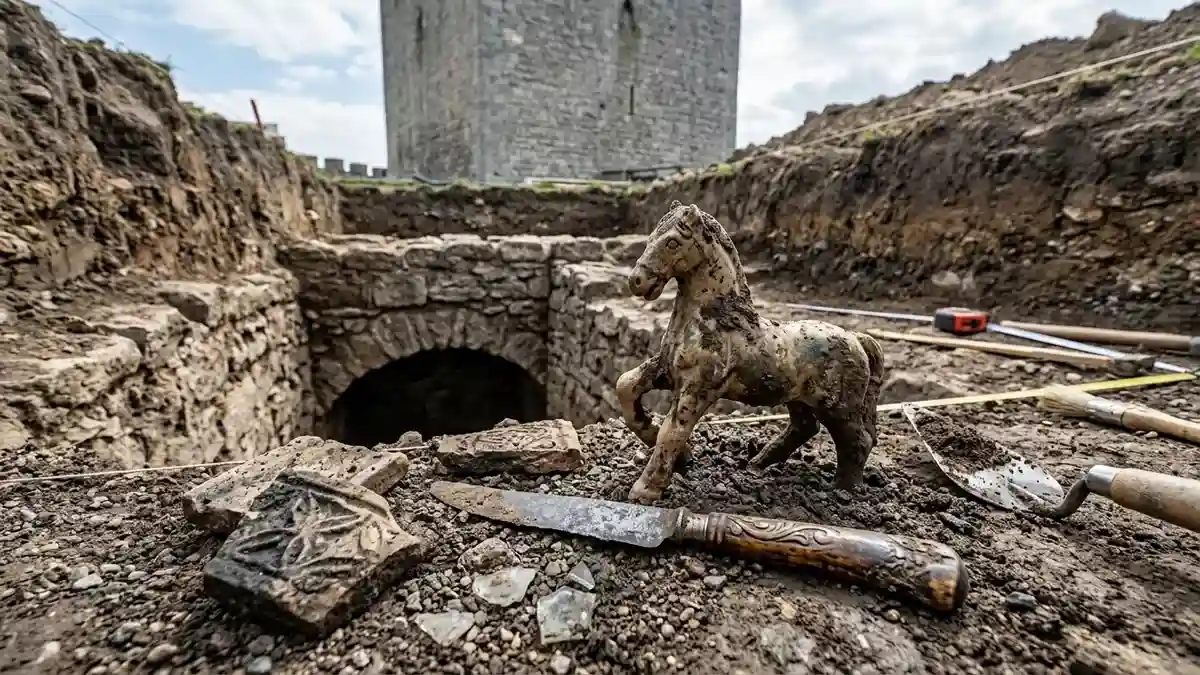
The excavation has dramatically redefined what historians knew about the lifestyle inside the castle’s outer bailey. Rather than encountering simple barracks or utilitarian storehouses, archaeologists have exposed the structural footprint of an elite, luxury residential complex:

Advanced Engineering: The remains feature a large, sturdy residential hall constructed over an intact vaulted cellar.
Prehistoric Heating Systems: The dwelling was equipped with a sophisticated indoor heating system. Researchers recovered beautifully crafted clay fragments belonging to an original tiled stove.
This domestic setup indicates an exceptional level of luxury and structural comfort. It directly mirrors the palace building (palas) found in the inner ward of the castle, which famously utilized an advanced underground hot-air heating network as early as 1180. Because this newly discovered residential complex sits directly over even older, unexcavated occupation layers, archaeologists believe the building could date back as far as the late 11th or early 12th century, potentially linking it directly to the castle’s earliest founding generation.

Redrawing the Castle’s Complex Defensive Lines
Beyond upscale housing, the ongoing fieldwork has forced military historians to completely rethink Schloss Neuenburg’s protective layout.
The geological data indicates that a massive outer defensive ditch extended significantly farther north than older blueprints suggested. This heavily engineered ditch cut directly through the natural rock spur, effectively slicing the mountain ridge to form an isolated, heavily fortified island of stone surrounding the “Dicker Wilhelm” tower.
Combined with the ruined foundations of a separate rectangular tower unearthed in earlier digs, these features highlight an aggressive, multi-layered defensive strategy designed to trap intruders within specialized kill zones before they could breach the primary inner gates.

[Outer Defensive Ditch] ──> Cuts the Rock Spur ──> Isolates "Dicker Wilhelm" Keep ──> Creates Standalone Fortified Island
Toys and Luxury Trash: Tracing Upper-Class Daily Life
During the 17th through the 20th centuries, Schloss Neuenburg was repurposed into a busy agricultural estate. The construction of massive farm buildings, such as the “long barn,” buried the medieval fortress under thick leveling layers of soil and gravel. Paradoxically, this agricultural capping served to protect the delicate medieval trash layers underneath from modern destruction.
Alongside the architectural foundations, archaeologists cleared a rich assortment of high-status medieval household debris. The standout artifact from the layer is a beautifully molded, dynamic 14th-century ceramic toy horse, a classic luxury find indicative of a wealthy noble household with children. The team also cataloged fine imported glass fragments and a polished dining utensil outfitted with a hand-carved bone handle. Together, these intimate items underscore a refined domestic culture and affluent daily lifestyle far removed from the gritty, utilitarian existence often associated with the outer walls of medieval castles.
Active archaeological work on the outer bailey is scheduled to continue through the remainder of 2026, promising to bring even more of Schloss Neuenburg’s earliest structural history to light.
Frequently Asked Questions
Who originally founded Schloss Neuenburg, and how old is it?
Schloss Neuenburg was founded around 1090 by Count Ludwig der Springer. The castle is nearly 940 years old and ranks among the most historically and architecturally significant cultural monuments in the state of Saxony-Anhalt, Germany.
What makes the newly discovered residential building unique?
The residential building is unique because it features a high level of comfort that was incredibly rare for its time, including a vaulted storage cellar and an integrated tiled stove heating system. This level of comfort was typically reserved exclusively for the high-ranking nobility residing in the central palace building.
What does the “Dicker Wilhelm” refer to?
“Dicker Wilhelm” (Fat William) is the traditional local nickname given to the massive, thick-walled stone keep or tower that dominates the defensive layout of Schloss Neuenburg’s outer bailey.
What kind of artifacts were found that show an elite lifestyle?
Archaeologists recovered several luxury items from the medieval layers, including a beautifully crafted 14th-century ceramic toy horse, fragments of fine glassware, and a polished domestic utensil featuring a hand-carved bone handle.
How did the medieval ruins survive later centuries of farming?
When the site transitioned into a large agricultural estate between the 17th and 20th centuries, workers dumped thick leveling layers of earth to flatten the terrain and build barns. This dirt unintentionally acted as a protective blanket, sealing the older medieval stone foundations and artifacts safely underground.