
Table of Contents
- 1. Unearthing KNM-ER 101000: A Historic Discovery
- 2. The Hand of Paranthropus: Power Meets Dexterity
- 2.1. Gorilla-Like Strength
- 2.2. Re-evaluating Tool Use
- 3. Walking the Earth: A Committed Upright Biped
- 4. Conclusion: Blurring the Lines of Humanity
- 5. Frequently Asked Questions
- 5.1. Why was Paranthropus boisei historically nicknamed “Nutcracker Man”?
- 5.2. Does this discovery prove that Paranthropus boisei made stone tools?
- 5.3. How old is the KNM-ER 101000 skeleton, and where was it found?
- 5.4. How did the walking stride of Paranthropus differ from modern humans?
- 5.5. Why is finding hand and foot bones with a skull so important to paleontology?
Prehistoric Skeleton Overturns Long-Held Theories of Human Evolution
For more than half a century, the story of human evolution was governed by a clean, comfortable division. On one side stood the genus Homo—our direct ancestors—celebrated as the intelligent, agile inventors of stone tools who walked gracefully across the African savannah. On the other side stood Paranthropus boisei, an extinct hominin branch nicknamed “Nutcracker Man.” With massive jawbones, giant molars, and a heavy bone crest on top of its skull, P. boisei was long dismissed as an evolutionary dead-end: a lumbering, gorilla-faced vegetarian that relied entirely on brute facial strength rather than intelligence or tool use to survive.
However, a revolutionary fossil discovery has completely shattered this old paradigm. The analysis of a beautifully preserved, 1.5-million-year-old partial skeleton has revealed that Paranthropus boisei possessed a remarkably human-like hand grip and walked upright on two legs with a distinctly modern gait. This finding blurs the lines of what makes the human lineage unique, proving that our “robust” cousins were far more dexterous, adaptable, and technologically capable than anyone ever imagined.
Prehistoric Skeleton Overturns Long-Held Theories of Human Evolution
Unearthing KNM-ER 101000: A Historic Discovery
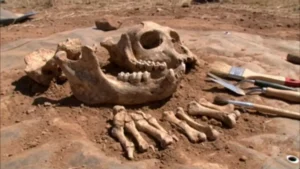
The breakthrough stems from an extraordinary cache of fossils discovered between 2019 and 2021 near the desert shores of Lake Turkana in northern Kenya. Designated by researchers as KNM-ER 101000, this partial skeleton represents the most complete single individual of Paranthropus boisei ever recovered from the earth.

+------------------------+----------------------------------------------------+
| Fossil Attribute       | KNM-ER 101000 Specimen Details                      |
+------------------------+----------------------------------------------------+
| Geological Age         | Approximately 1.5 million years old (Pleistocene)  |
| Geographic Origin      | Lake Turkana Basin, Kenya, East Africa             |
| Identifying Features   | Enormous molars, thick enamel, prominent skull crest|
| Revolutionary Elements | First definitive hand, wrist, and foot bone match   |
+------------------------+----------------------------------------------------+
While previous P. boisei discoveries consisted almost exclusively of isolated teeth and heavy jaw fragments, KNM-ER 101000 includes an unprecedented mix of skull fragments, teeth, hand bones, wrist joints, and foot elements. For the first time in paleoanthropology, scientists could definitively look past the creature’s massive chewing apparatus to examine the anatomy of its limbs, allowing them to map out exactly how it moved and interacted with the prehistoric landscape.
The Hand of Paranthropus: Power Meets Dexterity
When researchers examined the fossilized hand and wrist bones of the skeleton, they found a shocking combination of evolutionary traits. Rather than the long, highly curved fingers typical of tree-dwelling apes, Paranthropus boisei possessed a thumb and finger arrangement that looked strikingly human.
                    THE PARANTHROPUS GRIP PROFILE

  [ Elongated Thumb ] ===> Enables a 'Precision Grip' ===> Pinching & twisting
                                                            objects with control.
  [ Gorilla-Like Wrist ] => Retains a 'Primitive Base' ==> Exceptional crushing &
                                                            stripping strength.
The thumb was elongated relative to the fingers, giving the hominin the anatomical ability to execute a precision grip—the capacity to pinch, twist, and manipulate small objects between the tips of the fingers and the thumb.

Gorilla-Like Strength
However, the base of the palm and the wrist structure retained primitive, gorilla-like features. This means that while P. boisei could pinch objects, its hand lacked the fine-motor dexterity and subtle wrist mechanics seen in early Homo species like Homo habilis or Homo erectus.
Instead, its hands were engineered for raw, crushing power. For instance, the second phalanx (the middle finger bone) was found to be as thick and robust as that of a large silverback male gorilla.
Re-evaluating Tool Use
This unique anatomical blueprint suggests that P. boisei was a powerhouse of manual labor. It could exert massive force to strip tough, fibrous plants, smash open hard seed pods, or dig deep into the earth for roots.

More importantly, it provides physical proof that P. boisei possessed the manual capability to use simple cutting or pounding tools. While they may not have routinely knapped sophisticated stone handaxes like their Homo contemporaries, they certainly had the dexterity to wield unmodified stones or wooden clubs to process their food, fundamentally challenging the idea that advanced tool use belonged exclusively to our direct ancestors.
Walking the Earth: A Committed Upright Biped
The fossilized foot bones of KNM-ER 101000 have yielded equally paradigm-shifting insights, clarifying how this robust hominin navigated its Pleistocene ecosystem. The foot anatomy proves beyond a shadow of a doubt that Paranthropus boisei was a committed, terrestrial biped that spent the vast majority of its life walking upright on two legs.
                  ANATOMICAL PROFILE OF THE BI-PEDAL FOOT

      [ Shorter Big Toe ]                  [ Developed Arch ]
  ===========================          ===========================
  * Reduces absolute leverage          * Acts as a shock absorber
  * Results in a less efficient,        * Provides stabilization
    choppier walking stride              and propulsion forward
The foot featured a beautifully developed arch alongside a flexible big toe capable of bending at the joint during a stride. In human movement, these two features are absolutely vital: the arch acts as a natural shock-absorbing spring, while the flexing big toe provides the necessary propulsion and balance to push the body forward into the next step.
However, the big toe of P. boisei was noticeably shorter than that of modern humans. This slight structural variation means that while its gait was completely bipedal and highly stable, its stride was less energy-efficient and lacked the explosive walking power enjoyed by the Homo lineage. It moved through the savannah with a distinct, slightly choppier rhythm, fully adapted for ground travel but distinct in the way it applied mechanical force with every step.
Conclusion: Blurring the Lines of Humanity
The discovery of the KNM-ER 101000 skeleton stands as a spectacular reminder that evolution is rarely a straight, simple ladder. By placing highly advanced hand and foot bones side by side with the classic, heavy-jawed skull of Paranthropus boisei, this study fills a massive gap in our understanding of human prehistory. It forces us to view our ancient cousins not as primitive, slow-witted vegetarians destined for extinction, but as complex, strong, and highly adaptable hominins. As scientists continue to process the data from Lake Turkana, the lines defining what makes us uniquely “human” continue to blur, revealing a deep past that was incredibly rich, diverse, and shared.
Frequently Asked Questions
Why was Paranthropus boisei historically nicknamed “Nutcracker Man”?
The species earned the nickname “Nutcracker Man” because early fossil discoveries consisted primarily of skulls featuring enormous molars, incredibly thick dental enamel, and massive jawbone structures. Early anthropologists assumed these features evolved exclusively to crack open hard nuts, seeds, and tough plant roots.
Does this discovery prove that Paranthropus boisei made stone tools?
The study does not find direct evidence that P. boisei manufactured stone tools, but it proves they possessed the anatomical capability to do so. Their hand structures were fully capable of a precision grip, meaning they could easily select, hold, and use simple stones or sticks as pounding and cutting tools to aid their diet.
How old is the KNM-ER 101000 skeleton, and where was it found?
The partial skeleton is approximately 1.5 million years old, dating back to the Pleistocene epoch. It was carefully excavated during field seasons between 2019 and 2021 in the desert terrain surrounding the Lake Turkana Basin in northern Kenya, East Africa.
How did the walking stride of Paranthropus differ from modern humans?
While P. boisei walked entirely upright on two legs and possessed a modern foot arch, its big toe was proportionately shorter than ours. This anatomical difference made their stride slightly less powerful and energy-efficient than that of early humans, resulting in a stable but mechanically different walking gait.
Why is finding hand and foot bones with a skull so important to paleontology?
Hominin fossils are rarely found intact; usually, scientists find isolated teeth or single limb bones scattered across an area, making it difficult to match them to a specific species. Finding hand, foot, and skull elements together in a single, associated skeleton like KNM-ER 101000 allows scientists to confidently link physical behaviors (like walking and gripping) directly to a known species.