
Table of Contents
- 1. The Copper Metropolis of Hala Sultan Tekke
- 2. Sealed by Time: The Discovery in Area A
- 2.1. The Abandoned Well
- 2.2. The Accident That Saved History
- 2.3. Generations of Family Memory
- 3. A Treasury of Global Luxuries
- 3.1. Exquisite Mediterranean Ceramics
- 3.2. Exotic Treasures from Africa and Asia
- 4. The Western Connection: Sardinia and Oxhide Ingots
- 5. Bioarchaeology: Who Was Buried in the Tombs?
- 5.1. A Snapshot of Bronze Age Lifespans
- 5.2. Unlocking the DNA Code
- 6. Digital Preservation and Distinct Social Roles
- 7. Frequently Asked Questions
- 7.1. Where is Hala Sultan Tekke located and why was it important?
- 7.2. How did the ancient copper trade work in Cyprus?
- 7.3. What caused the remarkable preservation of the artifacts in these tombs?
- 7.4. What kinds of international luxury items were discovered?
- 7.5. What can ancient DNA tell us about the people buried there?
Royal Bronze Age Tombs in Cyprus Uncover an Ancient Global Trade Web
On the sun-drenched southern coast of Cyprus, near the modern salt lakes of Larnaca, archaeologists have unlocked a spectacular subterranean treasure trove. The discovery of two intact Late Bronze Age chamber tombs at the ancient harbor city of Hala Sultan Tekke (also known as Dromolaxia-Vyzakia) has revealed an astonishing wealth of high-status grave goods. These artifacts prove that 3,400 years ago, this Cypriot metropolis sat at the absolute center of a vast, interconnected trade network stretching from the Baltic Sea all the way to India and Afghanistan.
While history books often depict the ancient world as isolated, these newly excavated tombs paint a radically different picture: a bustling, cosmopolitan Bronze Age global economy fueled by a single, insatiable demand—copper.
Royal Bronze Age Tombs in Cyprus Uncover an Ancient Global Trade Web
The Copper Metropolis of Hala Sultan Tekke
Thriving from roughly 1650 BCE until its mysterious destruction around 1150 BCE, Hala Sultan Tekke was a massive urban center covering at least 25 hectares (over 60 acres). The lifeblood of this sprawling port city was metallurgy.
Excavations across the urban landscape have exposed monumental slag heaps, industrial furnaces, raw ore fragments, and heavy ceramic crucibles. By harvesting raw copper from the nearby Troodos Mountains, the city’s elite transformed Hala Sultan Tekke into an industrial superpower, exporting high-grade metal across the Mediterranean in exchange for the world’s finest luxury goods.
+-------------------------------------------------------------+
|              HALA SULTAN TEKKE CITY PROFILE                 |
+--------------------------+----------------------------------+
| Peak Era of Prosperity   | c. 1650 BCE to 1150 BCE          |
| Urban Footprint          | At least 25 hectares (61+ acres) |
| Primary Source of Wealth | Copper smelting and export       |
| Key Excavation Zone      | Area A (Extra-urban cemetery)    |
| Chronological Anchor     | 14th Century BCE (Tombs' peak)   |
+--------------------------+----------------------------------+
Sealed by Time: The Discovery in Area A
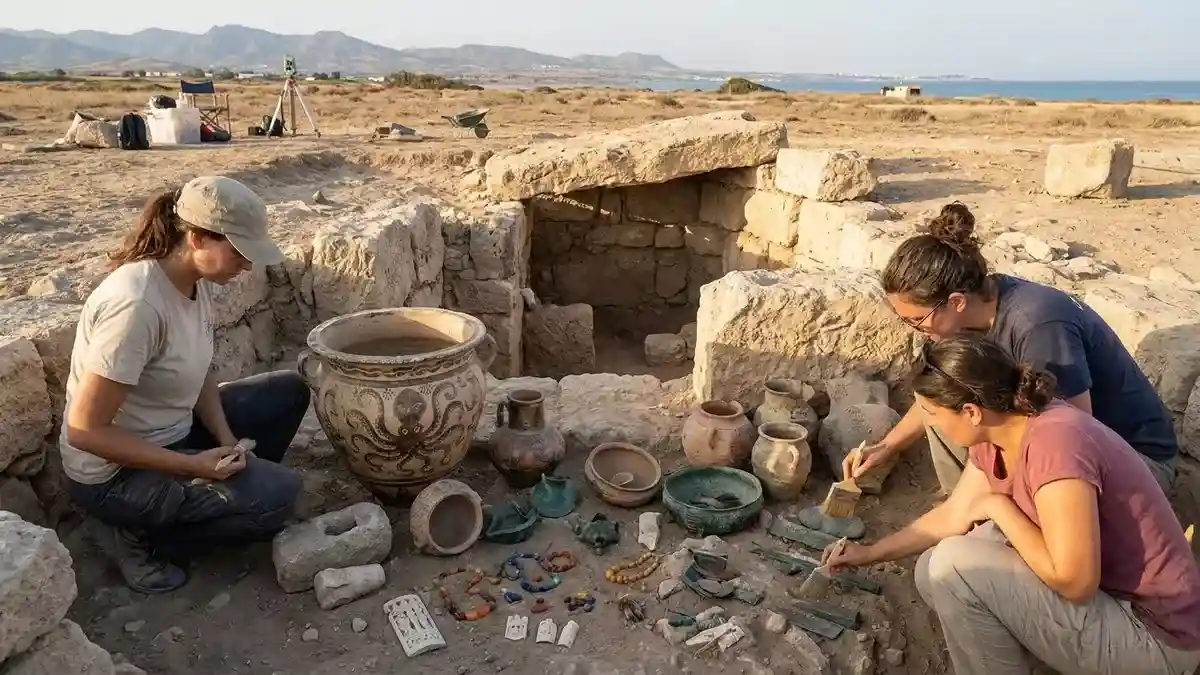
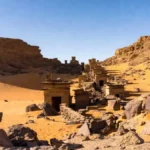
During recent fieldwork, archeological teams targeted an extra-urban cemetery situated in an area designated as Area A. Guided by advanced geophysical surveys, excavations exposed a complex ancient landscape, including eroded architectural foundations, an abandoned freshwater well, and two large subterranean chamber tombs dating directly to the 14th century BCE.
The Abandoned Well
The nearby ancient well provided fascinating clues about the city’s changing environment. Groundwater testing revealed an incredibly high salinity layer roughly ten meters below the surface. This sudden surge of saltwater contamination likely fouled the city’s drinking supply, forcing the Bronze Age inhabitants to abandon the well in antiquity.
The Accident That Saved History
Both of the newly discovered chamber tombs owe their incredible preservation to an ancient catastrophe: their heavy limestone roofs collapsed shortly after the final burials.
While the cave-in crushed some of the larger ceramic vessels, the fallen debris created an impenetrable, compacted seal. This barrier protected the contents from grave robbers and environmental decay for millennia, providing modern scientists with an uncompromised, pristine window into ancient funerary rituals.
“The roof collapse acted as a natural time capsule. Because the interior layers were sealed in the Bronze Age, we can trace exactly how multiple generations of an elite family used and reused these tombs over centuries.”
Generations of Family Memory
Stratigraphic analysis proves that these tombs were grand family mausoleums used continuously across multiple generations. When a prominent family member died, older ancestral skeletal remains were not discarded; instead, they were meticulously and respectfully moved to the side walls of the chamber to clear central floor space for the newly deceased. This deeply personal practice demonstrates powerful kin group bonds and a long cultural memory.
A Treasury of Global Luxuries
The sheer volume and geographical diversity of the imported goods recovered from the tombs have stunned Mediterranean historians. The elite families of Hala Sultan Tekke were burying their dead wrapped in luxuries gathered from every known corner of the ancient world.
                       [ Baltic Region ]
                            │ (Amber)
                            ▼
    [ Aegean / Crete ] ──►  HALA SULTAN TEKKE  ◄── [ Afghanistan ]
    (Octopus Kraters)      ▲                 ▲       (Lapis Lazuli)
                           │                 │
                           │                 │
                   [ Ancient Egypt ]   [ Western India ]
                    (Ivory/Calcite)       (Carnelian)
Exquisite Mediterranean Ceramics
Alongside high-quality local Cypriot pottery, the tombs were packed with luxury imports from the Aegean Sea. The collection includes beautifully painted vessels arriving from Crete, the Aegean islands, and the Greek mainland—specifically the famous Mycenaean palatial centers of Tiryns and Berbati. Among the most striking finds is a large, beautifully preserved Minoan krater adorned with intricate octopus motifs.
Exotic Treasures from Africa and Asia
The international connections extend far beyond Europe:
Ancient Egypt: The tombs yielded meticulously carved ivory cosmetics pieces and elegant, translucent vessels fashioned from premium Egyptian calcite (alabaster).
Afghanistan: Deep blue lapis lazuli beads were recovered, tracing back exclusively to the ultra-remote mines of Badakhshan in modern-day Afghanistan.
Western India: Vibrant, reddish carnelian gemstones were found intermingled with the burial shrouds, originating from the historic gemstone deposits of western India.
The Baltic Coast: Rich, golden amber beads and even a custom-carved amber scarab made their way down from the Baltic Sea regions of Northern Europe.
The Western Connection: Sardinia and Oxhide Ingots
One of the most historically significant revelations from the tombs was the identification of pottery originating from Nuragic Sardinia. Finding Sardinian ceramics in Cyprus provides crucial physical evidence for a massive maritime trade loop.
Archaeologists have long known that Cypriot copper traveled westward across the Mediterranean in the form of “oxhide ingots”—heavy, distinctively shaped blocks of raw metal molded to resemble stretched animal hides. The presence of Sardinian pottery at Hala Sultan Tekke confirms a direct exchange: Cypriot merchants shipped raw industrial copper to the western Mediterranean, and received finished prestige ceramics, specialized technologies, and western luxuries in return.
Bioarchaeology: Who Was Buried in the Tombs?
Initial bioarchaeological analysis of the human remains reveals a diverse family profile. The tombs contained individuals of all ages, ranging from fragile newborns to fully grown adults.
A Snapshot of Bronze Age Lifespans
Intriguingly, almost none of the recovered skeletons belonged to individuals older than forty. While these people were clearly members of the ultra-wealthy ruling class, their short lifespans fit perfectly into broader Late Bronze Age demographic models, where high infant mortality, infectious disease, and harsh environmental pressures meant that living past mid-life was an extreme rarity.
Unlocking the DNA Code
To look deeper into the lives of these ancient elites, international laboratories are currently conducting ancient DNA (aDNA) and stable isotope studies on the skeletal remains. This cutting-edge science aims to achieve three goals:
Establish the exact biological and genetic relationships between the individuals sharing the chambers.
Map the geographic mobility of these individuals to see if they were native Cypriots or foreign merchants who settled in the port city.
Trace the ancestral lineage of the city’s ruling class to determine if Hala Sultan Tekke was managed by a single dynastic family.
Digital Preservation and Distinct Social Roles
To ensure no data was lost during the delicate excavation process, digital recording teams deployed high-resolution 2D and 3D scanning technologies, mapping every bone, bead, and pottery shard exactly where it lay in the dirt. Following extraction, conservation specialists at museum facilities in Larnaca stabilized the fragile organic items and ceramics.
Interestingly, archaeologists noted clear variations in the types and quantities of imported goods between the two adjacent tombs. This discrepancy suggests that even within the highest tiers of the city’s elite, families held distinct social roles, controlled different trade routes, or perhaps hailed from entirely different cultural backgrounds, living together in harmony within this booming maritime gateway.
Frequently Asked Questions
Where is Hala Sultan Tekke located and why was it important?
Hala Sultan Tekke is a premier Late Bronze Age archaeological site situated on the southern coast of Cyprus near Larnaca. It was an essential maritime hub because it possessed a highly protected natural harbor and sat near rich copper deposits, allowing it to control the production and export of copper throughout the ancient world.
How did the ancient copper trade work in Cyprus?
Cypriot workers mined raw copper ore from the nearby Troodos Mountains and transported it to coastal cities like Hala Sultan Tekke. There, metalworkers smelted the ore in specialized furnaces, casting the molten metal into standardized, heavy “oxhide ingots.” These ingots were then loaded onto international merchant ships and traded across the Mediterranean.
What caused the remarkable preservation of the artifacts in these tombs?
Shortly after the final burials occurred in the 14th century BCE, the limestone roofs of both chambers collapsed. The resulting layers of compacted earth and stone sealed the interior deposits away from environmental erosion and prevented grave robbers from looting the treasures over the subsequent millennia.
What kinds of international luxury items were discovered?
The tombs contained an unprecedented variety of global imports, including Minoan octopus pottery from Crete, Mycenaean ceramics from mainland Greece, ivory and calcite vessels from Egypt, Baltic amber from Northern Europe, lapis lazuli beads from Afghanistan, and carnelian gemstones from Western India.
What can ancient DNA tell us about the people buried there?
Ongoing ancient DNA (aDNA) testing will allow scientists to determine the exact family trees and genetic relationships of the individuals inside the tombs. Furthermore, it will reveal their geographic origins, proving whether these wealthy elites were local Cypriots or traveling merchants who moved to the city from foreign lands.