
Table of Contents
- 1. 1. The Hidden World of the Etruscan Cista
- 1.1. What Was a Cista?
- 2. 2. The Tragically Beautiful Myth of Sarpedon
- 2.1. The Death of a Demi-God
- 2.2. The Divine Retrieval
- 3. 3. Masterful Ergonomics Meets Devastating Pathos
- 3.1. Empathy in Bronze
- 3.2. A Genius Engineering Choice
- 4. 4. The Etruscan Enigma: Who Were They?
- 4.1. The Asiatic Migration Theory
- 4.2. The Modern Genetic Twist
- 5. 5. Trade, Taste, and a Fascinating Obsession with Mortality
- 5.1. A Unique Focus on Brutality and Death
- 6. Conclusion
- 7. Frequently Asked Questions
- 7.1. What exactly is a cista and how was it used?
- 7.2. Who are the figures depicted on this specific bronze handle?
- 7.3. How old is the Sleep and Death cista handle and where is it kept?
- 7.4. Did the Etruscans originate from the ancient city of Troy?
- 7.5. What makes this handle more advanced than other ancient Etruscan metalwork?
5 Ancient Secrets a 2,400-Year-Old Trojan War Artifact Reveals Today
For nearly three thousand years, the sweeping epics of Homer have captured the human imagination. The grand battles, tragic heroes, and divine interventions of the Iliad and the Odyssey have been reimagined in endless waves of literature, modern cinema, and classic fine art. Yet, some of the most profound tributes to these ancient stories come from the ancient world itself.
A spectacular testament to this enduring influence rests in a small, beautifully detailed bronze sculpture crafted roughly 2,400 years ago. Once serving a highly practical purpose in an ancient household, this artifact offers modern historians a fascinating window into the aesthetics, spiritual beliefs, and mysterious origins of the Etruscans—a sophisticated and enigmatic civilization that thrived in central Italy long before the rise of the Roman Empire.
5 Ancient Secrets a 2,400-Year-Old Trojan War Artifact Reveals Today

1. The Hidden World of the Etruscan Cista
To appreciate the significance of this artifact, one must first understand the daily lives of the people who created it. Known to art historians as the “Sleep and Death cista handle,” this object was not meant to be displayed in a vacuum. Instead, it was designed as a decorative, functional handle permanently welded to the lid of a cista.
What Was a Cista?
A cista was a cylindrical, lidded box typically made of bronze. These containers were highly prized luxury items throughout the ancient Mediterranean, including Egypt, Greece, Rome, and particularly Etruria (modern-day Tuscany and parts of Umbria and Lazio).
While they served various ceremonial and sacred roles, cistae were most frequently used in wealthy households as ornate vanity boxes to store precious cosmetics, perfumes, jewelry, and grooming mirrors. The fact that an object intended for personal grooming was adorned with a tragic scene from the Trojan War reveals a striking contrast between daily luxury and the somber realities of mythic fate.
 4,000-Year-Old Child’s Skull Surgery Uncovered in Uzbekistan Changes Ancient Medical History
2. The Tragically Beautiful Myth of Sarpedon
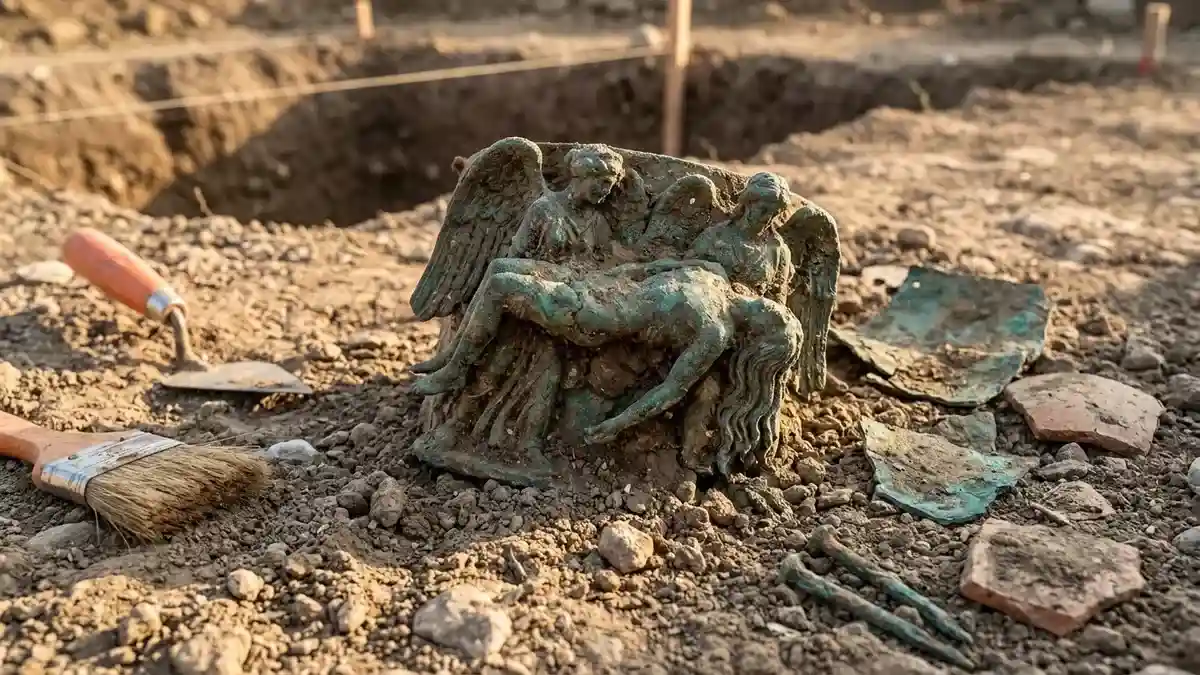
The bronze handle, which stands roughly 7.3 inches long and 7.2 inches tall, captures an incredibly specific and emotionally charged moment from Book XVI of Homer’s Iliad. It depicts the tragic aftermath of a fierce clash on the battlefields of Troy.
The Death of a Demi-God
Sarpedon was no ordinary soldier; he was a king of Lycia and a beloved son of Zeus, the king of the gods. Fighting valiantly on the side of the Trojans, Sarpedon encountered Patroclus, the close companion of the Greek champion Achilles. Patroclus had entered the fray disguised in Achilles’ legendary armor, striking terror into the hearts of the Trojan forces.
In a fierce duel, Patroclus mortally wounded Sarpedon. Though Zeus watched from Mount Olympus, agonizing over the fate of his mortal son, he ultimately bowed to cosmic destiny and allowed Sarpedon to perish.
The Divine Retrieval
Following Sarpedon’s death, a brutal skirmish erupted over his remains. The Greeks managed to strip the fallen prince of his armor, but before they could desecrate his body, Zeus intervened. He commanded Apollo to rescue the corpse from the chaotic battlefield.
Apollo cleansed the wounds and delivered the fallen hero to the twin deities Hypnos (the personification of Sleep) and Thanatos (the personification of nonviolent Death). The bronze sculpture captures the exact moment these gentle gods bend down to lift Sarpedon’s lifeless frame and transport him back to his homeland for a proper royal burial.
3. Masterful Ergonomics Meets Devastating Pathos
Ancient Etruscan metalwork is highly regarded, but this particular piece, housed in the permanent collection of the Cleveland Museum of Art, represents an extraordinary peak of artistic achievement. Scholars note that its complexity far exceeds standard Etruscan box handles, which were often simple, rigid geometric shapes or basic human figurines.
Empathy in Bronze
The anonymous metalworker who cast this piece between 400 B.C. and 375 B.C. succeeded brilliantly in translating the heavy, sorrowful poetry of Homer into physical metal. The figures of Sleep and Death are shown carefully cradling the heavy, limp form of the demigod. The tension in their bending bodies contrasts sharply with the completely relaxed, lifeless posture of Sarpedon, beautifully communicating the weight of mortality.
A Genius Engineering Choice
Beyond its profound emotional impact, the handle demonstrates a remarkable grasp of ergonomic design. Sarpedon’s long hair falls limply backward away from his head, forming a natural, curved gap.
According to art historians, this specific structural detail was intentionally engineered by the sculptor to serve as a perfectly positioned finger grip. The user of the box could slip their fingers under the bronze hair to easily lift the heavy metal lid off the vanity case. It is a stunning marriage of high art and practical utility.
4. The Etruscan Enigma: Who Were They?
The presence of this beautifully rendered Greek myth on an Italian artifact highlights one of the most enduring debates in classical archaeology: Why were the Etruscans so deeply obsessed with the legends of the Trojan War?
The Etruscans are one of history’s most mysterious advanced civilizations. Though they developed written language, built thriving cities, and heavily influenced early Roman religion, engineering, and architecture, very little of their own literature survives. Because their language is only partially deciphered today, much of what we know about them comes from the perspectives of external cultures, such as the Greeks and Romans.
The Asiatic Migration Theory
Writing centuries after the peak of Etruscan power, the famous Greek historian Herodotus claimed that the Etruscans were not native to Italy. Instead, he argued they migrated from Lydia, a region in Asia Minor located just south of ancient Troy.
This historical theory gained symbolic weight when later Roman writers popularized the myth of Aeneas, a Trojan prince who escaped the burning ruins of his city, traveled to Italy, and laid the cultural foundations for Rome and its neighbors. For generations, some scholars hypothesized that the Etruscans favored Trojan stories because they viewed themselves as direct descendants of the Trojans or their wartime allies.
The Modern Genetic Twist
However, modern science has thrown a wrench into this migration narrative. A comprehensive 2021 genetic study analyzing ancient DNA from the Italian peninsula suggested that the Etruscans were actually indigenous to the region, sharing a close genetic profile with their neighboring Latin populations. This discovery indicates that their deep cultural connection to Troy was likely a result of intense trade and cultural adoption rather than shared ancestry.
5. Trade, Taste, and a Fascinating Obsession with Mortality
If the Etruscans were native to Italy, why did they decorate their most intimate household items with the violent and tragic myths of Greece?
The most likely answer lies in the vast, interconnected trade networks of the ancient Mediterranean. During the 5th and 4th centuries B.C., Greek pottery, metalwork, and poetry flooded Italian markets. The Etruscans were eager consumers of Greek luxury goods, readily adopting their artistic styles, pantheon of gods, and mythological storytelling.
A Unique Focus on Brutality and Death
However, the Etruscans did not simply copy Greek art; they reinterpreted it through their own distinct cultural lens. Classical archaeologists point out that when Etruscan artists decorated vases and bronze cistae with scenes from the Trojan War, they intentionally chose moments of extreme violence, heavy sacrifice, and profound tragedy.
While Greek artists often emphasized the glory, heroism, and athletic triumph of the Trojan War, Etruscan patrons preferred the raw, unfiltered emotional consequences of conflict. The handle depicting Sleep and Death tenderly carrying away a dead prince perfectly encapsulates this unique cultural obsession with the transition from life to the afterlife.
Conclusion
The Sleep and Death cista handle is far more than a beautiful antique or a functional lid pull. It is a brilliant material intersection of Greek literature, Etruscan craftsmanship, and universal human emotion. By frozen-framing a tender moment of divine mercy amidst the horrors of war, an anonymous ancient sculptor created a masterpiece that continues to resonate with viewers thousands of years after the civilization that birthed it vanished into history.
Frequently Asked Questions
What exactly is a cista and how was it used?
A cista was a cylindrical container made of bronze, complete with a fitted lid. In the ancient Mediterranean world—especially among wealthy Etruscans—these decorative boxes were primarily used as luxury vanity cases to hold personal grooming items like cosmetics, perfumes, jewelry, and combs.
Who are the figures depicted on this specific bronze handle?
The handle features three mythological figures from Homer’s Iliad: Sarpedon (a fallen prince of Lycia and son of Zeus), Hypnos (the Greek god of sleep), and Thanatos (the Greek god of nonviolent death). The two gods are shown lifting Sarpedon’s body to carry him home.
How old is the Sleep and Death cista handle and where is it kept?
The artifact was crafted between 400 B.C. and 375 B.C., making it roughly 2,400 years old. It is currently preserved and on display in the permanent collection at the Cleveland Museum of Art in Ohio.
Did the Etruscans originate from the ancient city of Troy?
While the ancient Greek historian Herodotus believed the Etruscans migrated to Italy from Asia Minor near Troy, a groundbreaking 2021 genetic study suggests otherwise. The DNA evidence indicates that the Etruscans were actually local to the Italian peninsula, meaning they adopted Trojan myths through trade rather than bloodlines.
What makes this handle more advanced than other ancient Etruscan metalwork?
Unlike typical, rigid handles of the era, this piece features incredibly lifelike postures and rich emotional detail. Additionally, it displays brilliant ergonomic engineering: the sculptor designed Sarpedon’s falling bronze hair to create a natural gap that serves as a functional finger grip for lifting the box lid.