
Table of Contents
- 1. 1. The Alps Acted as a Prehistoric “Genetic Refuge”
- 2. 2. Ötzi Remains a True Genetic Outlier
- 3. 3. Ancient Alpine Society Was Strictly Patrilocal
- 4. 4. Dark Hair, Brown Eyes, and Zero Milk
- 5. 5. Small Cracks Formed in the Mountain Fortress
- 5.1. The Steppe Girl
- 5.2. The Bell Beaker Traveler
- 6. Conclusion
- 7. Frequently Asked Questions
- 7.1. Did the new DNA study change what we know about Ötzi’s appearance?
- 7.2. What does “patrilocal” mean in ancient societies?
- 7.3. Could Ötzi the Iceman drink milk?
- 7.4. Why do scientists call the ancient Alps a “genetic refuge”?
- 7.5. Are there any living relatives of Ötzi the Iceman today?
5 Ancient Secrets DNA Study Reveals About Ötzi the Iceman Today
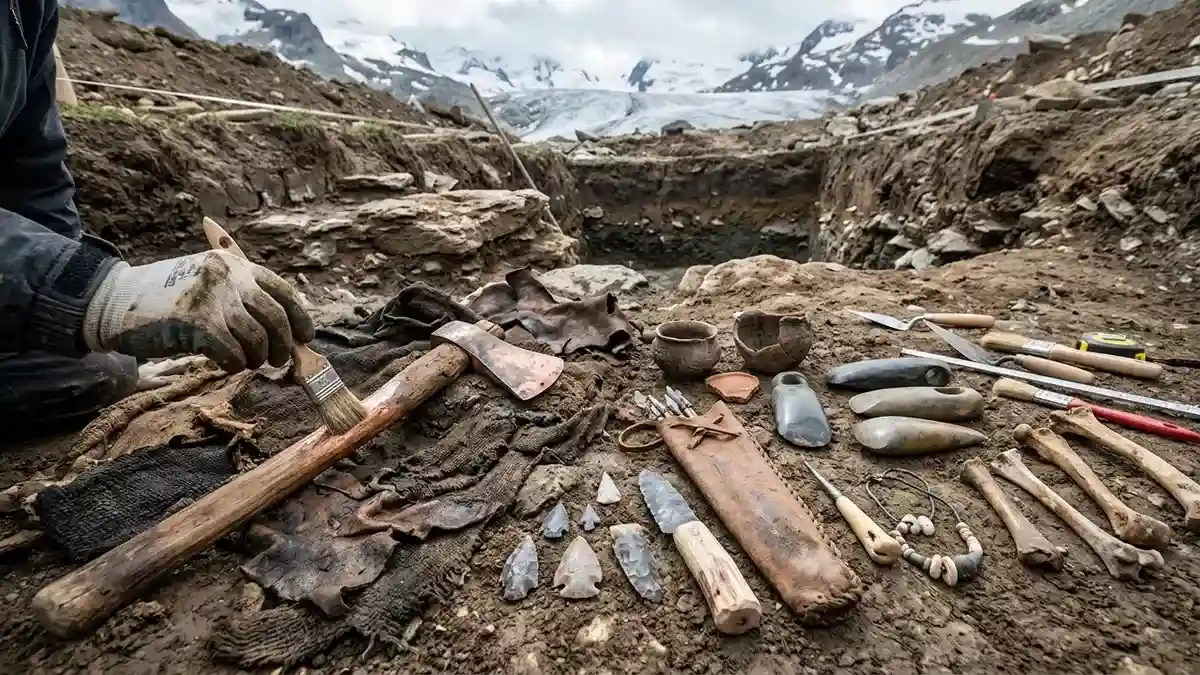
When hikers accidentally stumbled upon the frozen, mummified remains of a prehistoric man in the Italian Alps in 1991, they had no idea they had just uncovered one of the greatest archaeological sensations of the 20th century. Named Ötzi the Iceman, this 5,300-year-old Copper Age hunter has been poked, prodded, and scanned by scientists for over three decades. Yet, his exact origins and the nature of the world he traveled have remained shrouded in mystery.
Now, a sweeping paleogenomic study has cracked open the genetic vault of the ancient Alps. By analyzing the DNA of dozens of prehistoric individuals who lived alongside and after the famous ice mummy, researchers have painted an incredibly detailed picture of prehistoric European life. The findings reveal a mountain landscape that was not a chaotic migratory crossroads, but a stubborn genetic stronghold characterized by deep-rooted traditions, surprising family structures, and a striking resistance to outside civilization.
Here are five major secrets the latest ancient DNA analysis has revealed about Ötzi the Iceman and his mysterious alpine homeland.
5 Ancient Secrets DNA Study Reveals About Ötzi the Iceman Today
1. The Alps Acted as a Prehistoric “Genetic Refuge”
For thousands of years, prehistoric Europe was a chaotic melting pot. Waves of migrations from Anatolian farmers (modern-day Turkey) and later Yamnaya pastoralists from the Eurasian Steppe completely reshaped the genetic landscape of the continent, replacing older populations and shifting cultural dynamics.
However, the new study reveals that the Eastern Italian Alps stood completely firm against these dramatic demographic shifts. Researchers successfully mapped the whole genomes of 47 prehistoric individuals who lived in this high-altitude region between 6400 and 1300 BCE—spanning the Mesolithic era all the way to the Middle Bronze Age.
The results showed an astonishing degree of genetic continuity. Between 80% and 90% of the genetic makeup of these alpine individuals came directly from early Anatolian farmers. Remarkably, this genetic profile remained virtually untouched for more than 2,000 years. While the rest of Europe was experiencing massive genetic turnover, the rugged terrain of the Alps acted as a geographic fortress, preserving a pristine, ancient lineage far longer than surrounding lowland regions.
2. Ötzi Remains a True Genetic Outlier
Ever since Ötzi’s initial genome was sequenced, his high concentration of Anatolian farmer ancestry has puzzled scientists. The new data confirms that while the Iceman shared a massive portion of his genetic blueprint with his immediate Copper Age neighbors, his direct family tree was radically unique.
Every human carries specific genetic markers inherited directly from their parents, categorized into paternal and maternal haplogroups (genetic clans sharing a common ancestor). When scientists looked closely at Ötzi’s specific lineages, they discovered something extraordinary:
Paternal Lineage: Ötzi belongs to a highly specific Y-chromosome haplogroup known as G2a-Z6208.
Maternal Lineage: His mitochondrial DNA (passed down from mother to child) carries an equally rare signature.
To date, neither of Ötzi’s exact maternal or paternal genetic markers has ever been detected in any other ancient skeleton or modern human population. Even within his own mountain sanctuary, where genetic stability was the norm, Ötzi belonged to an isolated branch of a family tree that has completely vanished from the face of the Earth. He was, quite literally, one of the last of his kind.
3. Ancient Alpine Society Was Strictly Patrilocal
By comparing the overall genetic diversity of the men in the study against the women, researchers were able to reconstruct the intimate social and marital structures of these prehistoric mountain communities.
The DNA revealed an incredibly telling pattern: the men within these alpine valleys shared a very low diversity of Y-chromosome markers, meaning their paternal lines were tightly consolidated and remained unchanged across multiple generations. Conversely, the women exhibited a remarkably high diversity of mitochondrial DNA markers.
This genetic contrast is a textbook indicator of a patrilocal society. In this ancient cultural setup, men remained in the villages or valleys where they were born, inheriting the land, defensive strongholds, and social status of their fathers.
To prevent inbreeding and build vital political alliances, women migrated out of their birthplaces, traveling from distant clans to marry into these male-dominated alpine communities. This social mechanism explains how the male lineage remained heavily stabilized over thousands of years while the maternal lines constantly infused the region with fresh genetic connections from the outside world.
4. Dark Hair, Brown Eyes, and Zero Milk
What did these ancient mountain dwellers actually look like, and what did they eat? By analyzing the genetic variants responsible for physical characteristics, scientists were able to generate a highly accurate physical profile for the majority of the 47 individuals in the study.
True to the physical characteristics observed on Ötzi’s well-preserved mummy, the vast majority of his contemporaries possessed dark hair, brown eyes, and relatively dark skin tones. This thoroughly debunks older artistic interpretations that frequently depicted ancient alpine hunters with fair skin or light features.
Prehistoric Alpine Population Profile:
👁️ Eyes: Brown
💇 Hair: Dark
🥛 Diet: Completely Lactose Intolerant
Furthermore, the genetic data provided an intriguing look at their primitive diet. Every single individual analyzed in the study carried the genetic marker for severe lactose intolerance. None of them possessed the mutated gene required to digest the sugars in fresh milk into adulthood.
This finding indicates that despite living in an environment perfectly suited for herding livestock, these early societies had not yet adapted to dairy. While they certainly herded animals for meat, wool, and leather, dairy products like fresh milk, cheese, and butter had not yet become the nutritional staples they are in the region today.
5. Small Cracks Formed in the Mountain Fortress
While genetic isolation was the overwhelming norm for these ancient highlanders, the Alps were not entirely closed off from the rest of the world. The study detected a few isolated, fascinating instances of foreign genetic intrusion, proving that rare travelers did occasionally pierce the mountain boundary.
The Steppe Girl
Researchers identified the remains of a young girl, labeled LAS01, who lived around 2400 BCE. Her DNA showed a sudden, distinct influx of Steppe-affiliated ancestry. Her presence in the valley provides undeniable proof of early, limited contact with the migrating Bronze Age horsemen who were beginning to settle the European lowlands.
The Bell Beaker Traveler
Another individual, designated SIU01, who walked the mountains around 1600 BCE, carried a complex genetic cocktail. This person possessed both Steppe genes and the specific R1b haplogroup, a hallmark genetic signature inextricably linked to the famous Bell Beaker culture that dominated Western Europe.
Additionally, a handful of skeletons (such as NOG302 and ROM402) revealed unmistakable genetic signatures tracing back to the Eastern Mediterranean and the Caucasus mountains. These scattered individuals indicate that while the Eastern Italian Alps successfully resisted massive population replacements, their borders remained gently permeable to lone travelers, traders, and brides seeking a new life in the mountains.
Conclusion
The image of prehistoric Europe as a landscape defined by constant, total displacement has been challenged by the quiet stability of the Italian Alps. As scientists continue to peer into the ancient DNA of our ancestors, the world of Ötzi the Iceman becomes clearer than ever. It was a world constructed on an intense reverence for geographic roots, tight-knit family structures where women linked distant valleys together, and an enduring lifestyle that withstood the march of continental history for millennia.
Frequently Asked Questions
Did the new DNA study change what we know about Ötzi’s appearance?
No, it actually confirmed it. The study showed that the vast majority of people living in Ötzi’s region shared his physical traits, meaning they predominantly had dark hair, brown eyes, and darker skin complexions, matching the physical characteristics seen on his mummified remains.
What does “patrilocal” mean in ancient societies?
A patrilocal society is a social structure where men stay in the community or territory where they were born, while women leave their native clans to marry into the husband’s family. This practice stabilizes the male genetic lineage over generations while increasing the diversity of the female genetic lineage.
Could Ötzi the Iceman drink milk?
No. The genetic analysis showed that Ötzi, along with all 47 prehistoric individuals tested in the study, was completely lactose intolerant. This strongly suggests that dairy farming and milk consumption were not yet a part of the daily diet or agricultural economy in the Copper Age Alps.
Why do scientists call the ancient Alps a “genetic refuge”?
They call it a refuge because the high-altitude, rugged terrain isolated the local population from the massive migratory waves that swept across the rest of Europe. This geographic isolation allowed the original Anatolian farmer ancestry of the inhabitants to remain unchanged for over 2,000 years.
Are there any living relatives of Ötzi the Iceman today?
While modern Europeans share general ancestral roots with the ancient Anatolian farmers, Ötzi’s specific paternal Y-chromosome lineage (G2a-Z6208) and his precise maternal mitochondrial DNA markers have never been found in any other ancient skeleton or living person today, making his direct family line extinct.