
Table of Contents
- 1. The Anatomy of an Ancient ‘Retoucher’
- 2. Technological Foresight and Advanced Spatial Planning
- 2.1. Who Made the Boxgrove Tool?
- 3. Tracking the Migration of Ancient Knowledge
- 4. Frequently Asked Questions
- 4.1. How old is the Boxgrove elephant bone tool?
- 4.2. Why did early humans use bone instead of stone to shape tools?
- 4.3. What species of human made this artifact?
- 4.4. How do scientists know the bone was used as a tool?
- 4.5. Why is the lack of other elephant bones at the site important?
Half-Million-Year-Old Elephant Bone Tool Rewrites European History
A groundbreaking archaeological study has identified a 480,000-year-old tool crafted from elephant bone at the famous Boxgrove site in West Sussex, England. The astonishing artifact represents the oldest known organic tool made from elephant skeletal remains ever discovered in Europe. Measuring 11 centimeters long, 6 centimeters wide, and 3 centimeters thick, this durable piece of cortical bone completely shifts our understanding of the cognitive and technological prowess possessed by archaic human ancestors during the Middle Pleistocene epoch.
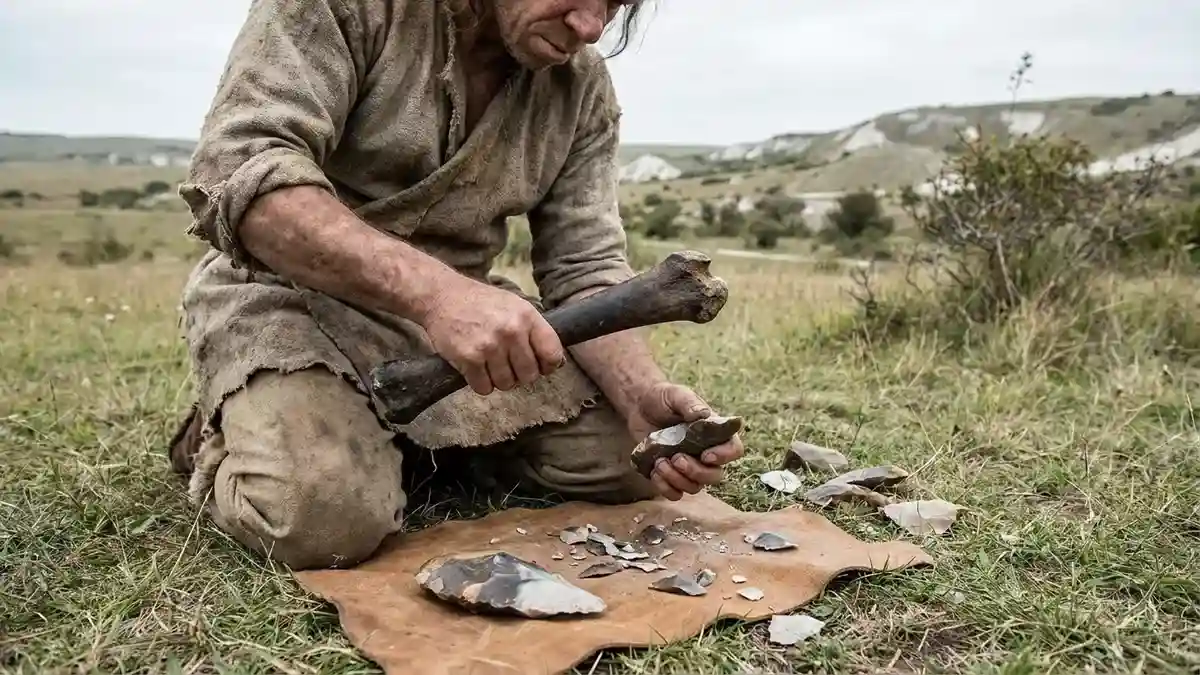
Rather than a simple piece of butchery waste, advanced microscopic analysis reveals that early hominins deliberately selected, modified, and carried this heavy bone to use as a precision implement for stone knapping. The presence of this organic tool challenges the long-held assumption that early humans in northern Europe relied solely on stone hammers to shape their environments, revealing a deep grasp of raw material engineering nearly half a million years ago.
Half-Million-Year-Old Elephant Bone Tool Rewrites European History
The Anatomy of an Ancient ‘Retoucher’
The bone fragment was subjected to rigorous 3D laser scanning and high-resolution electron microscopy by an international team of researchers. The results, published in the journal Science Advances, exposed a dense concentration of impact pitting, microscopic scarring, and tiny shards of flint physically embedded directly into the flat striking surface of the bone.

These telltale physical signatures identify the object as an ancient retoucher—a specialized soft hammer used by prehistoric artisans to resharpen, thin, and meticulously finish the edges of flint handaxes.
Flint Knapping Dynamics:
├── Hard Hammer (Stone): Used for heavy, initial fracturing and rough block shaping
└── Soft Hammer (Bone/Antler): Absorbs shock, yielding thin, highly symmetrical edges
Using a soft hammer made of dense elephant bone allowed prehistoric knappers far greater control over force distribution compared to striking flint with another hard rock. The elasticity of the organic tissue allowed the toolmaker to peel away paper-thin flakes, creating the signature razor-sharp, highly symmetrical ovate handaxes that define the legendary Acheulean industry at the Boxgrove site.
Technological Foresight and Advanced Spatial Planning
What elevates this discovery from a casual find to a major anthropological milestone is the sheer amount of planning and abstract thinking it implies. The hominins operating at Boxgrove did not simply stumble across a carcass and opportunistically smash a bone; the evidence points to deliberate, structured behavioral strategies.
Material Selectivity: The tool was manufactured from exceptionally dense cortical bone tissue, demonstrating that these ancient humans understood the structural mechanics of different materials and knew bone was uniquely suited for delicate knapping tasks.
Fresh Modification: Microscopic wear patterns show the bone was modified and put to use while it was still relatively fresh, rather than being scavenged years later as a dry, brittle fossil.
Geographical Importation: Ancient elephants and mammoths were rare encounters in the prehistoric landscapes of southern England. Strikingly, no other elephant skeletal remains were found across the Boxgrove paleosol layer. This means the hominins intentionally harvested this bone elsewhere and carried it across vast distances to their toolmaking camp, demonstrating spatial planning and resource management.
Who Made the Boxgrove Tool?
Because the artifact dates back approximately 480,000 years, archaeologists cannot definitively pinpoint which hominin species manufactured and wielded it. The two prime candidates dominating the anthropological debate are Homo heidelbergensis—whose physical remains have been previously excavated at Boxgrove—and early ancestral lineages of the Neanderthals (Homo neanderthalensis).
Regardless of the exact species, the mastery of advanced knapping methodologies—such as platform preparation and the complex tranchet flake removal technique (striking a specialized flake off the tip to create an ultra-sharp, straight knife edge)—proves that these early humans possessed advanced cognitive abilities, including working memory, abstract design concepts, and long-term technological foresight.
Tracking the Migration of Ancient Knowledge
While elephant-bone tool kits have been well-documented in East Africa dating back as far as 1.5 million years, European examples older than 43,000 years are exceptionally scarce. The few early bone tools previously found in Europe were almost exclusively confined to warmer, Mediterranean regions of southern Europe.
The discovery at Boxgrove provides definitive proof that these sophisticated organic tool strategies had migrated to higher, northern latitudes during the Lower Palaeolithic era. The ability to adapt and maintain these complex manufacturing technologies allowed early human groups to thrive and survive within the notoriously volatile and challenging climates of prehistoric northern Europe, raising fascinating questions about how technological knowledge was preserved and transmitted across isolated populations throughout the ancient world.
Frequently Asked Questions
How old is the Boxgrove elephant bone tool?
The tool is securely dated to approximately 480,000 years ago, placing it in the Middle Pleistocene epoch of the Lower Palaeolithic period.
Why did early humans use bone instead of stone to shape tools?
Bone acts as a “soft hammer.” Because it is more elastic than stone, it absorbs the shock of impact when striking flint, allowing the toolmaker to detach highly controlled, thin flakes to produce an incredibly straight, sharp, and symmetrical cutting edge.
What species of human made this artifact?
The precise species remains unverified, but based on the timeline and European geographic location, the tool was manufactured by either Homo heidelbergensis or early ancestral Neanderthals.
How do scientists know the bone was used as a tool?
Researchers used 3D scanning and electron microscopy to identify specific impact marks, compression scars, and microscopic fragments of flint physically embedded into the bone’s surface, which perfectly match the wear patterns caused by knapping.
Why is the lack of other elephant bones at the site important?
The total absence of other elephant skeletal remains at Boxgrove proves that early humans did not kill or butcher the animal on-site. Instead, they recognized the value of the material, modified the bone while it was fresh, and carried it with them over long distances to their camp.