
Table of Contents
- 1. The Muddy Trenches of Castle Kolno
- 2. High-Tech Analysis Reveals a Lethal Medieval Technique
- 3. Status, Magic, and Poison: The Power of the Amethyst
- 4. A Poignant Moment of Carelessness Frozen in Time
- 5. Frequently Asked Questions
- 5.1. Where exactly was the amethyst jewel found?
- 5.2. How old is the artifact and who did it belong to?
- 5.3. What is fire gilding and why was it dangerous?
- 5.4. What did amethysts symbolize during the Middle Ages?
- 5.5. What do archaeologists mean by “conspicuous consumption”?
600-Year-Old Amethyst Jewel Found in Castle Moat Unlocks Noble Secrets
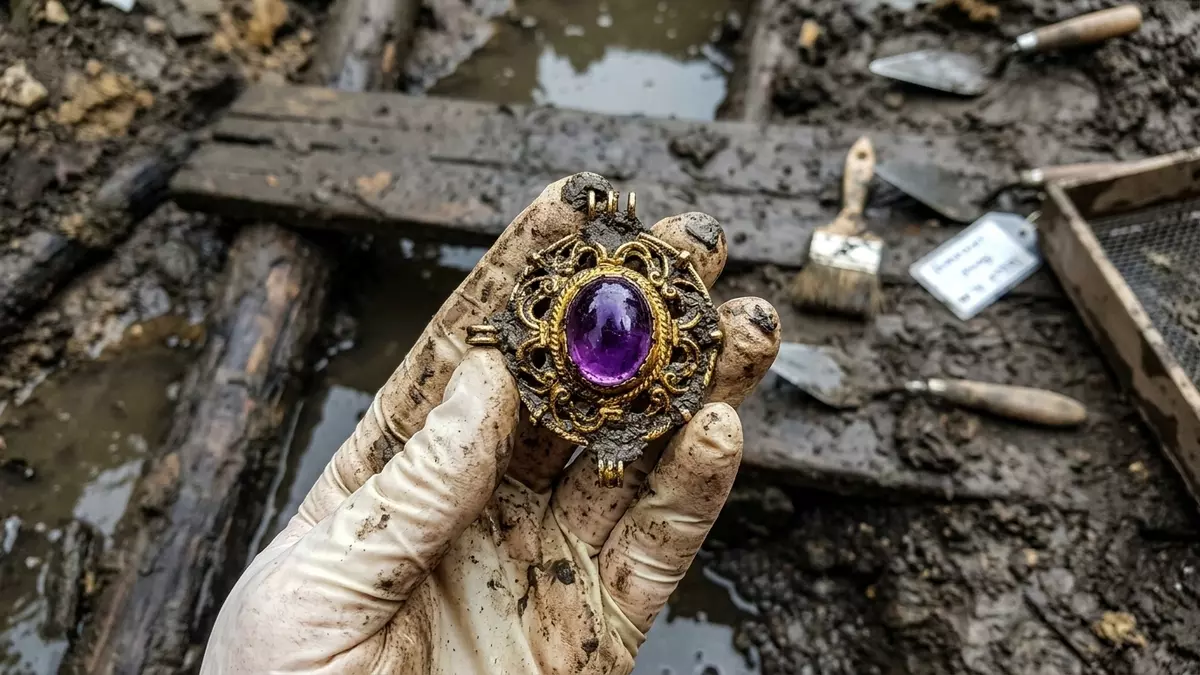
A glittering flash of purple and gold recently emerged from the deep, waterlogged mud of an ancient defensive trench in southwestern Poland. Archaeologists excavating the site of a ruined border stronghold have recovered a stunning, 600-year-old amethyst jewel.
While medieval treasures are typically discovered hidden away in deliberate hoards or buried deep within the tombs of royalty, this high-status artifact was found in a remarkably mundane setting: the muck of a castle moat. The rare find is providing historians with a captivating look at the extreme wealth, toxic craftsmanship, and superstitious beliefs of the medieval aristocracy.
600-Year-Old Amethyst Jewel Found in Castle Moat Unlocks Noble Secrets

The Muddy Trenches of Castle Kolno
The spectacular discovery was made at the site of Castle Kolno, a medieval fortification situated along a strategic ducal border in what is now Stare Kolnie, Poland. Originally constructed in the early 13th century by Duke Bolesław III of Brzeg, the castle later served as a heavily fortified residence for elite knights. Its history came to a violent end in 1443 when it was completely destroyed during a brutal civil conflict in the region of Silesia.
Led by Dr. Lech Marek, an archaeologist from the University of Wrocław, excavations at the castle have been ongoing since 2010. Over the last decade and a half, the team has pulled an array of historical artifacts from the site, including 14th- and 15th-century military weaponry, horseback-riding equipment, and domestic ceramics.
However, none of those discoveries carry the sheer luxury or individual intrigue of the newly unearthed amethyst jewel. The artifact was found embedded in the thick sediments of the castle’s northern moat, resting directly between the preserved timber posts of an ancient drawbridge.

High-Tech Analysis Reveals a Lethal Medieval Technique
To understand the exact composition and origin of the jewel without damaging its fragile structure, the research team subjected it to advanced non-destructive laboratory testing.
       [ The Kolno Amethyst Jewel ]
                  │
        ┌─────────┴─────────┐
        ▼                   ▼
[Raman Spectroscopy]  [X-Ray Fluorescence]
  Confirms Stone:       Confirms Metal:
     Amethyst          Fire-Gilded Silver
                       (with Mercury)
First, scientists utilized Raman spectroscopy—a technique that measures laser light scattering to identify molecular structures—to analyze the vibrant purple gemstone. The test confirmed that the stone is a genuine, high-quality amethyst.
Next, the team used X-ray fluorescence to analyze the metallic housing holding the gem. The results showed that the setting was made of high-purity silver that had been finished using a process known as fire gilding (or mercury gilding).

The Danger of Fire Gilding
To achieve a bright, gold-plated finish on silver, medieval craftsmen mixed real gold dust with liquid mercury to create a pasty amalgam. This paste was applied to the silver object, which was then heated over an open flame. The intense heat vaporized the mercury into a highly toxic gas, leaving behind a smooth, chemically bonded layer of gleaming gold. This process was incredibly dangerous, routinely causing severe neurological damage, blindness, and early death for the artisans who practiced it.
Status, Magic, and Poison: The Power of the Amethyst
During the Middle Ages, jewelry was never worn simply for its aesthetic beauty. Every gemstone and precious metal carried intense spiritual, medical, and social significance. In a scientific paper published in the journal Antiquity, Dr. Marek and co-author Beata Miazga detailed the complex web of folklore that surrounded amethysts during the 14th and 15th centuries.
To the medieval mind, an amethyst was a powerful magical amulet believed to possess concrete supernatural properties. According to popular folklore of the era, wearing an amethyst provided direct protection against:
Intoxication: The very word amethyst comes from the ancient Greek amethystos, meaning “not drunk.” It was widely believed to keep the wearer sober.
Venom and Poison: Nobles constantly feared assassination via poisoned food or drink; the amethyst was thought to neutralize deadly toxins.
Beyond its physical protections, the deep purple hue of the stone carried heavy religious symbolism, representing spiritual faith, deep modesty, and the blood of Christian martyrdom.
A Poignant Moment of Carelessness Frozen in Time
For archaeologists, this jewel represents a classic example of “conspicuous consumption.” In sociological terms, this refers to the practice of buying and publicly displaying expensive, non-functional luxury goods strictly to advertise one’s immense wealth, power, and elevated social status to the rest of the world. An object crafted from mercury-gilded silver and imported amethyst shouted to everyone who saw it that the wearer was a member of the absolute elite.
Yet, the most fascinating aspect of the Kolno jewel is not its extreme wealth, but how it was lost. Because it was found sitting in the mud between the wooden pillars of the castle’s northern entrance bridge, it was clearly not hidden on purpose.
Instead, a wealthy aristocrat, an affluent knight, or perhaps a visiting duke was riding across the bridge 600 years ago when the brooch snapped, or a decorative setting tore loose from their clothing. The tiny, priceless ornament tumbled through the gaps in the wooden bridge planks and splashed into the dark water of the moat below.
To the medieval noble, losing such a valuable status symbol must have been incredibly frustrating. But that single, fleeting moment of human carelessness effectively preserved a beautiful piece of aristocratic material culture for six centuries, allowing modern scientists to pull it from the mud and reconstruct the forgotten world of medieval nobility.
Frequently Asked Questions
Where exactly was the amethyst jewel found?
The jewel was discovered by archaeologists digging in the waterlogged sediments of the northern moat at Castle Kolno, a ruined medieval fortification located in southwestern Poland. It was found sitting directly between the ancient timber posts of the castle’s entrance bridge.
How old is the artifact and who did it belong to?
The jewel is determined to be more than 600 years old, dating back to the late 14th or early 15th century. While the exact name of the owner is lost to history, the high quality of the craftsmanship and materials proves it belonged to a high-ranking aristocrat, a wealthy knight, or a visiting noble.
What is fire gilding and why was it dangerous?
Fire gilding was a medieval manufacturing technique used to coat silver with a layer of gold. Craftsmen mixed gold with liquid mercury, painted the mixture onto the silver, and heated it. The process was highly lethal because it released toxic mercury vapors into the air, causing severe poisoning, brain damage, and shortened lifespans for the jewelers.
What did amethysts symbolize during the Middle Ages?
In medieval folklore, amethysts were believed to hold supernatural powers, specifically guarding the wearer against alcohol intoxication and deadly venoms. In a religious context, the purple stones also symbolized deep faith, modesty, and the sacrifice of martyrdom.
What do archaeologists mean by “conspicuous consumption”?
Conspicuous consumption refers to the public display of expensive, luxurious items to openly demonstrate wealth and high social status rather than for any practical, everyday function. The amethyst jewel served as a physical status symbol designed to immediately broadcast the owner’s nobility.