
Table of Contents
- 1. The Cultural Frontier of Eilsleben
- 2. Unveiling the Shamanic Deer Headdress
- 2.1. A Bridge to Mesolithic Magic
- 2.2. Blending Ancient Toolkits
- 3. Coexistence Without Contamination
- 4. Defensive Boundaries and Future Insights
- 5. Frequently Asked Questions
- 5.1. What is the significance of the deer skull headdress found in Germany?
- 5.2. Who were the Linear Pottery culture (LBK) peoples?
- 5.3. How did the environmental landscape of Eilsleben help preserve these artifacts?
- 5.4. Does this discovery mean that the farmers and hunter-gatherers intermarried?
- 5.5. What other non-farming tools were found at the site?
Ancient Deer Mask Discovered in Germany Reveals Surprising Ice Age-Neolithic Alliance
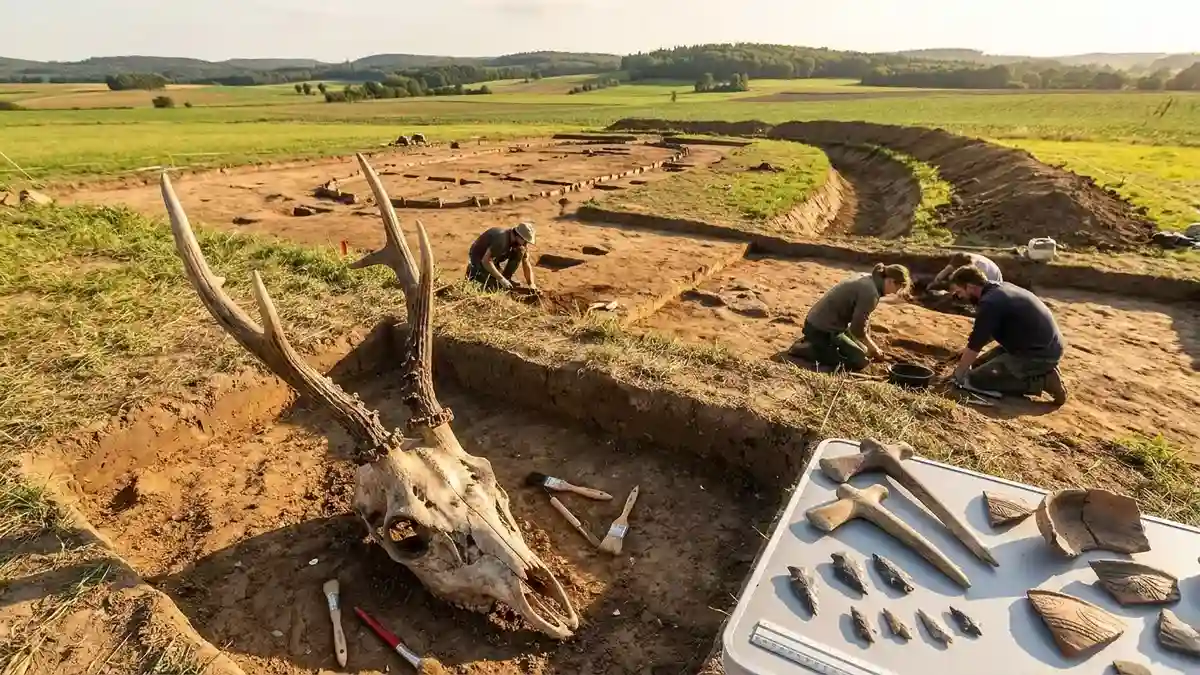
Deep within the fertile loess plains of Eilsleben in Saxony-Anhalt, Germany, archaeologists have unearthed a stunning 7,500-year-old artifact that challenges our understanding of Europe’s first cultural transition. The discovery of a modified roe deer skull—designed to be worn as a ceremonial headdress—proves that Europe’s earliest pioneering farmers didn’t just replace the local hunter-gatherers; they lived alongside them, traded technology, and even shared deeply sacred spiritual rituals.
For decades, the transition from nomadic foraging to settled agriculture has been viewed as a sharp, often hostile dividing line in human history. However, the organic treasures preserved at this northern frontier frontier demonstrate a complex, peaceful blending of two entirely different worlds.
Ancient Deer Mask Discovered in Germany Reveals Surprising Ice Age-Neolithic Alliance
The Cultural Frontier of Eilsleben
Dating back to approximately 5375 BCE, the settlement of Eilsleben represents the absolute northernmost boundary of early Neolithic expansion into Central Europe. Founded by members of the Linear Pottery culture (commonly known as the LBK), this 20-acre village was a bustling agricultural outpost.

Recent excavations in 2024 uncovered perfectly preserved occupation layers that escaped the damage of modern plowing. Protected for millennia beneath collapsed house debris, these layers have provided researchers with an incredible look into everyday life along the ancient frontier.
+-------------------------------------------------------------+
|                  EILSLEBEN SETTLEMENT PROFILE               |
+--------------------------+----------------------------------+
| Occupation Date          | Circa 5375 BCE                   |
| Cultural Tradition       | Linear Pottery Culture (LBK)     |
| Total Settlement Size    | Approximately 20 acres           |
| Key Structural Features  | Longhouses, ditches, ramparts    |
| Preserved Artifacts      | Over 70,000 items under analysis |
+--------------------------+----------------------------------+
Unveiling the Shamanic Deer Headdress
The crown jewel of the recent fieldwork is a roe deer skull with its antlers still attached, deliberately modified so it could be bound to a human head.
A Bridge to Mesolithic Magic
Headdresses made from deer skulls are a classic, highly symbolic hallmark of the older Mesolithic (hunter-gatherer) belief system. Famous examples, such as the famous 9,000-year-old shaman burial at Bad Dürrenberg, demonstrate how vital these masks were to foraging spirituality.

Finding an iconic hunter-gatherer ritual object meticulously preserved inside a permanent, agricultural LBK farming village reveals that these two societies were sharing deep ideological and symbolic ideas, rather than merely trading raw materials like meat or stone.
Blending Ancient Toolkits
Beyond the ceremonial mask, the site yielded clear proof that the farmers were actively adopting the wilderness survival skills of their neighbors. While typical LBK sites rely almost exclusively on domesticated bone and stone, Eilsleben is filled with Mesolithic-style hunting tools, including:
T-Shaped Antler Axes: Heavy, versatile tools likely utilized as ground-clearing hoes.
Antler Punches & Pressure Flakers: Specialized gear used to intricately shape flint.
Transverse Flint Arrowheads: Specialized, flat-edged projectile points specifically designed by foragers for harvesting game.
“Antler rarely served as a primary raw material in the standard early farming toolkit. Its heavy presence here suggests that the farmers didn’t isolate themselves—they actively learned selected crafting and hunting skills from neighboring foragers.”
Coexistence Without Contamination
Interestingly, this deep cultural exchange did not result in a mass mixing of the two populations. While the artifacts prove that farmers and foragers worked, traded, and prayed side-by-side in the borderlands, recent genetic studies from the region show very limited intermarriage between the two groups during this era.
Instead, Eilsleben represents a peaceful cultural boundary. The communities maintained their distinct genetic identities while embracing an integrated system of daily neighborly contact, technology transfer, and mutual respect.
Defensive Boundaries and Future Insights
The village was not entirely undefended. Excavations mapped a complex network of encircling ditches and ramparts built during different phases of the settlement.
Ongoing radiocarbon dating and structural analysis of these enclosures will help researchers determine whether these fortifications were built to protect against outside conflicts, serve as social status displays, or act as symbolic boundary markers to help different communities navigate a rapidly shifting, shared landscape.
As scientists continue to analyze human remains, soil chemistry, and the massive catalog of 70,000 artifacts recovered from the site, Eilsleben will undoubtedly continue to reshape our perspective on how Europe’s first farmers and last hunter-gatherers shaped each other’s destinies at the dawn of civilization.
Frequently Asked Questions
What is the significance of the deer skull headdress found in Germany?
The deer skull headdress is a deeply spiritual artifact traditionally belonging to Mesolithic hunter-gatherer cultures. Finding it inside an Early Neolithic farming settlement proves that Europe’s first agriculturalists and local foragers shared intimate symbolic and religious ideas, rather than living in complete isolation or constant conflict.
Who were the Linear Pottery culture (LBK) peoples?
The Linear Pottery culture, or LBK, represents the first wave of true farming communities to expand across Central Europe around 5500–5000 BCE. They are famous for their characteristic longhouses, distinctively decorated pottery, and introduction of domesticated crops and livestock to the region.
How did the environmental landscape of Eilsleben help preserve these artifacts?
Eilsleben is located in a fertile loess region. In the excavated areas, ancient occupation layers were trapped in a shallow depression and protected by collapsed house debris and burnt clay (daub). This shield protected the delicate bones, organic plant remains, and antler tools from being destroyed by centuries of modern agricultural plowing.
Does this discovery mean that the farmers and hunter-gatherers intermarried?
Surprisingly, no. While the archaeological artifacts at Eilsleben show a massive transfer of technology and shared rituals, modern genetic data from human remains in the region indicates that there was very limited intermarriage or population mixing. They shared ideas and lifestyles while maintaining separate cultural identities.
What other non-farming tools were found at the site?
Archaeologists recovered numerous specialized hunter-gatherer items, including T-shaped antler axes used for heavy chopping or hoeing, antler punches for stone tool manufacturing, and transverse flint arrowheads specifically engineered for hunting wild game.