
Table of Contents
- 1. The Time Capsule of Cougar Mountain Cave
- 1.1. Dating the Dawn of Tailored Apparel
- 1.2. A Diverse Record of Ancient Innovation
- 2. Mastering the Needle and Thread
- 2.1. The Purpose of the Artifacts
- 2.2. The Finest Needles of the Pleistocene
- 3. The Symbiosis of Plant and Animal Technology
- 3.1. Advanced Fiber Manipulation
- 3.2. The Legacy of the Rabbit Skin Robe
- 4. Ice Age Survival and Mass Harvesting
- 4.1. The Archeological Footprint of Communal Drives
- 4.2. Year-Round Trapping Systems
- 5. Adapting to an Evolving Planet
- 5.1. Facing the Chill of the Younger Dryas
- 5.2. The Shift to Lighter Textiles
- 6. A New Perspective on First Americans
- 7. Frequently Asked Questions
- 7.1. What makes the Oregon hide discovery so unique compared to other ancient finds?
- 7.2. How did scientists determine the age of the sewn hide?
- 7.3. What environmental factors forced humans to develop sewing technology in Oregon?
- 7.4. What animals were used to make these ancient clothes and tools?
- 7.5. How did early Americans catch enough rabbits to make fur garments?
Ice Age Discovery Proves Humans Sewed Clothes 13,000 Years Ago
Deep within the arid caves of the Oregon desert, archaeologists have uncovered a revolutionary piece of human history: the oldest known physical evidence of sewn animal hide in North America. This remarkable discovery, dating back nearly 13,000 years, offers an unprecedented glimpse into the sophisticated survival strategies of early Americans.
For generations, scientists have debated exactly when and how early humans developed tailored clothing to survive harsh environments. While stone tools and bone fragments routinely withstand the test of time, organic materials like fur, leather, and plant fibers almost always rot away. However, the extraordinarily dry conditions of Oregon’s Great Basin have acted as a natural time capsule, preserving delicate artifacts that rewrite our understanding of Ice Age technology.
Ice Age Discovery Proves Humans Sewed Clothes 13,000 Years Ago
The Time Capsule of Cougar Mountain Cave
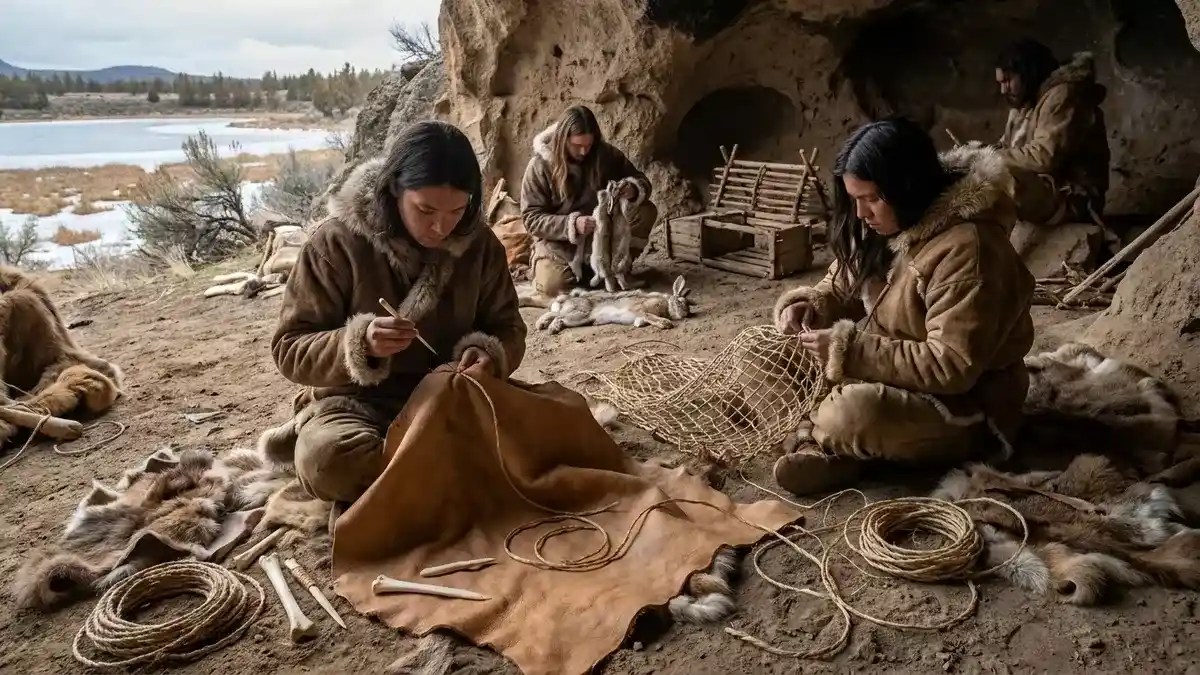
The groundbreaking find occurred at Cougar Mountain Cave, a volcanic rock shelter located in modern-day Oregon. Nestled within layers of ancient dust, researchers identified two small fragments of animal skin deliberately joined together by a meticulously crafted strip of cordage.
 1,600-Year-Old Coin Hoard Unearthed in Galilee Tunnels Reveals Last Jewish Rebellion Against Rome
Dating the Dawn of Tailored Apparel
To determine the age of the artifact, scientists utilized advanced radiocarbon dating techniques on the hide and the binding cord. The results placed the items between 12,900 and 11,700 years ago.
This specific window aligns perfectly with the Younger Dryas—a period of extreme, abrupt climate cooling that hit the Northern Hemisphere near the end of the last Ice Age. As temperatures plummeted, the ability to create fitted, wind-resistant garments became a matter of life and death for local communities.
A Diverse Record of Ancient Innovation
The sewn leather fragments were not isolated finds. They were part of a massive assemblage of 55 perishable artifacts recovered from Cougar Mountain Cave and the nearby Paisley Caves.

Through rigorous analysis, a multidisciplinary research team secured 66 distinct radiocarbon dates from the collection, confirming that humans consistently utilized these shelters for over a millennium. The organic items represent at least 15 different plant and animal species, showcasing a deep, expert knowledge of the local ecosystem.
+-------------------------------------------------------------+
|               COUGAR MOUNTAIN CAVE ARTIFACT KEY             |
+--------------------------+----------------------------------+
| Age of Sewn Hide         | 12,900 to 11,700 years old       |
| Climatic Era             | Younger Dryas (Ice Age Cooling)   |
| Total Analyzed Artifacts | 55 organic items                 |
| Total Radiocarbon Dates  | 66 baseline dates                |
| Species Represented      | At least 15 plant & animal types |
+--------------------------+----------------------------------+
Mastering the Needle and Thread
The level of craftsmanship evident in the Oregon hide fragments surprised researchers. The stitches were tight, deliberate, and regular, indicating that sewing was not a novel experiment but a highly refined cultural tradition.
The Purpose of the Artifacts
While the fragments are relatively small, their structural design suggests they were components of highly flexible gear. Anthropologists believe the sewn pieces likely originated from:

Form-fitting cold-weather clothing like parkas or tunics
Durable, protective footwear designed for rugged terrain
Insulated structural covers for portable shelters
The Finest Needles of the Pleistocene
The hypothesis of an advanced sewing culture is heavily supported by adjacent archaeological finds. Across four distinct excavation sites in the region, teams have unearthed elegant bone needles featuring drilled eyes.
These sewing tools rank among the finest and most delicate examples ever recovered from the Late Pleistocene epoch anywhere in the world. Crafting such thin, durable needles from animal bone required immense patience and specialized skill, proving that tailoring was a highly valued trade in ancient America.
“The presence of eyed needles and intricately twisted cordage proves that these early inhabitants weren’t just wrapping themselves in loose pelts—they were engineering custom, fitted gear to combat an increasingly hostile climate.”
The Symbiosis of Plant and Animal Technology
The ancient residents of the Great Basin did not rely on animal hides alone. The textile collection demonstrates a seamless integration of hunting products and botanical engineering.
Advanced Fiber Manipulation
Among the preserved materials, archaeologists documented an array of plant-based cords featuring various thicknesses, plies, and intentional twists. This diversity indicates that early weavers customized their cordage for specific tasks, separating thin thread for garment stitching from thick ropes for heavy lifting.
Furthermore, woven fragments found in the caves reveal complex twining techniques. These patterns are characteristic of ancient weaving styles used to manufacture durable storage bags, fish nets, and floor mats.
The Legacy of the Rabbit Skin Robe
At Paisley Caves, researchers made another stunning discovery: a strip of rabbit fur with the soft downy hair still perfectly intact. This artifact bridges the gap between deep history and documented indigenous traditions.
The fur strip closely mirrors the construction of rabbit skin blankets and robes historically crafted by Northern Paiute communities. In these traditional practices, hundreds of soft rabbit pelts were cut into strips, twisted together with strong plant fibers, and woven into exceptionally warm, flexible capes and skirts. The Paisley Caves finding suggests this specific textile tradition is at least 13,000 years old.
Ice Age Survival and Mass Harvesting
To sustain a culture reliant on fur clothing and complex netting, early Americans had to develop highly organized, communal hunting strategies.
The Archeological Footprint of Communal Drives
Roughly 100 kilometers from Paisley Caves, two massive prehistoric hearth sites have provided the ecological context for these textile technologies. Excavations at these cooking zones uncovered more than 14,000 rabbit bones, while almost no remains from large game like deer or bison were present.
An imbalance of this magnitude points directly to large-scale, communal rabbit drives. During these seasonal events, entire communities would pool their resources, stringing together hundreds of feet of plant-fiber nets across the landscape. Groups of people would then flush thousands of rabbits out of the brush, funnening them into confined spaces for mass capture.
Year-Round Trapping Systems
While massive communal drives provided an explosion of food and raw material, smaller-scale hunting sustained families throughout the rest of the year.
Among the preserved wooden artifacts recovered from the dry caves, scientists identified carved triggers and tension sticks. These wooden components perfectly match the mechanics of historical deadfall traps, confirming that individuals utilized automated, hidden traps to catch small game on a daily basis.
Adapting to an Evolving Planet
The rise and fall of this heavy leather sewing culture matches the dramatic climate shifts of the ancient world. The technology tells a story of human resilience in the face of environmental upheaval.
Facing the Chill of the Younger Dryas
During the Younger Dryas cooling event, the Great Basin looked radically different than the arid landscape of today. The region was wetter and colder, covered in expansive marshlands and massive, deep lakes fed by glacial runoff.
The damp, freezing conditions created a premium value for tailored, waterproof leather clothing. Without form-fitting fur garments and insulated footwear, human expansion into these resource-rich wetlands would have been virtually impossible.
The Shift to Lighter Textiles
As the Younger Dryas came to an end around 11,000 years ago, the global climate shifted rapidly once again. The Great Basin transitioned into a much warmer, more arid environment, causing the vast lakes to evaporate into desert playas.
As the intense cold faded, the archaeological record reflects a parallel shift in human technology:
Fewer Bone Needles: The occurrence of delicate bone needles dropped significantly in the upper, younger dirt layers of the caves.
Increase in Plant Textiles: Light, breathable woven items made from sagebrush bark, tulle, and wild hemp began to dominate the artifact assemblages.
Material Replacement: Heavy, insulated hide suits were systematically phased out, replaced by lightweight woven sandals, aprons, and fiber baskets better suited for hot desert foraging.
A New Perspective on First Americans
The discoveries in Oregon challenge old-fashioned stereotypes of Ice Age humans as primitive nomads dressed in crude, unrefined wrappings. Instead, the evidence paints a vibrant picture of a highly adaptable society capable of complex organic engineering.
By blending animal processing with sophisticated plant-fiber weaving, these early communities created a resilient, integrated system of daily survival. These rare, perishable treasures from Cougar Mountain and Paisley Caves offer undeniable proof that the art of tailoring is a foundational human innovation born out of necessity, ingenuity, and a changing world.
Frequently Asked Questions
What makes the Oregon hide discovery so unique compared to other ancient finds?
Organic materials like skin, fur, and plant fibers decay rapidly when exposed to moisture and bacteria. This discovery is unique because the hyper-arid microclimate of Oregon’s dry caves preserved the actual hide and stitching for nearly 13,000 years, providing direct, physical evidence of Ice Age tailoring that rarely survives elsewhere.
How did scientists determine the age of the sewn hide?
Researchers used accelerator mass spectrometry (AMS) radiocarbon dating on both the animal skin fragments and the plant-fiber cord used to sew them. This allowed them to securely date the creation of the artifact to between 12,900 and 11,700 years ago.
What environmental factors forced humans to develop sewing technology in Oregon?
The artifact dates to the Younger Dryas, a period of sudden and intense global cooling. Oregon’s Great Basin became cold, wet, and filled with massive lakes. To survive this harsh climate, early inhabitants needed fitted, wind-resistant leather clothing and insulated footwear rather than simple draped animal skins.
What animals were used to make these ancient clothes and tools?
Archaeologists identified a wide range of species within the cave artifacts, most notably jackrabbits and cottontail rabbits, which provided both food and soft fur. Larger animal hides were utilized for durable leather, while various local desert plants were harvested for their strong, fibrous inner bark to make thread and nets.
How did early Americans catch enough rabbits to make fur garments?
Evidence shows they conducted massive, coordinated communal hunts. By weaving long nets out of plant fiber, communities could seal off valleys and drive thousands of rabbits into a central area at once, securing a vast amount of meat and pelts in a single event.