
Table of Contents
- 1. Unearthing the Salzmünde Culture Near Gerstewitz
- 2. Anatomy of the Sacred Pits: Flames, Skulls, and Canine Companions
- 2.1. The Intact Ritual Vessels
- 2.2. The Sacrificial Dog and the Skull
- 3. Multi-Phase Funerals and the Context of Crisis
- 3.1. Navigating a Changing Neolithic Landscape
- 4. The Symbolic Role of the Prehistoric Dog
- 5. Conclusion
- 6. Frequently Asked Questions
- 6.1. 1. What exactly was discovered near Gerstewitz, Germany?
- 6.2. 2. Who were the Salzmünde people?
- 6.3. 3. What does a “multi-phase funeral rite” mean in archaeology?
- 6.4. 4. Why were dogs included in these ancient sacrificial pits?
- 6.5. 5. What environmental factors triggered these complex rituals?
12 Mysterious Ritual Pits Discovered Along German Energy Route
The ancient past frequently communicates through silent, buried monuments that challenge modern assumptions about prehistoric life. While it is easy to assume that early European farming communities lived straightforward lives governed solely by the seasons, a spectacular archaeological breakthrough in central Germany reveals a far more complex reality. During an infrastructure development survey, research teams uncovered a massive network of 5,000-year-old ceremonial structures that offer a fascinating look into a society navigating environmental collapse and social upheaval through elaborate spiritual practices.
The discovery of twelve massive ritual pits reveals a community deeply invested in the symbolic world. These ancient features contain a haunting mixture of human skulls, charred architecture, and carefully arranged animal sacrifices. They provide vital physical proof of how our ancestors utilized highly structured, multi-phase ceremonies to cope with intense climate insecurity and the threat of regional warfare.
12 Mysterious Ritual Pits Discovered Along German Energy Route
Unearthing the Salzmünde Culture Near Gerstewitz
The site of this major discovery is located near the village of Gerstewitz in the Saxony-Anhalt region of Germany. The excavation was initiated as a preconstruction safeguard along the planned route of the SuedOstLink, a high-voltage power transmission project spearheaded by grid operator 50Hertz. In compliance with cultural preservation laws, the State Office for Heritage Management and Archaeology Saxony-Anhalt deployed field teams to survey the landscape, leading to the identification of a significant prehistoric ritual complex.

[SuedOstLink Infrastructure Project] ➔ [Preconstruction Field Survey] ➔ [12 Salzmünde Ritual Pits Exposed]
Dating precisely to the Late Neolithic period—between 3400 and 3050 BCE—the features are directly linked to the enigmatic Salzmünde Culture. Operating as a distinctive regional branch of the broader Funnel Beaker Culture, the Salzmünde population established their primary settlements along the middle and lower stretches of the Saale River.
In archaeological circles, this specific society is celebrated for its highly complex, unconventional relationship with death and mortuary design. Traditional Salzmünde graves are characterized by layers of intentionally smashed pottery, the intentional burning of homes directly over burial grounds, and widespread evidence of structural violence. They possess a clear preference for secondary skeletal manipulation, particularly the extraction and separate interment of human skulls.
Anatomy of the Sacred Pits: Flames, Skulls, and Canine Companions
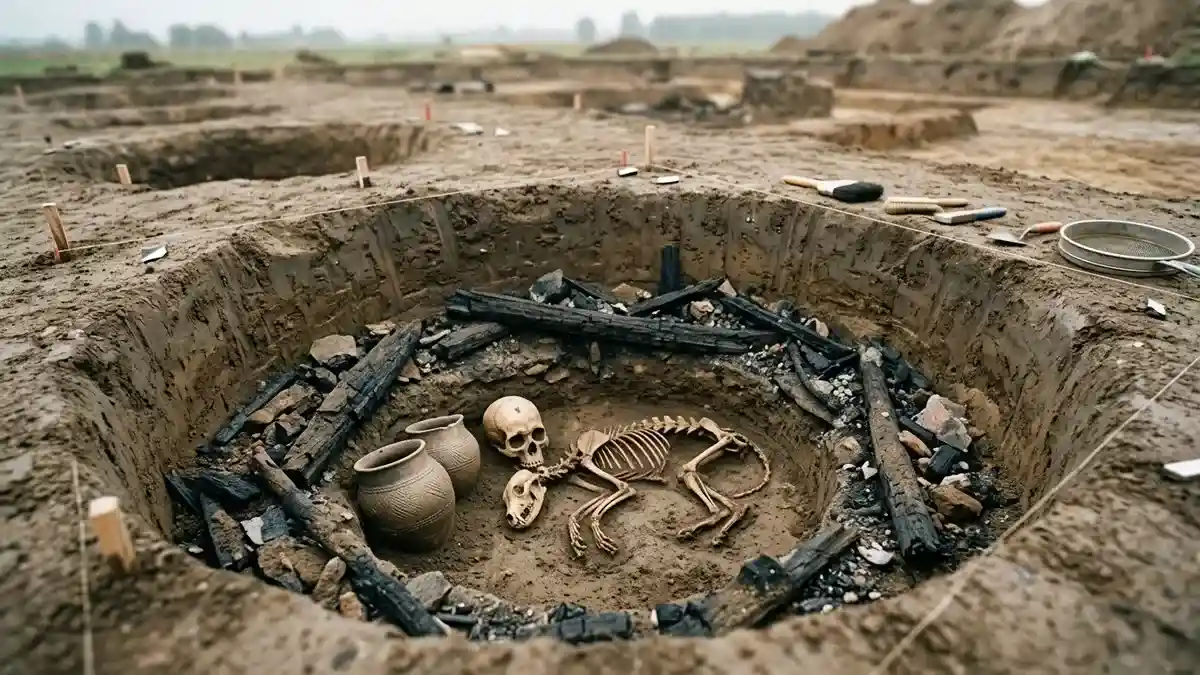
The excavations at the Gerstewitz site exposed twelve large, circular pits measuring between 2 and 3 meters (roughly 6.5 to 10 feet) in diameter and dropping down to depths of up to 2.5 meters into the subsoil. The layout indicates a highly coordinated sacred space, as the cluster of pits was completely enclosed by a series of protective perimeter ditches.

Rather than serving as standard domestic storage cellars or trash repositories, the contents of these shafts reveal a highly deliberate, symbolic filling process. The pits were packed with a dense mixture of premium offerings and burnt structural debris:
The Intact Ritual Vessels
Inside one of the excavated pits, archaeologists discovered two completely intact ceramic vessels. Positioned carefully away from the surrounding rubble, these pots were evidently manufactured and utilized specifically for ritual libations or food offerings during the sealing ceremony, serving as a direct physical link to the participants’ actions.
The Sacrificial Dog and the Skull
The most complex and haunting arrangement emerged from a neighboring shaft. This pit contained the charred skeletal remains of a domestic dog, preserved perfectly in its original anatomical position. Resting directly alongside the animal’s torso was a detached human skull.

Intriguingly, forensic analysis of the human skull revealed no signs of weather-induced degradation or environmental wear. This lack of weathering suggests a highly specific timeline: while the dog’s remains may have been exposed or kept elsewhere for a prolonged period, the human skull was fresh and recently harvested when it was deposited into the active pit alongside the canine companion.
Multi-Phase Funerals and the Context of Crisis
The complexity of the site deepened when researchers cleared out a series of old cooking ovens that had been intentionally converted into ritual spaces. Inside one of these modified oven pits, anthropologists uncovered the commingled skeletal remains of two individual humans.
Forensic analysis demonstrated that these bodies had undergone extensive decomposition in a separate, external location long before their bones were gathered and placed inside the oven. This physical evidence points to a multi-phase, deeply theatrical funeral process that required months or even years to complete.
[Initial Death] ➔ [External Exposure & Decomposition] ➔ [Skeletal Re-harvesting] ➔ [Final Pit Interment]
This staging implies that the Gerstewitz pits were not quickly dug and filled in a single afternoon. Instead, they remained open to the sky for extended periods, serving as active, recurring ceremonial stages where communities could return to interact with the remains of their ancestors.
Navigating a Changing Neolithic Landscape
Why did the Salzmünde people invest so much collective energy into these elaborate, resource-heavy ceremonies? Historians point to a massive regional crisis unfolding across Central Europe around 3000 BCE.
During this era, the continent suffered a severe climatic downturn, characterized by cooling temperatures and highly volatile, unpredictable weather patterns that directly threatened agricultural yields and livestock survival. Simultaneously, the expanding Bernburg Culture began pushing into traditional Salzmünde territory from the north, triggering intense territorial strain and social anxiety.
Faced with failing crops and the threat of invasion, the Salzmünde populations turned inward, developing increasingly complex spiritual rituals to restore order to their world. By burying family skulls alongside companion animals and burning down structural elements, they were calling upon the protective spirits of their ancestors and animal guides to secure safety, weather stability, and territorial sovereignty.
The Symbolic Role of the Prehistoric Dog
The recurring presence of dogs within these Late Neolithic ritual contexts remains a subject of intense academic interest. In early farming societies, domestic dogs were essential economic assets, serving as hunting partners, camp guardians, and livestock herders.
The intentional sacrifice and careful anatomical placement of a dog within a human skull pit prove that their value extended deep into the spiritual realm. Many specialists believe that the Salzmünde people viewed dogs as spiritual guides or psychopomps—divine mediators capable of safely guiding human souls across the boundary separating the land of the living from the underworld of the dead.
Conclusion
The excavations along the SuedOstLink transmission path have provided the international scientific community with far more than a simple collection of ancient artifacts. By exposing the Gerstewitz ritual complex, archaeology has lifted the veil on a resilient society navigating an ancient environmental crisis. The twelve circular pits show that when faced with a changing world, our ancestors did not simply surrender to despair; they constructed a deeply symbolic, beautifully complex ceremonial language to honor their dead, preserve their heritage, and seek comfort amid the unknown.
Frequently Asked Questions
1. What exactly was discovered near Gerstewitz, Germany?
Archaeologists conducting preconstruction surveys for the SuedOstLink power project discovered twelve large, ditch-enclosed ritual pits dating back 5,000 years. The features are tied directly to the Late Neolithic Salzmünde Culture and contain a symbolic mixture of human skulls, complete animal sacrifices, intact pottery, and charred building remains.
2. Who were the Salzmünde people?
The Salzmünde Culture (c. 3400–3050 BCE) was a distinct regional branch of the broader European Funnel Beaker Culture, centered primarily along the Saale River valley in modern-day Germany. They are known for their highly complex mortuary traditions, which frequently involved secondary bone manipulation, violence, and the separate burial of human skulls.
3. What does a “multi-phase funeral rite” mean in archaeology?
A multi-phase funeral rite means that a deceased individual was not buried permanently immediately after death. Instead, the body was allowed to decompose elsewhere (such as via exposure on a platform). Months or years later, the community would return to harvest specific bones—often the skull—to use them in secondary ceremonies before final interment in a ritual pit.
4. Why were dogs included in these ancient sacrificial pits?
In the Salzmünde worldview, dogs likely served a dual purpose as essential working animals in life and spiritual guides in death. Because of their protective instincts, they were frequently sacrificed and buried alongside human remains to act as symbolic guardians or mediators helping human souls navigate the transition into the afterlife.
5. What environmental factors triggered these complex rituals?
Around 3000 BCE, Central Europe experienced a severe climate downturn marked by unpredictable, colder weather that disrupted farming and animal herding. This environmental strain, combined with the territorial expansion of the rival Bernburg Culture, created a period of intense societal stress, prompting the Salzmünde people to seek stability through complex religious ceremonies.