
Table of Contents
- 1. The Mystery Cult of Mithras: From Persia to Rome
- 1.1. The Standard Layout of a Roman Mithraeum
- 2. How the Močići Sanctuary Shatters the Imperial Pattern
- 3. Mapping an Out-of-Doors Ritual Arena
- 4. The Sacred Chemistry of Stone, Water, and Pastoral Life
- 4.1. The Connection to Silvanus and Local Grazing
- 5. A Clash of Myths: Reconnecting with Iranian Roots
- 6. Conclusion
- 7. Frequently Asked Questions
- 7.1. 1. What makes the Močići Mithras sanctuary different from typical Roman temples?
- 7.2. 2. How did archaeologists map the site to discover its layout?
- 7.3. 3. What is depicted in the main relief sculpture at Močići?
- 7.4. 4. Why is the natural spring at the site historically significant?
- 7.5. 5. How does the deity Silvanus tie into the site?
Open-Air Mithraeum in Croatia Explodes Traditional Roman Temple Models
For centuries, the standard image of a Roman temple dedicated to the mystery cult of Mithras has been fixed in the minds of historians and archaeologists: a dark, subterranean, windowless hall designed to isolate a secretive group of initiates from the outside world. Yet, a groundbreaking archaeological study of a sanctuary along the Adriatic coast has completely overturned this rigid architectural model, revealing that some ancient worshippers prioritized the raw, open-air natural landscape over constructed stone walls.
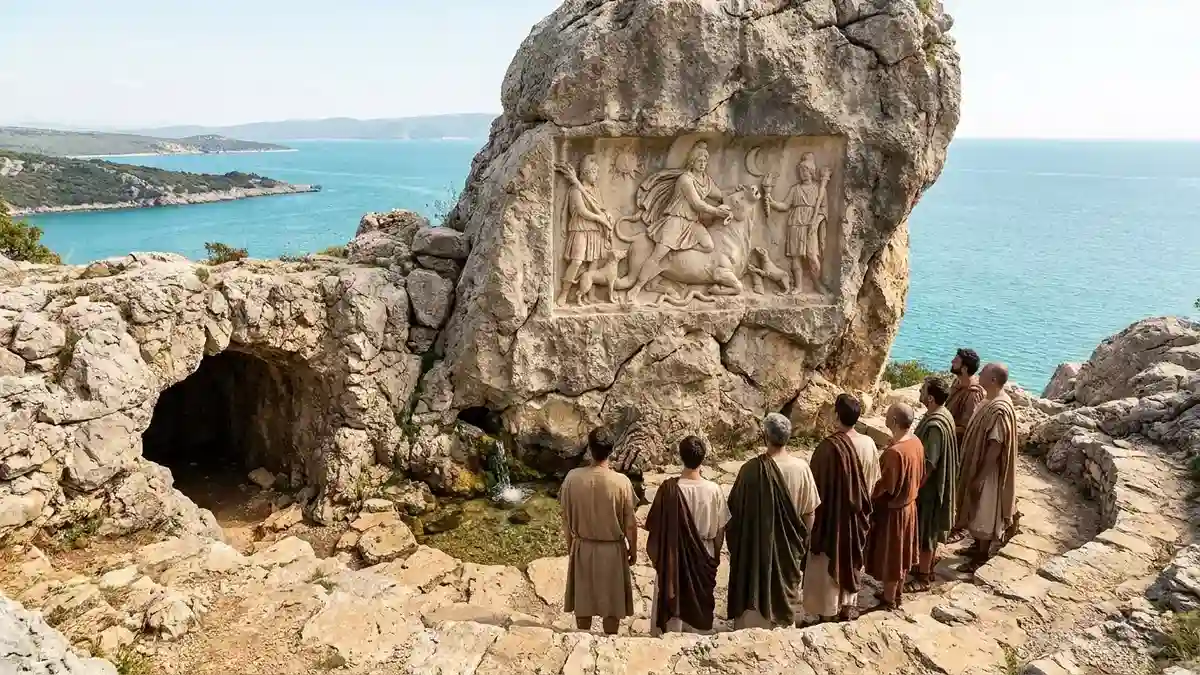
The research focuses on Močići, a unique sanctuary located on a cliffside above the Adriatic Sea near the ancient Roman colony of Epidaurum in present-day Croatia. By pairing modern digital mapping with landscape analysis, scientists have demonstrated that this sacred site completely lacked the roofs, walls, and formal benches characteristic of typical Roman temples. Instead, it was an entirely open-air ritual environment where the natural geology of the region dictated how ancient ceremonies were performed.
Open-Air Mithraeum in Croatia Explodes Traditional Roman Temple Models
The Mystery Cult of Mithras: From Persia to Rome
The worship of Mithras represents one of the most fascinating religious transformations in the ancient world. The cult traces its oldest roots back to Mithra, an ancient Iranian and Persian deity who served as a guardian of contracts, light, truth, and cosmic order within pre-Zoroastrian and later Zoroastrian traditions.

As Roman legionnaires, administrative officials, and merchants pushed eastward, they adopted elements of this Persian belief system. Between the second and fourth centuries CE, they carried it back toward the West, where it morphed into a highly secretive, male-only “mystery cult.”
In mainstream Roman practice, the god was reimagined as a figure of personal salvation and intense initiation rituals. Across the vast expanses of the Roman Empire—from the military outposts of Britain to the urban centers of Rome itself—worshippers gathered in standardized, artificial temples called mithraea.
The Standard Layout of a Roman Mithraeum
A typical Roman Mithras temple was designed to mimic a cosmic cave. These long, rectangular, windowless rooms usually measured over 60 square meters and featured:
Side Benches: Raised stone or masonry benches running along the side walls where initiates reclined during communal ritual feasts.
The Central Tauroctony: A prominent, brightly painted relief sculpture at the far back wall depicting the cult’s central myth: Mithras slaying a cosmic bull.
How the Močići Sanctuary Shatters the Imperial Pattern
The coastal site of Močići breaks nearly every rule of conventional Roman Mithraic architecture. At this Dalmatian sanctuary, the primary relief sculpture of Mithras is carved directly into a living limestone cliff face situated right above the mouth of a small, natural cave.
The artwork itself strictly adheres to classical Roman iconographic conventions. It depicts the standard, highly symbolic tauroctony scene: Mithras plunging a dagger into the neck of the bull, accompanied by a dog and a serpent licking the life-giving blood, a scorpion attacking the animal from below, flanking torchbearers, and representations of the sun and moon in the upper corners.
Yet, while the artwork looks completely Roman, the structural context is entirely different. Archaeological investigations confirmed that there are no traces of constructed walls, artificial roofs, or built masonry benches anywhere at the site.
Furthermore, the interior of the natural cave is incredibly cramped, measuring just 17.7 square meters. This tiny space is far too small to accommodate the large, communal ritual dinners that defined Roman Mithraic communities. The relief is also positioned in a way that makes it highly difficult to view comfortably from inside the cave’s dark interior. Instead, the carving is perfectly oriented to be seen clearly by an observer standing outside on the hillside, aligning the sacred image directly with the surrounding open-air landscape.
Mapping an Out-of-Doors Ritual Arena
To fully grasp how ancient worshippers interacted with this unique space, researchers utilized advanced photogrammetry—a technique that stitches together hundreds of high-resolution photographs to create highly accurate 3D digital models—alongside rigorous field measurements.
The digital mapping revealed a expansive, natural hollow surrounding the cliff and cave mouth. This open, rocky depression forms a gathering space measuring approximately 14 meters across, offering roughly 120 square meters of usable exterior ground.
Rather than squeezing into a dark, artificial room, the evidence strongly suggests that worshippers gathered out in the open, using the natural limestone amphitheater as their ritual stage. The cliff face, the sky, and the open air served as the boundaries of their temple.
The Sacred Chemistry of Stone, Water, and Pastoral Life
Mithraic theology across the Roman world frequently emphasized the god’s connection to water and stone, often celebrating him as a “rock-born” deity. In urban environments, temples had to artificially recreate these elements, using masonry to mimic caves and installing complex plumbing to pipe water into indoor basins.
At Močići, nature did the work for them. The sanctuary features a permanent, natural limestone spring that flows with fresh water year-round. Worshippers did not need to construct symbolic representations of cosmic elements because the living stone and the life-giving water already existed on-site in their purest, unadulterated forms.
The Connection to Silvanus and Local Grazing
The study also re-examined a secondary relief sculpture located inside the small cave. This carving is traditionally linked to Silvanus, a Roman wildwood deity who, in the Dalmatian region, became deeply conflated with indigenous pastoral gods protecting forests, livestock, and rugged terrains.
The inclusion of Silvanus highlights the deep connection between the sanctuary and the local economy. The surrounding Dalmatian landscape relied heavily on seasonal herding and pastoral grazing in the rocky hills. Because the permanent spring at Močići provided a reliable water source for livestock moving through an otherwise dry, karstic landscape, the site became a natural crossroads where daily agrarian survival and spiritual devotion blended seamlessly.
A Clash of Myths: Reconnecting with Iranian Roots
The open-air, nature-driven layout of Močići may also bridge the gap between Roman Mithraism and its older Persian origins. While Roman urban temples focused heavily on indoor initiation banquets, the older Iranian traditions of Mithra were deeply tied to the broader cosmic balance, visible light, and the open sky.
By placing the ritual activity outside in the sun, beside a living water source, and directly centered on an unaltered rock face, the creators of the Močići sanctuary honors the primal myths of the god’s stone birth and his association with environmental fertility far more directly than any windowless city temple ever could.
Conclusion
The revelations at Močići challenge the long-standing archaeological assumption that Roman religion was a rigid, standardized package of architectural blueprints exported uniformly across the provinces. Instead, it proves that ancient religious practices were highly adaptive, deeply conversational processes shaped by local geographies and cultural landscapes. Worshippers in Dalmatia did not force an abstract, urban temple model onto their environment; they allowed the cliffs, the springs, and the open skies of the Adriatic coast to define their sacred experience.
Frequently Asked Questions
1. What makes the Močići Mithras sanctuary different from typical Roman temples?
Most Roman temples dedicated to Mithras (known as mithraea) were long, fully enclosed, windowless rooms measuring over 60 square meters, featuring built stone side benches for indoor ritual meals. Močići completely breaks this rule by featuring no walls, roofs, or built benches, operating entirely as an open-air sacred space.
2. How did archaeologists map the site to discover its layout?
Researchers utilized photogrammetry—taking numerous overlapping photographs of the cliff, cave, and terrain and processing them through advanced software—to create highly detailed 3D digital models. This was combined with traditional field measurements to map out a 120-square-meter natural outdoor gathering area.
3. What is depicted in the main relief sculpture at Močići?
The carving is a traditional Roman tauroctony, which depicts the central myth of the cult: the god Mithras slaying a cosmic bull. The scene includes all standard imperial symbols, such as flanking torchbearers, a dog, a serpent, a scorpion, and celestial symbols of the sun and moon.
4. Why is the natural spring at the site historically significant?
Mithraic religious tradition frequently associated the god with living water and rock formations, which urban temples had to artificially recreate using plumbing and masonry. At Močići, a natural, permanent spring flows through the limestone year-round, allowing worshippers to conduct rituals around unaltered natural elements.
5. How does the deity Silvanus tie into the site?
A secondary relief inside the cave depicts Silvanus, a deity associated with forests, herding, and wild, rocky landscapes. His presence indicates that the sanctuary was deeply connected to the local pastoral economy, as the permanent spring served as a vital water stop for livestock grazing on the Dalmatian hills.