
Table of Contents
- 1. From Bomb Scare to Historic Masterpiece
- 2. The Secret Life of a Decommissioned Weapon
- 3. Tracking Hull’s Maritime Defense Networks
- 4. The Link to the 1930s Dock Infill
- 5. Preserving a Heavy Piece of History
- 6. Frequently Asked Questions
- 6.1. Why did the construction workers think the cannon was a bomb?
- 6.2. How were old cannons turned into mooring posts?
- 6.3. What was Queen’s Gardens before it became a park?
- 6.4. What is the difference between cast iron and modern steel weapons?
- 6.5. Where can I see the discovered cannon today?
Construction Crews Unearth 18th-Century Cannon in Historic English Plaza
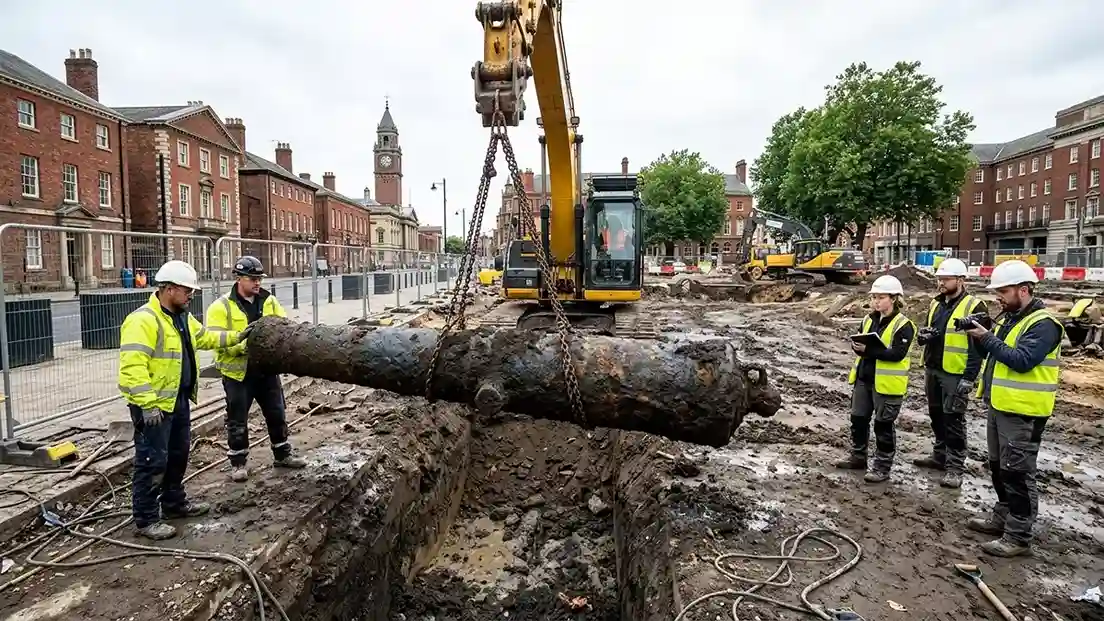
A routine urban restoration project in England has turned into a major archaeological investigation. Construction crews working on the multi-million-dollar revitalization of Queen’s Gardens in Kingston upon Hull (commonly known as Hull) shocked historians when they dug up a massive, intact cast-iron cannon buried deep beneath the park’s walkways.
The discovery was made on February 13 by contractors from CR Reynolds while they were excavating a trench for a modern water storage tank. What began as a standard infrastructure upgrade instantly transformed into a high-stakes archaeological recovery operation that sheds new light on the city’s rich seafaring and military heritage.
Construction Crews Unearth 18th-Century Cannon in Historic English Plaza
From Bomb Scare to Historic Masterpiece
The discovery began with a moment of sudden panic. While digging down roughly 1.5 meters (nearly five feet) into the soil, an excavator operator struck a massive, unyielding metallic object. Given Hull’s history as one of the most heavily bombed British cities during the Second World War Blitz, the construction crew immediately paused operations, fearing they had struck an unexploded German bomb.
 Republican-Era Tombs and Hercules Shrine Unearthed in Eastern Rome Reveal Centuries of Suburban Life
However, once specialized engineers cleared away the dense clay, they spotted distinctive, raised reinforcement rings encircling one end of the iron cylinder. Instead of a 20th-century explosive, they were looking at the barrel of a historical piece of artillery.
[Physical Specifications of the Hull Cannon]
├── Length: 2.6 meters (8.5 feet)
├── Weight: Over 1 metric ton (2,200+ lbs)
├── Material: Solid cast iron
└── Status: Capped muzzle (Decommissioned in antiquity)
The weapon is a formidable piece of historical engineering, measuring 2.6 meters in length and tipping the scales at well over a ton. Early estimates from on-site historians place its manufacture somewhere between the late 17th and mid-18th centuries, a time when Hull was a booming, fortified trading port.
The Secret Life of a Decommissioned Weapon
Specialists from Humber Field Archaeology rushed to the scene to document the artifact in situ (in its original resting place). Their initial forensic analysis revealed a critical clue: the muzzle of the cannon had been intentionally capped and sealed. This modification indicates that the weapon had been officially decommissioned from active military service and modified for a second, civilian life.

+-------------------------------------------------------------+
|              THE LIFE CYCLE OF THE HULL CANNON              |
+----------------------+--------------------------------------+
| Era / Phase          | Intended Function                    |
+----------------------+--------------------------------------+
| 17th – 18th Century  | Military defense (Warship or Fort)   |
| 19th Century         | Replaced by advanced steel artillery |
| Late 19th Century    | Repurposed as a dockside mooring post|
| 1930s Great Depres.  | Pushed into dock during infill project|
| 2026 Excavation      | Unearthed during park restoration    |
+----------------------+--------------------------------------+
Archaeologists believe that after the smoothbore iron cannon became obsolete due to the invention of modern rifled steel artillery, it was recycled by port engineers. In the late 19th and early 20th centuries, maritime cities across Great Britain regularly buried old cannon barrels vertically into dockside quays, leaving just the base exposed to serve as incredibly sturdy mooring bollards for heavy merchant ships.
Tracking Hull’s Maritime Defense Networks
Before it was buried as a dockside mooring post, this cannon played a vital role in local defense. Investigators are currently looking into two primary possibilities for its original deployment:
Naval Warfare: The cannon may have been mounted on the deck of a British warship or a heavily armed merchant vessel traveling the hazardous North Sea trade routes.
Coastal Fortifications: It could have belonged to a land-based artillery battery positioned along Hull’s medieval walls or the famous Hull Citadel, built by King Charles II to protect the strategic harbor from foreign invaders.

This artifact marks only the third historical cannon ever recovered from archaeological excavations within the city. Its discovery provides rare, physical evidence of the coastal defense infrastructure that allowed the city to evolve into one of England’s primary gateways for international trade.
“Discoveries like this are a vivid reminder of Hull’s deep-rooted connection to the sea. This cannon stood guard over our waters before helping to tie down the very ships that built our city’s wealth.”
— Humber Field Archaeology Research Team
The Link to the 1930s Dock Infill
The physical location where the cannon was found holds the key to why it was buried where it was. Modern-day Queen’s Gardens was not always a green public park. Prior to the mid-20th century, the site was occupied by Queen’s Dock, which opened in 1778 as the city’s very first commercial dock.
By the 1930s, the dock had become obsolete for modern, deep-draft cargo ships. As part of a massive urban renewal project during the Great Depression, the local government decided to close and fill in the historic waterway, transforming the space into a public plaza.
When workers filled Queen’s Dock with millions of tons of soil and rubble, they simply snapped or pushed the old cannon mooring posts down into the mud, sealing them away until modern contractors dug them up nearly a century later.
Preserving a Heavy Piece of History
City officials have confirmed that the heavy iron barrel has been successfully lifted out of the excavation pit and moved to a secure, specialized conservation facility. Because the iron sat in damp, acidic soil for decades, it will undergo a meticulous restoration process to remove layers of corrosion and stabilize the metal.
Once the conservation team finishes cleaning the surface, they hope to locate foundry stamps, manufacturing dates, or royal cyphers engraved into the iron, which will pinpoint the exact year and location where the weapon was cast. Eventually, the city plans to put this recovered piece of maritime history on permanent public display.
Frequently Asked Questions
Why did the construction workers think the cannon was a bomb?
During World War II, Hull was targeted by German bombers due to its vital shipping docks, making it one of the most bombed cities in the UK outside of London. Unexploded ordnance (UXO) is still frequently discovered during modern construction projects in the UK, so crews are trained to stop digging immediately whenever they hit large, unexplained metallic objects in the ground.
How were old cannons turned into mooring posts?
When smoothbore cast-iron cannons became obsolete, port cities had a massive surplus of heavy metal barrels. To save money and resources, engineers buried the barrels vertically into the dock walls—muzzle first—and filled the hollow interior with concrete or iron caps. The thick, flared knob at the back of the cannon (the cascabel) was left sticking out of the ground, making a perfect hook to wrap ship ropes around.
What was Queen’s Gardens before it became a park?
Before becoming a public park, the area was Queen’s Dock, which opened in 1778. It was a massive water basin where merchant vessels unloaded goods from around the world. It was filled in during the 1930s when shipping vessels grew too large for the shallow basin, and the area was repurposed into the grand public gardens seen today.
What is the difference between cast iron and modern steel weapons?
Cast iron cannons, popular from the 1500s through the 1800s, were created by pouring molten iron into a mold. They were incredibly heavy, brittle, and prone to exploding if overcharged with gunpowder. Modern steel weapons, which replaced them in the late 19th century, are forged under immense pressure, making them lighter, significantly stronger, and capable of shooting streamlined shells much further.
Where can I see the discovered cannon today?
The cannon is currently undergoing a long stabilization and cleaning process by archaeological conservators to prevent the iron from flaking or rusting away now that it is exposed to the air. Once this scientific preservation process is complete, Hull City Council intends to display the weapon in a local museum or integrate it directly back into the newly restored Queen’s Gardens plaza.