
Table of Contents
- 1. Unearthing the Salcombe Wreck: A Timeline of Discovery
- 2. Identifying the Dom van Keulen: Clues from the National Archives
- 3. Anatomy of a 17th-Century Cargo: A Global Trade Hub
- 4. Salvage Operations and the British Museum Collection
- 5. Conclusion
- 6. Frequently Asked Questions
- 6.1. Where did the gold coins found on the shipwreck originally come from?
- 6.2. Did anyone die when the Dom van Keulen sank in 1633?
- 6.3. Why is the shipwreck site closed to standard recreational divers?
- 6.4. What is gum arabic, and why was it being shipped to the Netherlands?
- 6.5. What did the crew use the fish-shaped sounding weight for?
30-Year Marine Mystery Solved with Identification of 1633 Gold Shipwreck
For nearly three decades, a nameless shipwreck resting off the jagged southern coast of England has fueled the imaginations of historians and treasure hunters alike. Discovered by divers in the mid-1990s, the underwater site yielded hundreds of glittering gold coins buried deep within the channel silt. Yet, the true identity of the vessel, its country of origin, and the fateful circumstances surrounding its final journey remained locked beneath the waves.
Now, following a monumental effort spanning thirty years of archival detective work and forensic marine analysis, researchers have officially cracked the case. The lost vessel has been confidently identified as a prominent 17th-century Dutch merchant ship laden with thousands of Moroccan gold ducats. This breakthrough beautifully illuminates a sophisticated, multi-continental trading network that connected West African gold fields to the bustling economies of northern Europe.
30-Year Marine Mystery Solved with Identification of 1633 Gold Shipwreck
Unearthing the Salcombe Wreck: A Timeline of Discovery
The journey to solving this maritime riddle began in 1995 near Salcombe, a picturesque coastal town in Devon, England. While exploring the seabed at a depth of roughly 18 meters, local divers stumbled upon a scattered field of ancient debris. Peering through the murky water, they spotted iron cannons, heavy anchors, and a handful of heavily encrusted gold coins.

+------------------------+----------------------------------------------------+
| Wreck Attribute        | Marine Archaeological Details                      |
+------------------------+----------------------------------------------------+
| Initial Discovery Year | 1995 by local divers near Salcombe, Devon           |
| Seabed Footprint       | Approximately 30 meters across                     |
| Depth Elevation        | Roughly 18 meters (59 feet) below the surface      |
| Legal Status           | Heavily protected under British law via Historic England|
+------------------------+----------------------------------------------------+
Recognizing the immense historical value of the site, British maritime authorities immediately restricted access, placing the zone under strict legal protection. Over the subsequent decades, licensed diving teams systematically mapped the site, which stretches across a 30-meter footprint on the ocean floor. While the structural woodwork of the ship had long since rotted away, the heavy artillery and scattered cargo remained precisely where they fell three centuries earlier.
Identifying the Dom van Keulen: Clues from the National Archives
The crucial breakthrough that finally gave the anonymous wreck a name did not happen at sea, but rather inside the climate-controlled vaults of the National Archives. Prominent historian Ian Friel meticulously combed through 17th-century maritime court filings, insurance claims, and personal correspondence to piece together a compelling historical narrative.
                    THE FATEFUL PATH OF THE MERCHANDISE

  [ Kingdom of Morocco ] ===> Encountered Severe Storms ===> [ English Coastline ]
  * Loaded with gold,          * Hull sprang a major leak     * Wrecked near Salcombe
    skins, and saltpeter       * Entire crew escaped safely   * Cargo lost to seabed
Friel’s research successfully matched the physical evidence from the Devon seabed with official records documenting the tragic loss of a Dutch merchant vessel named the Dom van Keulen. In the autumn of 1633, the heavily laden trade ship was navigating its way north through the English Channel, bound for a home port in the Netherlands, when it ran directly into a catastrophic seasonal storm.

Battered by immense waves, the ship’s wooden hull sprang a severe leak. As the water level rose inside the hold, the captain realized the vessel was doomed, maneuvering it toward the English coastline. While the ship ultimately sank beneath the waves, archival records show that the entire crew managed to escape safely onto dry land.
Anatomy of a 17th-Century Cargo: A Global Trade Hub
The newly published findings offer an invaluable, unaltered look at the vibrant commercial ties linking North Africa and Europe during the seventeenth century. The Dom van Keulen was effectively a floating warehouse, carrying a diverse array of high-value goods acquired along the Atlantic coast of Morocco:
Barbary Ducats: Approximately 9,000 brilliant gold coins minted directly in North Africa.
Gum Arabic: 150 sacks of a precious tree-bark resin highly prized in Europe for textile printing, ink fabrication, and medicinal ointments.
Saltpeter: 64 bags of potassium nitrate, an essential chemical building block used across European munitions factories to manufacture gunpowder.
Goat Skins: 320 high-quality cured hides intended for the luxury European leather garment market.
The massive cache of Barbary ducats pulled from the seabed provides a direct link to the global gold trade of the era. During the 1600s, Morocco’s strategic ports served as the primary gateway for vast amounts of gold traveling north from West African mines.
Dutch merchants eagerly exchanged manufactured goods, textiles, and metalwork for this raw African gold, which was then funneled directly into domestic mints to produce the highly stable currencies that powered international trade routes.
Salvage Operations and the British Museum Collection
Interestingly, the historical record indicates that modern divers were not the first people to harvest the wealth of the Dom van Keulen. Shortly after the ship foundered in late 1633, local salvagers and representatives for the merchants likely used primitive diving bells and grappling hooks to successfully recover a significant portion of the submerged cargo. However, because the ship broke apart rapidly in the surf, hundreds of gold coins slipped between the rocks, remaining hidden for more than 360 years.
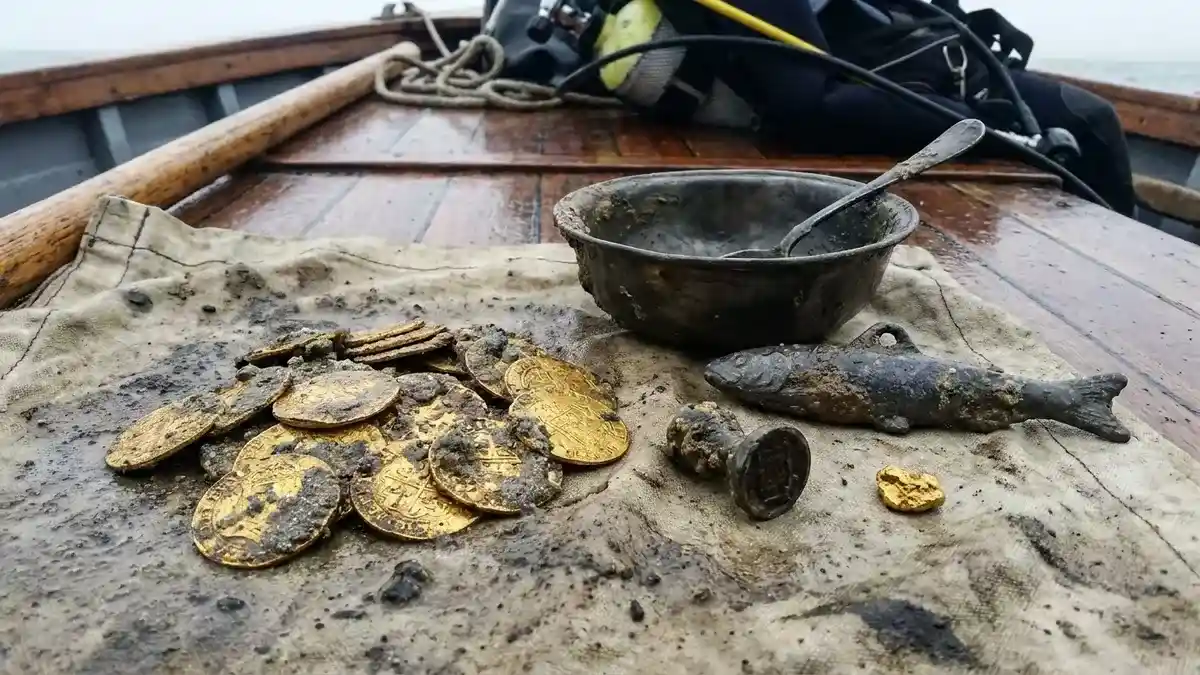
Today, the vast majority of the recovered treasures are housed within the secure collection of the British Museum. Alongside the mesmerizing gold coins, archaeologists have salvaged an intimate assortment of personal items that bring the daily lives of the 17th-century crew into sharp focus:
Personal Utensils: A well-preserved pewter bowl and a matching spoon used during shipboard meals.
Navigational Gear: A specialized lead sounding weight cleverly shaped like a pilchard fish, used by the crew to measure water depth and collect seafloor sediment samples.
Trade Tools: A personalized stamp seal used by the supercargo (merchant agent) to verify official manifests, alongside a heavy gold finger nugget.
Conclusion
The definitive identification of the Dom van Keulen stands as a spectacular triumph for modern maritime archaeology and historical research. What began as a scattered puzzle of uncontextualized gold coins on a rocky Devon reef has evolved into an epic, fully documented story of international trade, stormy seas, and an enduring economic bridge linking West Africa to Northern Europe. Thanks to the seamless coordination between archival historians and marine archaeologists, this lost ghost ship has finally reclaimed its name, ensuring its place in the vibrant tapestry of global maritime history.
Frequently Asked Questions
Where did the gold coins found on the shipwreck originally come from?
The gold coins are Barbary ducats, which were officially minted in Morocco under the ruling Sa’dian Sharif dynasty. The raw gold used to strike these coins originated from extensive West African trade networks that moved the precious metal north across the Sahara Desert to Moroccan coastal ports.
Did anyone die when the Dom van Keulen sank in 1633?
No. According to recovered historical logs preserved within the National Archives, despite the severity of the storm and the critical hull leak that ultimately sank the ship, the captain successfully managed the crisis, allowing the entire crew to safely abandon ship and reach the English coast.
Why is the shipwreck site closed to standard recreational divers?
The site is protected under strict British maritime heritage laws and is actively managed by Historic England. Because the remaining artifacts, cannons, and anchors are highly fragile and vulnerable to looting or accidental damage, only specially licensed archaeological diving teams are legally permitted to visit the wreck.
What is gum arabic, and why was it being shipped to the Netherlands?
Gum arabic is a natural secretion harvested from specific African acacia trees. In the 17th century, it was a highly valued industrial luxury import in northern Europe, utilized extensively as a binding agent for high-quality inks, a stabilizer in textile manufacturing, and a key ingredient in pharmaceutical compounds.
What did the crew use the fish-shaped sounding weight for?
The lead sounding weight, whimsically cast in the shape of a pilchard fish, was a critical navigation tool. Sailors dropped it over the side of the hull on a marked rope to determine the exact depth of the water. The bottom of the weight was often coated with tallow (animal fat) to pick up sand or mud from the seabed, helping the captain determine their exact position on a maritime chart.