
Table of Contents
- 1. The Block Excavation: Saving Prehistoric Time Capsules
- 2. Anatomy of the Treasure: What Was Inside?
- 3. Fake Silver: The Advanced Alchemy of Tin Enrichment
- 4. A Ceremonial Spectacle in the Sunlight
- 5. Conclusion: A Three-Year Journey Into the Past
- 6. Frequently Asked Questions
- 6.1. How old is the Peebles Hoard, and where was it found?
- 6.2. If silver didn’t exist in Bronze Age Scotland, how are the objects silvery?
- 6.3. What are bronze “rattle pendants” and how were they used?
- 6.4. Why did archaeologists dig up the hoard inside a giant block of dirt?
- 6.5. How long will the conservation process take before the hoard can be displayed?
3,000-Year-Old Silvery Secret Uncovered in Scotland’s Peebles Hoard
When metal detectorist Mariusz Stepien pushed his equipment through the damp soil south of the town of Peebles in 2020, he knew he had stumbled onto something special. What he couldn’t have anticipated was that his discovery would rewrite the textbook on prehistoric European technology.
Dating to the Late Bronze Age between 1000 and 800 BCE, the spectacular Peebles Hoard consists of more than 500 bronze and rare organic artifacts. Following its official allocation to National Museums Scotland (NMS) through the strict British Treasure Trove process, the treasure was moved into laboratory conservation. Now, meticulous cleaning has exposed a breathtaking secret: a gleaming, brilliant silvery finish coating the artifacts—from an era when true silver was virtually unknown in the region.
3,000-Year-Old Silvery Secret Uncovered in Scotland’s Peebles Hoard
The Block Excavation: Saving Prehistoric Time Capsules
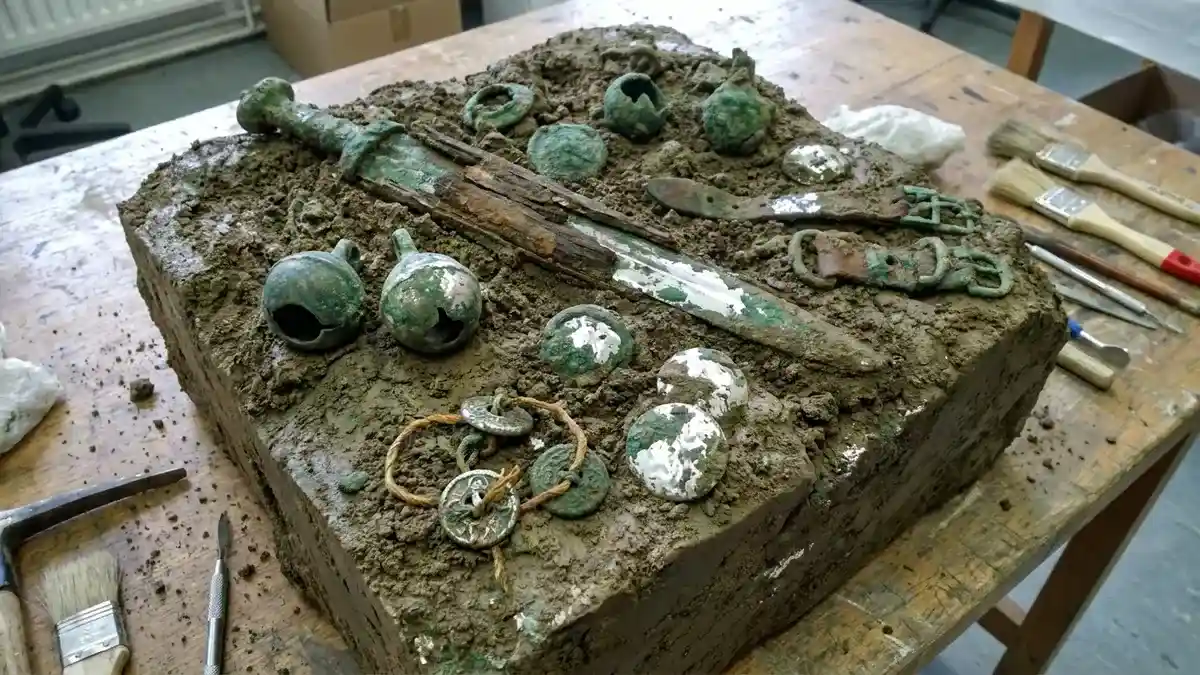
The incredible preservation of the Peebles Hoard is entirely due to the rapid, forward-thinking response of the recovery team. Recognizing that the fragile metal items were intimately intertwined with ancient organic strings, wood, and leather, archaeologists refrained from pulling the objects out of the earth piece by piece.

Instead, the excavation team carved out the entire surrounding mass of earth as a single, heavy block of soil. Wrapped securely and transported intact, this dirt capsule was systematically dissected under controlled laboratory conditions at the National Museums Collection Centre in Edinburgh. This high-stakes methodology allowed scientists to preserve micro-traces of textile cords and wooden components that would have instantly crumbled to dust in an open-air field excavation.
Anatomy of the Treasure: What Was Inside?
The contents of the Peebles Hoard represent one of the most complete and unique snapshots of elite Late Bronze Age material culture ever recovered from northern Europe. The assembly includes several items that are completely unique to world archaeology.
+------------------------+----------------------------------------------------+
| Artifact Category      | Specific Archaeological Discoveries                |
+------------------------+----------------------------------------------------+
| Ceremonial Regalia     | Two highly unusual bronze rattle pendants           |
| High-Status Weaponry   | A bronze sword resting inside its wooden scabbard  |
| Elite Garments         | Intricate bronze buttons strung on original strings|
| Transport & Equestrian | Finely decorated strap attachments and harness gear|
+------------------------+----------------------------------------------------+
When first extracted from the soil block, every single object was heavily masked beneath an encrusted layer of dirt and a thick, opaque green copper patina—the natural crust that forms on copper-based alloys over millennia of underground burial. It took months of microscopic dental picking and chemical stabilization to peel back this green mask, exposing the original, astonishing surfaces beneath.

Fake Silver: The Advanced Alchemy of Tin Enrichment
The most explosive revelation from the conservation lab was the sudden appearance of bright, silver-colored surfaces shining on several high-status objects. Because true silver metallurgy had not yet arrived in Bronze Age Scotland, the museum team utilized advanced laboratory scanning to determine exactly what chemical wizardry was at play.
The scientific analysis exposed an incredible example of prehistoric intentional design. The brilliant silver finish was achieved through a highly sophisticated technique known as surface tin enrichment:
                  SURFACE TIN ENRICHMENT PROCESS

  [ Raw Bronze Base ] =======> Subjected to Heat & =======> [ High-Tin Surface ]
  (Copper-Tin Alloy)          Chemical Treatments          (Creates Silvery Sheen)
By intentionally manipulating the heating and cooling cycles of the bronze castings, or by applying a concentrated layer of molten tin directly to the surface, ancient smiths forced the tin molecules to migrate outward. This created a dense, polished outer layer that beautifully mimicked the bright luster of silver.

This process proves that prehistoric metalworkers possessed an incredibly advanced, intuitive grasp of chemistry and metallurgy. They weren’t just melting metal; they were deliberately engineering specific visual finishes to drastically enhance the beauty, reflective qualities, and perceived value of their creations.
A Ceremonial Spectacle in the Sunlight
What was the purpose of creating a deceptive silvery sheen? To the Bronze Age mind, metal was a deeply symbolic material closely tied to cosmic order, spiritual power, and socio-political hierarchy.
Experts conclude that the silvery objects—particularly the heavy strap fittings and the unique rattle pendants—formed the decorative hardware for an elite chariot or ceremonial horse harness. Imagine an ancient tribal leader parading through the Scottish landscape during a sacred solstice gathering:
The Visual Impact: As the horse-drawn chariot moved, the meticulously enriched tin surfaces would catch the direct sunlight, casting brilliant, blinding white flashes across the crowd.
The Acoustic Drama: Simultaneously, the unique bronze rattle pendants would emit a rhythmic, metallic chime with every stride of the horses, combining sound and light into an overwhelming display of divine authority and extreme wealth.
Conclusion: A Three-Year Journey Into the Past
The painstaking conservation of the Peebles Hoard is a marathon, not a sprint. The elite team at National Museums Scotland estimates that it will take a full three years of continuous laboratory work to systematically stabilize, clean, and digitally document all 500 fragments.
By successfully peering beneath the thick green patina to discover this 3,000-year-old silvery secret, conservators have permanently dismantled the outdated idea that prehistoric Scotland was a technologically isolated backwater. Instead, the Peebles Hoard stands as a shining monument to human ingenuity, revealing a sophisticated world of brilliant craftspeople who possessed the imagination and technical skill to bend the elements to their creative will.
Frequently Asked Questions
How old is the Peebles Hoard, and where was it found?
The Peebles Hoard is approximately 3,000 years old, dating precisely to the Late Bronze Age between 1000 and 800 BCE. It was discovered in 2020 by a licensed metal detectorist in a field located just south of the town of Peebles in the Scottish Borders.
If silver didn’t exist in Bronze Age Scotland, how are the objects silvery?
The brilliant silver color is the result of an advanced metallurgical technique called surface tin enrichment. Ancient smiths treated the objects to force the tin content within the bronze alloy to concentrate heavily on the outer surface, creating a beautiful coating that perfectly mimicked the shiny appearance of silver.
What are bronze “rattle pendants” and how were they used?
Rattle pendants are exceptionally rare, hollow bronze ornaments designed to hold loose metal balls or rings inside. When attached to elite horse harnesses or ceremonial clothing, they jangled dynamically with movement, creating a distinct acoustic performance that accompanied high-status public rituals.
Why did archaeologists dig up the hoard inside a giant block of dirt?
The hoard was extracted as a single, heavy soil block to protect the incredibly fragile organic materials trapped between the metal weapons and ornaments. By excavating the dirt block slowly inside a sterile laboratory, scientists successfully saved remnants of 3,000-year-old wooden scabbards, leather straps, and woven textile strings.
How long will the conservation process take before the hoard can be displayed?
Because each of the 500+ delicate artifacts must be individually stabilized, microscopically cleaned of corrosion, and chemically preserved against future decay, the complete conservation campaign led by National Museums Scotland is projected to take roughly three years.