
Table of Contents
- 1. The Secret Vaults of the Bone-Eating Raptor
- 2. Inside the Nest: A Mix of Nature and Medieval History
- 2.1. The 650-Year-Old Esparto Sandal
- 3. Decoding Ecological and Environmental Timelines
- 4. A Slow Return for an Endangered Icon
- 5. Frequently Asked Questions
- 5.1. How old are the human artifacts found inside the vulture nests?
- 5.2. Why did the vultures collect shoes, leather, and crossbow bolts?
- 5.3. What kept these delicate organic materials from rotting?
- 5.4. What is esparto grass?
- 5.5. Are bearded vultures still found in Spain today?
650-Year-Old Sandal Discovered in Ancient Spanish Vulture Nests
In the sheer cliffs of southern Spain, a team of researchers scaling vertical rock faces made an extraordinary discovery. They didn’t find hidden cave paintings or buried treasure chests, but something far more unusual: ancient, abandoned bird nests.
A fascinating study published in the journal Ecology reveals that these centuries-old nests, built by a unique species of raptor, functioned as natural time capsules. Over generations, the birds collected human garbage and dropped items to fortify their homes. Among the debris, scientists uncovered a perfectly preserved, 650-year-old woven sandal alongside a treasure trove of medieval artifacts.
650-Year-Old Sandal Discovered in Ancient Spanish Vulture Nests

The Secret Vaults of the Bone-Eating Raptor
The master architects behind these historical vaults were bearded vultures (Gypaetus barbatus). These massive birds are among the most distinct raptors on the planet. They are famous for feeding almost exclusively on animal bones—which they swallow whole or drop from great heights onto rocks to shatter into digestible pieces—and they intentionally stain their feathers a bright orange color using iron-rich mud.
Bearded vultures are also creatures of deep habit. They return to the exact same cliffside nesting sites year after year, generation after generation. Over decades and centuries, this continuous occupation builds up thick, densely compacted, and heavily layered platforms composed of sturdy branches, packed animal wool, and dense bone fragments.
Between 2008 and 2014, scientists rappelled down steep limestone cliffs in Andalusia, Spain, to access 12 of these unique nests. The nesting sites had lain completely undisturbed for a century, ever since local populations of the bearded vulture were driven to extinction in the region during the early 20th century.

Inside the Nest: A Mix of Nature and Medieval History
As researchers carefully excavated the thick, compressed layers of the abandoned nests, they struck an incredible mixture of natural history and human craftsmanship. In total, the platforms yielded more than 2,100 animal bones, 86 detached hooves, and dozens of fossilized eggshells.
Surprisingly, roughly nine percent of the material recovered from the nests consisted of human-made items. The prehistoric inventory included:
129 distinct fragments of ancient fabrics and textiles
72 preserved pieces of hand-worked leather
25 separate items woven from local esparto grass
A selection of weapons, including a medieval crossbow bolt and a hunting slingshot

The 650-Year-Old Esparto Sandal
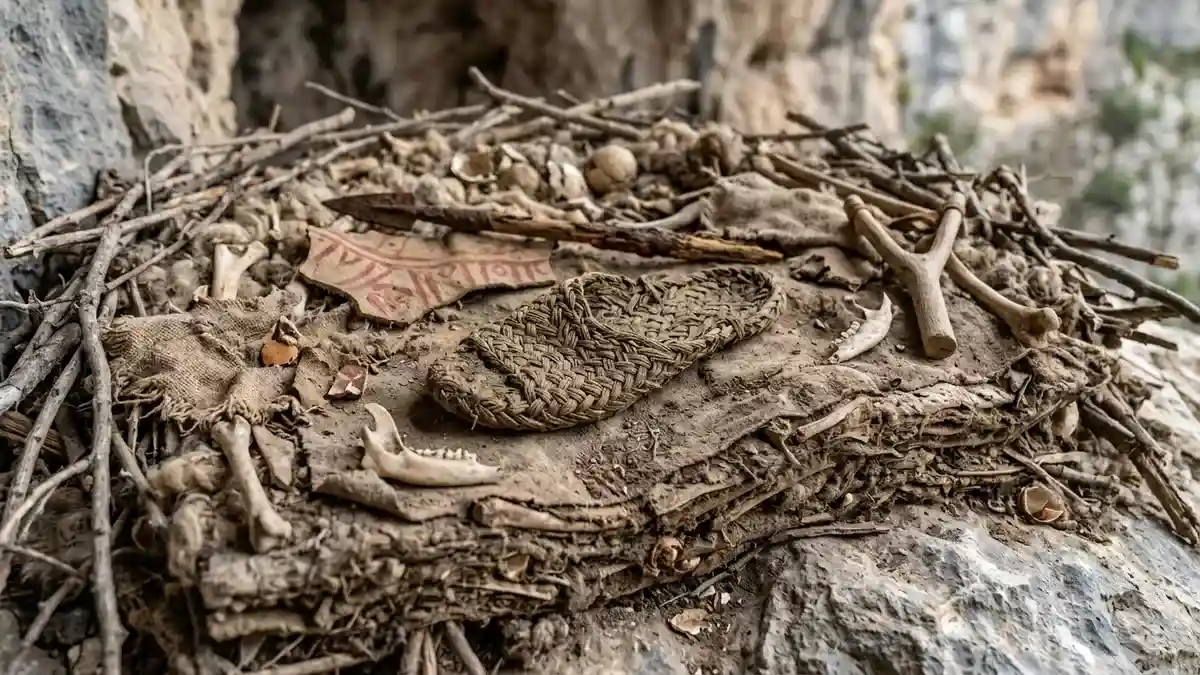
The absolute crown jewel of the excavation was a beautifully woven footwear specimen: a traditional esparto grass sandal. Radiocarbon dating tests confirmed that the shoe is between 650 and 750 years old, placing its creation firmly in the middle of Spain’s medieval period.
Esparto is a exceptionally tough, fibrous Mediterranean grass that local artisans have used for millennia to weave durable ropes, mats, baskets, and traditional espadrille footwear. Because the nest was tucked deep inside a dry, cool, and highly sheltered cliffside cave, the shoe was protected from the destructive elements of rain, wind, and direct sunlight. It survived in near-perfect structural condition.
Right alongside the ancient shoe, the same nest preserved a fragment of painted sheep leather decorated with vibrant red ochre paint, which also dates back several centuries.
Accidental Curators: The vultures did not choose these items for their historical value. While scavenging across the landscape for soft insulation or structural materials to repair their homes, the birds simply snatched up interesting, durable items discarded by nearby human settlements or left behind by traveling hunters.
Decoding Ecological and Environmental Timelines
Beyond its undeniable value to medieval historians, this avian archive is a goldmine for ecological science. By analyzing the dense, sequential layers of bones, feathers, and eggshells, scientists can effectively map out how the local environment changed over hundreds of years.
The preserved animal bones act as a historical ledger, showing exactly which wildlife species populated southern Spain during the Middle Ages and how vulture eating habits shifted in response to human agricultural expansion.
Furthermore, future toxicological studies plan to test the preserved, multi-layered eggshells for microscopic traces of heavy metals, early industrial pollutants, and agricultural pesticides. This chemical timeline will provide invaluable data to modern conservationists working to protect the planet’s remaining raptor populations.
A Slow Return for an Endangered Icon
While these ancient nests have brought the bearded vulture back into the scientific spotlight, the species itself faces a fragile future. Once a common sight soaring across the mountain ranges of southern Europe, the birds suffered catastrophic population crashes during the 19th and 20th centuries due to intense human hunting, habitat fragmentation, and the widespread loss of wild megafauna.
Bearded Vulture Status Profile (Mediterranean Region)
====================================================
Current Wild Population : Fewer than 250 individuals
Primary Modern Threats  : Habitat loss, illegal poisoning, powerline collisions
Conservation Strategy   : Captive breeding and active reintroduction programs
Although the birds were completely wiped out in southern Spain a century ago, dedicated wildlife reintroduction programs have slowly begun bringing them back to the Andalusian crags. With fewer than 250 wild individuals remaining across the broader Mediterranean basin, the species remains critically endangered.
The discovery of these medieval nests highlights a deep, interconnected bond between Spain’s cultural history and its natural heritage. By acting as accidental historians, these magnificent bone-eating birds have gifted the modern world a brilliant, intact portrait of medieval life that would have otherwise rotted away into the soil centuries ago.
Frequently Asked Questions
How old are the human artifacts found inside the vulture nests?
According to precise radiocarbon dating, the human-made artifacts range from 150 to roughly 675 years old. The oldest and most significant find is a woven grass sandal dating back 650 to 750 years ago.
Why did the vultures collect shoes, leather, and crossbow bolts?
Bearded vultures constantly gather materials from their surrounding environment to build, reinforce, and insulate their nests. While scavenging near medieval human settlements or hunting camps, they simply picked up discarded pieces of tough fabric, leather, and grass to line their homes.
What kept these delicate organic materials from rotting?
The nests were built within sheltered, deep cliffside caves in southern Spain. The exceptionally dry, cool, and stable microclimate inside these rock cavities prevented moisture from destroying the fragile textiles, grass sandals, and ancient leather.
What is esparto grass?
Esparto is a rugged, fibrous grass native to the Mediterranean region. For centuries, it has been harvested and braided by local cultures to create highly durable consumer goods, including baskets, ropes, mats, and traditional Iberian footwear like espadrilles.
Are bearded vultures still found in Spain today?
The species was driven to total extinction in southern Spain about a century ago due to hunting and habitat loss. However, modern wildlife conservation initiatives have successfully begun reintroducing captive-bred bearded vultures back into the mountains of Andalusia.