
Table of Contents
- 1. Engineering Light in Miniature: The Artifact Anatomy
- 2. Decoding the Sole: The Hidden Byzantine Gammadion Cross
- 3. The Foot as a Symbol of Early Christian Pilgrimage
- 4. “A Light Unto My Path”: The Biblical Metaphor Made Real
- 5. Legacy of the Byzantine Metalworkers
- 6. Frequently Asked Questions
- 6.1. Where exactly was this ancient bronze foot lamp made?
- 6.2. What is a gammadion cross, and why is it on the sole of the sandal?
- 6.3. How large is the artifact, and how was it displayed?
- 6.4. What kind of fuel did this Byzantine lamp require to work?
- 6.5. Where is the artifact currently located for public viewing?
1,600-Year-Old Bronze Foot Lamp Unlocks Deep Early Christian Secrets
Ancient illumination was rarely just about fighting the dark. For millennia, pouring oil into a small clay or metal vessel and lighting a fiber wick was a standard nightly chore across the Mediterranean. Yet, during the height of the Roman and Byzantine eras, everyday objects frequently underwent a radical transformation, turning utilitarian tools into complex masterpieces of religious expression.
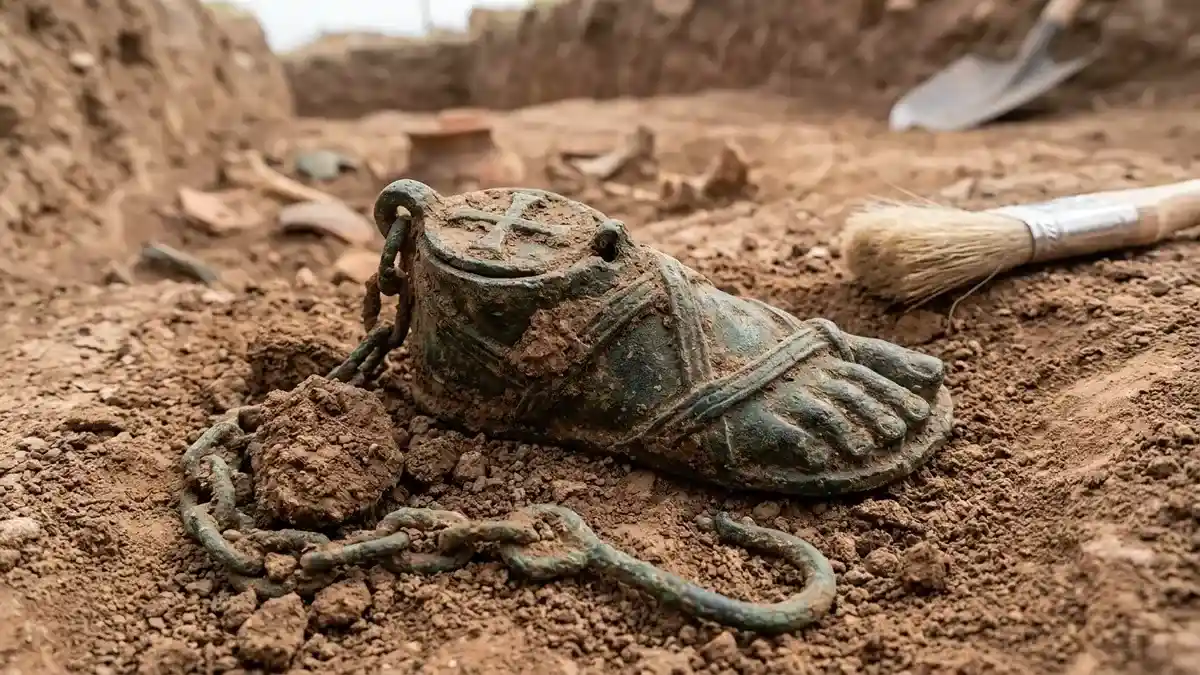
One of the most extraordinary examples of this artistic blending survives today in the permanent collections of the Metropolitan Museum of Art: a rare, fifth-century bronze hanging oil lamp meticulously sculpted into the shape of a sandaled human right foot.
Crafted roughly 1,600 years ago in ancient Syria—a vital cultural and religious hub of the Byzantine Empire—this artifact is far more than a whimsical antique light fixture. It stands as a stunning, three-dimensional tapestry of early Christian theology. By analyzing its intricate physical design, archeologists and art historians have uncovered multi-layered symbolic meanings that range from physical healing and dangerous holy pilgrimages to profound biblical metaphors of spiritual enlightenment.

1,600-Year-Old Bronze Foot Lamp Unlocks Deep Early Christian Secrets
 Secrets of the Coast: Brain Removal and Long-Distance Dynasties Uncovered in Iron Age Scotland
Engineering Light in Miniature: The Artifact Anatomy
Despite its immense historical and symbolic weight, the bronze foot lamp is surprisingly delicate. It measures a mere 3.25 inches (8.3 centimeters) in length, making it significantly smaller than a real human foot. Yet, what it lacks in pure scale, it makes up for in extraordinary preservation. The lamp is still attached to its original, fully intact suspension apparatus: a bronze hanging chain and hook measuring more than 17 inches (43.5 cm) long. This allowed the fixture to be suspended from a ceiling or wall bracket, casting its protective glow down upon ancient devotees.
The anonymous Byzantine metalworker who designed the piece possessed a brilliant eye for functional anatomy. Every mechanical element required to store fuel and sustain a flame was seamlessly integrated into the physical shape of the sandaled foot:
The Fuel Intake & Cross Lid: At the back of the heel, near the ankle joint, the artisan carved an opening where organic plant fluids—most likely olive oil—could be poured into the hollow interior. Protecting this reservoir is a flat, fitted cover topped with a prominent Christian cross. This cross acts as a literal signature, immediately identifying the item as an early Christian holy object.
The Wick Spout: At the opposite end of the vessel, the right big toe directly cradles the spout of the lamp. This opening held the linen or hemp wick, allowing the flame to emerge directly from the front edge of the foot.
The Sandal Thongs: Wrapping across the top of the foot and anchoring around the ankle are beautifully cast bronze representations of leather or cord straps, securing a defensive sole to the foot.

Decoding the Sole: The Hidden Byzantine Gammadion Cross
If you were to flip the delicate bronze lamp upside down, you would find a geometric design etched directly into the bottom of the sandal sole: a swastika. To a modern observer, this symbol carries heavy, tragic political connotations. However, to understand the true intent of this ancient artifact, one must firmly step back into the cultural landscape of the fifth-century Byzantine Empire.

In antiquity, this ancient cross-cultural pattern was known to Greek-speaking societies as a gammadion cross. The name stems from its unique geometric construction, which looks exactly like four capital letters of the Greek alphabet gamma ($\Gamma$) fused together at a central point.
For the early Christians and the broader Roman-Byzantine world, the gammadion was a completely positive emblem representing:
Universal order and cosmic balance
Physical health, vitality, and safe passage
Profound good fortune and divine favor
Placing the gammadion cross explicitly on the sole of a sandaled foot served a deeply protective purpose. In a world where foot travel was dangerous and filled with the threat of disease or injury, marking the bottom of a shoe with symbols of vitality acted as a protective blessing for a traveler’s daily walk.
The Foot as a Symbol of Early Christian Pilgrimage
Beyond its immediate protective associations, the choice of a sandaled foot carries profound ties to the social realities of the fifth-century Church. This era marked an explosion of Christian pilgrimage. Across the Byzantine territory, thousands of devout believers abandoned their homes to travel hundreds of miles to the Holy Land, visiting the sacred sites of the Levant and Syria.
These journeys were undertaken almost exclusively on foot, testing the physical endurance and spiritual resolve of the traveler. A hanging lamp shaped as a sandaled foot served as an intimate, poetic tribute to the physical realities of the pilgrim’s journey. Suspended within a home or a local house of worship, the burning lamp honored the miles walked in faith, transforming the physical act of stepping into a sacred ritual of devotion.
“A Light Unto My Path”: The Biblical Metaphor Made Real
The symbolic depth of the artifact runs even deeper than physical travel. In early Christian art and theology, oil lamps were rarely viewed as simple home utilities. Instead, the process of burning oil to banish the dark was seen as a literal metaphor for spiritual enlightenment, the washing away of sin, and the ultimate promise of soul immortality.
In a landmark 1969 scholarly analysis published by Vera Ostoia, a renowned curator of medieval art at The Met Cloisters, researchers tied the bronze foot lamp directly to Hebrew and Christian scripture. Specifically, the object appears to be a physical, three-dimensional manifestation of Psalm 119:105:
“Thy word is a lamp unto my feet, and a light unto my path.”
By forcing a literal flame to spark directly from the big toe of a sculpted foot, the ancient craftsman created an undeniable visual sermon. For the early Christian believer watching the lamp flicker in the dark, the message was unmistakable: to follow the teachings and word of God was to ensure that your feet would never stumble into spiritual darkness, safely guiding your path through the trials of mortal life.
Legacy of the Byzantine Metalworkers
The hanging bronze foot lamp remains an incredible testament to a bygone era of craftsmanship, where spiritual meaning was packed into every square inch of physical matter. It bridges the gap between ancient folklore—which viewed feet as symbols of health and healing—and early Christian theology, which reframed the journey of life as a holy walk with God. Today, preserved safely in New York City, this tiny bronze foot continues to cast a bright light on the artistic and spiritual sophistication of our ancestors.
Frequently Asked Questions
Where exactly was this ancient bronze foot lamp made?
The lamp was created in ancient Syria, which functioned as a major artistic, economic, and spiritual province of the Byzantine Empire during the fifth century.
What is a gammadion cross, and why is it on the sole of the sandal?
The gammadion cross is an ancient geometric symbol that resembles four Greek letters gamma ($\Gamma$) joined together. In the fifth century, it was a highly positive motif used to invoke good luck, health, divine protection, and vitality for travelers.
How large is the artifact, and how was it displayed?
The bronze foot itself is quite small, measuring just 3.25 inches (8.3 cm) long, which is much smaller than a standard human foot. However, it was designed to hang from above using an attached bronze suspension chain and hook that measures over 17 inches (43.5 cm) in length.
What kind of fuel did this Byzantine lamp require to work?
Like the vast majority of lamps throughout the ancient Mediterranean, this vessel was designed to hold organic plant-based oils. In the Byzantine Empire, olive oil was the most common fuel source, which slowly traveled up a fiber wick resting in the spout by the big toe.
Where is the artifact currently located for public viewing?
This rare 1,600-year-old Christian artifact is preserved and displayed within the permanent medieval art collections of the Metropolitan Museum of Art in New York City.