
Table of Contents
- 1. The Rise and Fall of the 50,000-Year Cognitive Leap
- 1.1. The Fragmented Trail of Modern Behavior
- 2. Dissecting the Evidence: Fossils, Tools, and Genetics
- 2.1. 1. Technological Transitions Were Highly Localized
- 2.2. 2. The Myth of the “Anatomically Modern” Human
- 2.3. 3. What the DNA Actually Says
- 3. The Arch-Nemesis of Prehistory: The Dating Dilemma
- 4. Embracing a Messier, Multi-Disciplinary Truth
- 5. Frequently Asked Questions
- 5.1. What was the “Human Revolution” theory?
- 5.2. Why does the new study argue against this revolution?
- 5.3. How old are the oldest Homo sapiens fossils?
- 5.4. How does genetics disprove a sudden evolutionary leap?
- 5.5. Why is it so difficult for scientists to date early human migration sites?
Deep History Rewritten: New Research Debunks the Sudden “Human Revolution” Theory
How did Homo sapiens become the last human species standing? For decades, mainstream science favored a dramatic, cinematic explanation: a sudden “Human Revolution” that occurred roughly 50,000 years ago, instantly transforming our ancestors into cognitively advanced masters of art, language, and technology. This sudden spark supposedly allowed modern humans to storm out of Africa and outcompete every other hominin species on Earth.
However, a comprehensive new scientific review turns this long-held narrative on its head. Published in Quaternary Science Reviews by prominent archaeologist Huw S. Groucutt, the study argues that our species did not achieve dominance through a sudden, localized evolutionary miracle. Instead, human evolution was a painfully slow, uneven, and highly complex mosaic that unfolded gradually across hundreds of thousands of years.

Deep History Rewritten New Research Debunks the Sudden Human Revolution Theory
The Rise and Fall of the 50,000-Year Cognitive Leap
For generations of researchers, the “Human Revolution” model offered an elegant, simple solution to the mystery of human origins. The theory posited that a fortuitous genetic mutation spontaneously rewired the human brain around 50,000 years ago.

This theoretical rewiring was believed to have triggered the rapid, simultaneous emergence of “behavioral modernity”—a suite of advanced traits including:
Complex symbolic thought and abstract art
Sophisticated bone and composite stone tools
Deliberate body ornamentation (such as shell beads)
Expansive, highly organized trade and social networks

While this theory made for a compelling story, the growing mountain of modern archaeological data has made it completely unsustainable.

The Fragmented Trail of Modern Behavior
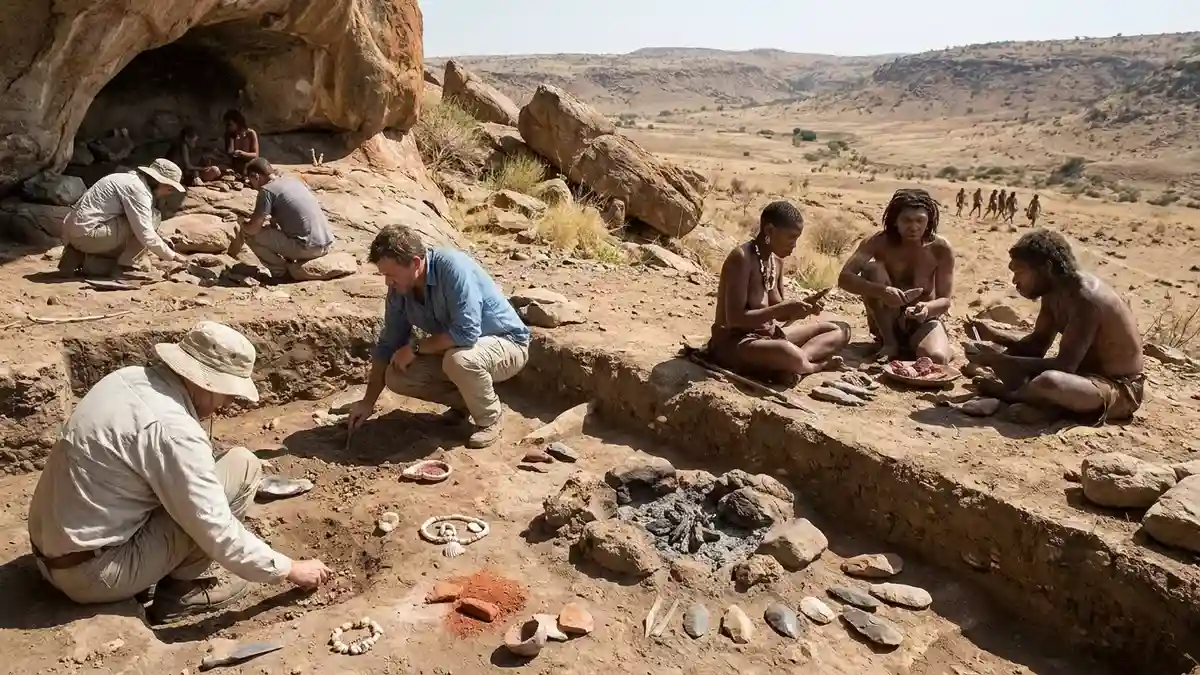
When scientists look closely at the actual archaeological layers across the African continent, the evidence tells a fundamentally different story. The markers of advanced human behavior do not suddenly burst into existence all at once 50,000 years ago. Instead, they appear scattered randomly across deep time.
[ 300,000+ Years Ago ] ──► Jebel Irhoud Fossils (Early Homo sapiens features)
                                │
[ 100,000+ Years Ago ] ──► Fragmented emergence of shell beads & pigments
                                │
[  50,000 Years Ago  ] ──► Traditional "Human Revolution" theory date (DEBUNKED)
                                │
[   Gradual Path    ] ──► Continuous, multi-regional mixing and technological shifts
Shell beads, complex bone tools, engraved pigments, and heavily structured domestic hearths have been excavated at various African sites dating to tens of thousands of years before the supposed revolution. Crucially, these behaviors did not emerge as a unified package deal. A population in one region might invent advanced body ornamentation, only for that practice to vanish from the archaeological record for millennia before popping up somewhere else entirely.
Rather than a single explosive turning point, the birth of human culture looks like a slow, flickering series of independent innovations spread out across widely dispersed populations.
Dissecting the Evidence: Fossils, Tools, and Genetics
To dismantle the revolution myth, the review meticulously cross-examines three independent pillars of historical science: the stone tool record, fossil anatomy, and modern paleogenomics.
1. Technological Transitions Were Highly Localized
If a singular cognitive revolution had swept through the human population, we would expect to see stone tool technologies shift uniformly across the board. The data shows the exact opposite.
The transition from older stone-shaping traditions to more advanced, delicate tool kits occurred at wildly different times depending on the geographic region. Some human groups adopted advanced technologies tens of thousands of years ahead of their neighbors, proving there was no synchronized, continent-wide breakthrough.
2. The Myth of the “Anatomically Modern” Human
Even the term “anatomically modern human” has come under fire. The fossil record indicates that human physical traits did not change overnight.
Fossils discovered in Jebel Irhoud, Morocco, which are well over 300,000 years old, display a fascinating mix of features: they possess facial structures that look remarkably like ours today, yet they retain primitive, elongated braincases. Other ancient human populations kept archaic physical characteristics until much later in history. Human anatomy, much like human behavior, developed via a prolonged, piecemeal assembly line rather than a sudden structural overhaul.
3. What the DNA Actually Says
Early genetic theories attempted to track down a single “magic bullet” mutation that separated us from Neanderthals and older hominins. Modern genetic sequencing has thoroughly debunked this fantasy.
Current paleogenomic data outlines a highly fluid, convoluted history. Our origins are rooted in a vast network of early African populations that periodically drifted apart, adapted to local environments, reunited, and exchanged genes over immense stretches of time. We are the product of an ancient, continental-scale biological blender.
The Arch-Nemesis of Prehistory: The Dating Dilemma
Reconstructing this decentralized human diaspora is made incredibly difficult by the complex science of tracking time. Archaeologists must rely on an array of distinct dating methods to calculate the age of ancient sediment layers, bones, and stone tools.
The Interdisciplinary Divide: Different dating methodologies often yield conflicting age estimates, creating intense debates over when humans actually arrived in specific geographic areas.
A prime example of this chronological tug-of-war is Misliya Cave in Israel. Archaeologists discovered a human upper jawbone at the site, with some initial dating techniques suggesting Homo sapiens had managed to push into the Levant as early as 180,000 to 190,000 years ago. However, alternative testing methods on the very same layers hint at much younger dates.
The review stresses that the dates themselves are rarely the problem; rather, the issue lies in how researchers link those dates to specific artifacts or geological layers. To counter this, the study argues that historians must prioritize sites where multiple, independent dating techniques yield matching results before drawing sweeping conclusions about human migration.
Embracing a Messier, Multi-Disciplinary Truth
The core takeaway of this landmark review is a call for scientific humility and deeper collaboration. For too long, geneticists, physical anthropologists, and stone-tool specialists have worked in isolated silos, occasionally producing contradictory timelines that ignore the data of their peers.
By weaving fossils, genetics, and technology into a single, cohesive tapestry, a new paradigm of human origin takes shape. Homo sapiens did not conquer the world because of a sudden stroke of evolutionary luck or a sudden mental awakening. Our survival was earned through a multi-millennial, continent-spanning process of gradual adaptation, trial and error, and cultural exchange. The true story of how we became human is far less sudden—and infinitely more fascinating—than we ever realized.
Frequently Asked Questions
What was the “Human Revolution” theory?
The “Human Revolution” was a long-standing archaeological theory proposing that a sudden cognitive shift occurred in Homo sapiens around 50,000 years ago. This shift was believed to have triggered an abrupt explosion of advanced behaviors, such as art, language, symbolic thought, and complex toolmaking, instantly separating modern humans from all other hominin species.
Why does the new study argue against this revolution?
The study points out that the archaeological, fossil, and genetic evidence simply does not support a sudden event. Markers of advanced human behavior—like shell beads, complex tools, and pigments—appear in Africa tens of thousands of years before the supposed 50,000-year mark, appearing and disappearing at different times and places rather than in a single wave.
How old are the oldest Homo sapiens fossils?
The oldest known fossils exhibiting clear Homo sapiens characteristics were discovered in Jebel Irhoud, Morocco, and date back to more than 300,000 years ago. However, these individuals still possessed some primitive physical traits, proving that our modern anatomy evolved gradually over hundreds of thousands of years.
How does genetics disprove a sudden evolutionary leap?
Instead of finding a single, revolutionary genetic mutation that suddenly altered human intelligence, modern genetic mapping shows a slow, complex history of interbreeding and gene flow. It reveals that Homo sapiens arose from various distinct groups across Africa that separated, adapted, mixed, and traded genetic material over millennia.
Why is it so difficult for scientists to date early human migration sites?
Dating ancient sites is highly complex because different scientific techniques can yield wildly different age estimates for the same layer of earth or artifact. Furthermore, connecting a specific date to a mobile fossil or tool requires flawless geological context, as shifting soil, erosion, and burrowing animals can easily mix ancient layers with newer material.