
Table of Contents
**Jordan Mass Grave Exposes Justinian Plague Horror**
Archaeologists in Jordan have uncovered a chilling snapshot of one of history’s deadliest pandemics. A mass grave in the ancient city of Jerash holds the remains of around 230 people who perished during the Plague of Justinian, offering the first clear biomolecular proof of the disease’s devastating impact in the Byzantine East. This discovery illuminates how a ruthless epidemic reshaped urban life, exposed social vulnerabilities, and left communities scrambling to bury their dead in emergency conditions.
The Justinian Plague, which swept across the Mediterranean world from 541 to 750 CE, is often compared to the Black Death that struck Europe centuries later. Named after Emperor Justinian I, the outbreak killed millions and contributed to the decline of the Eastern Roman Empire. The Jerash find provides rare physical evidence of how ordinary people experienced this catastrophe, revealing not just the scale of death but also patterns of migration and resilience in a thriving ancient city.
Jordan Mass Grave Exposes Justinian Plague Horror

### The Justinian Plague: A Medieval Killer
The Plague of Justinian ranks among the most consequential pandemics in human history. Caused by the bacterium *Yersinia pestis*, it spread rapidly through trade routes, thriving in densely populated cities. Contemporary accounts describe gruesome symptoms including fever, swollen lymph nodes, and rapid death. The disease likely traveled via fleas on rats aboard ships, turning bustling ports into gateways for disaster.
In the Byzantine Empire, the plague struck at a time of political ambition and economic strain. Emperor Justinian sought to restore Roman glory, but the epidemic undermined his efforts, killing soldiers, farmers, and city dwellers alike. Estimates suggest up to half the population in some regions perished, triggering labor shortages, economic collapse, and social upheaval that echoed for generations.
Until now, direct archaeological confirmation of the plague in the Eastern Mediterranean has been limited. The Jerash mass grave changes that, providing scientists with tangible remains to study the pathogen and its human victims.
### Discovery at Jerash’s Ancient Hippodrome
Jerash, known in antiquity as Gerasa, was once a prosperous Roman and Byzantine center in modern-day Jordan. Famous for its colonnaded streets, temples, and theaters, the city boasted around 25,000 residents at its peak in the 3rd century CE. By the late 6th century, however, its population had shrunk to roughly 10,000 amid broader regional challenges.
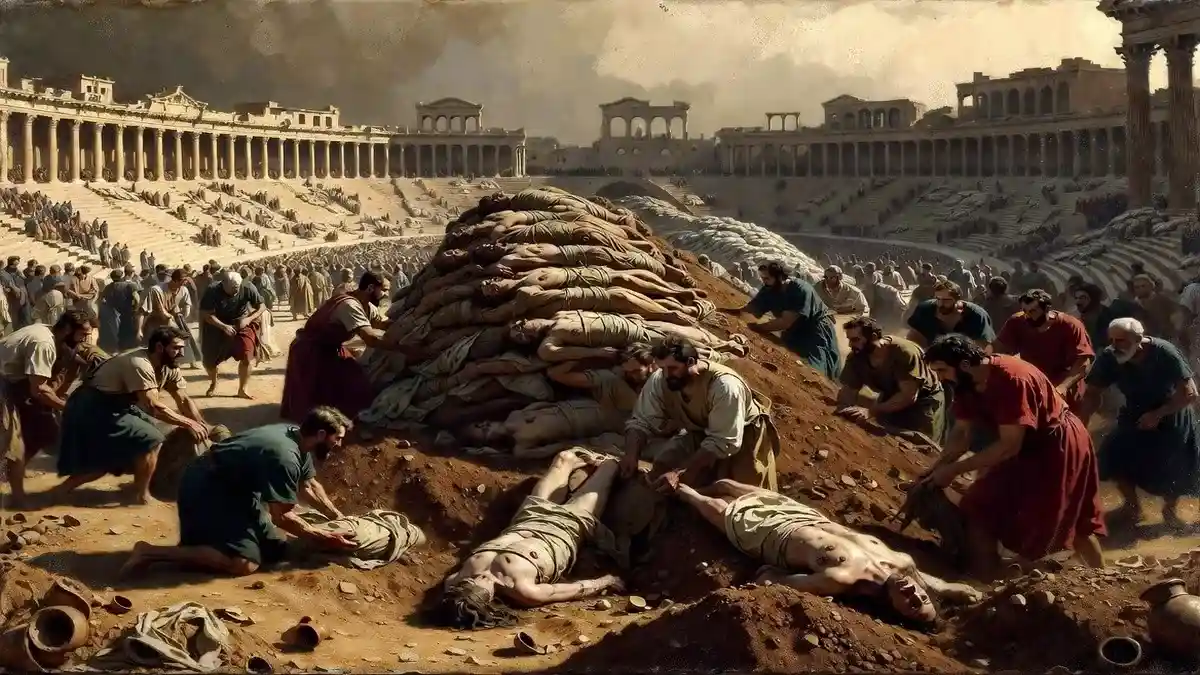
Archaeologists uncovered the mass grave in two chambers of the city’s hippodrome—a large public arena originally built for chariot races. Instead of orderly tombs or family plots, they found bodies stacked in tightly packed layers over pottery debris. The haphazard arrangement, with little regard for traditional funerary rites, points to a frantic response to overwhelming mortality. Researchers estimate the burials occurred over just days or weeks during a single intense outbreak.
This emergency pit mirrors later medieval plague graves in Europe, underscoring the universal chaos pandemics bring. Unlike gradual cemetery growth, this site captures a singular crisis moment, frozen in time beneath the sands of Jordan.
### Who Were the Victims?
The scale—approximately 230 individuals—highlights the plague’s lethal efficiency in an urban setting. Bodies were interred quickly, often without personal grave goods or careful positioning typical of Byzantine Christian burials. This departure from custom reflects the sheer urgency faced by survivors as death tolls mounted.
Bioarchaeological analysis paints a picture of a diverse group. Many were likely locals, but evidence suggests others had traveled from farther afield. The grave thus became a final gathering place for people from varied backgrounds united by tragedy.
### Scientific Breakthroughs Confirm the Plague
A multidisciplinary team from the University of South Florida led the investigation, published in the *Journal of Archaeological Science*. Ancient DNA extracted from the remains definitively identified *Yersinia pestis*. Genetic sequencing revealed a consistent strain across victims, confirming they died in one synchronous epidemic wave rather than scattered incidents.
This marks the first biomolecular verification of a Justinian Plague mass grave in the region, strengthening historical accounts and allowing precise pathogen reconstruction. Such data helps scientists trace the evolution of plague strains and understand why certain outbreaks proved so virulent.
### Clues from Bones and Teeth
Beyond disease confirmation, stable isotope analysis provided insights into the victims’ lives. Carbon and nitrogen isotopes in bones indicate a regional diet centered on C3 plants like wheat and barley, supplemented by local proteins. This aligns with typical Byzantine Levantine foodways, reflecting agricultural traditions that sustained cities for centuries.
Oxygen isotopes from tooth enamel, however, told a more complex story. Wider variation compared to other Levantine sites suggests many individuals spent their childhoods in different water-source environments. In other words, a significant portion of the buried group were migrants or travelers who had moved to Jerash later in life.
Mitochondrial DNA further revealed maternal haplogroups like H13 and L3e, consistent with the genetic diversity expected in a cosmopolitan Byzantine city connected to broader Mediterranean networks.
### Social and Urban Impacts of the Pandemic
The Jerash findings reveal how plague exposed and exacerbated underlying pressures. Jerash was already experiencing population decline before the outbreak. The sudden arrival of diverse individuals in the grave suggests the city served as a hub for migrants, traders, and refugees—people whose mobility became a risk factor during the epidemic.
In normal times, such diversity would blend across generations in cemeteries. The crisis compressed these stories into one dramatic burial event. It highlights urban vulnerability: crowded living conditions, trade connections, and strained infrastructure made cities prime targets for rapid disease spread.
The choice of the hippodrome—a former entertainment venue turned ad-hoc cemetery—symbolizes the breakdown of civic order. Public spaces were repurposed for mass burial when traditional grounds could no longer cope, a pattern repeated in later pandemics.
### Broader Lessons from Late Antiquity
The Justinian Plague coincided with other challenges, including climatic shifts, wars, and economic instability. Its long-term effects may have accelerated the transition from classical antiquity to the early Middle Ages, weakening empires and reshaping power dynamics.
In the Eastern Mediterranean, the pandemic likely disrupted agriculture, tax collection, and military recruitment. Survivors faced labor shortages that changed social structures, possibly empowering certain groups while marginalizing others.
The Jerash grave adds crucial archaeological depth to textual sources, which often focus on elite perspectives. By studying ordinary victims, researchers gain a more democratic view of history—one centered on everyday people navigating extraordinary circumstances.
Comparisons with European Black Death graves show striking similarities in burial practices and demographic impact. Yet regional differences, such as Jerash’s diverse migrant profile, illustrate how local contexts shaped pandemic experiences.
### Modern Relevance of Ancient Crises
Today, as the world reflects on recent global health emergencies, the Jerash discovery feels strikingly relevant. It demonstrates how pandemics test societal resilience, expose inequalities, and force rapid adaptations. Issues like migration, urban density, and emergency response remain central concerns.
Advanced techniques like ancient DNA and isotope geochemistry allow deeper reconstruction of past lives, offering lessons for preparedness. Understanding historical pathogen dynamics also informs current research on plague and other re-emerging diseases.
Ongoing work at Jerash and similar sites continues to refine chronologies and explore long-term recovery patterns. Future studies may examine how communities rebuilt after the plague and whether genetic adaptations emerged among survivors.
### Preserving Jordan’s Archaeological Heritage
Jerash remains one of Jordan’s premier archaeological destinations, with well-preserved Roman and Byzantine ruins attracting visitors worldwide. The hippodrome mass grave adds a poignant human dimension to the site’s story, reminding tourists and scholars alike of the city’s turbulent past.
Collaborative efforts between international teams and local authorities ensure careful excavation and analysis while respecting cultural sensitivities. Such projects highlight Jordan’s rich contribution to understanding Mediterranean history.
**Conclusion**
The mass grave at Jerash stands as a powerful testament to the human cost of the Justinian Plague. Nearly 1,500 years later, the remains of 230 victims—diverse in origin but united in death—offer an unparalleled window into a society under siege. Through DNA, isotopes, and careful archaeological context, researchers have reconstructed not only the presence of *Yersinia pestis* but also the social fabric of a city confronting catastrophe.
This discovery enriches our knowledge of Late Antiquity, underscoring the plague’s role in reshaping the ancient world. It also serves as a sobering reminder of pandemics’ enduring impact on human lives and communities. As scientists continue to analyze these remains, the people of ancient Jerash speak across the centuries, teaching us about vulnerability, migration, resilience, and the universal challenges of surviving history’s greatest health crises.
In an era still grappling with infectious diseases, the Jerash findings bridge past and present, emphasizing the importance of preparedness, compassion, and scientific inquiry when facing the unknown.
### FAQ
**What is the Justinian Plague?**
A devastating pandemic caused by *Yersinia pestis* that ravaged the Mediterranean from 541 to 750 CE, killing millions and weakening the Byzantine Empire.
**Why is the Jerash mass grave significant?**
It is the first biomolecularly confirmed plague burial from the pandemic in the Eastern Mediterranean, with ancient DNA proving *Yersinia pestis* and revealing details about victims’ lives.
**How many people were buried in the Jerash hippodrome?**
Approximately 230 individuals, stacked in layers during a short, intense burial period, indicating a major outbreak.
**What do isotopes reveal about the victims?**
Diet was typical of the region, but varied oxygen isotopes suggest many had diverse childhood origins, pointing to a mobile, mixed urban population.
**How does this compare to the Black Death?**
Similar mass burial practices and high mortality, though the Justinian Plague occurred centuries earlier and affected the Byzantine world profoundly.
**Where is Jerash located?**
In northern Jordan, the site of ancient Gerasa features impressive Roman and Byzantine ruins and is a major archaeological and tourist destination.
**What will future research focus on?**
Further genetic studies, recovery patterns after the plague, and comparisons with other contemporary sites to better understand the pandemic’s full scope.