
Table of Contents
- 1. Hiding in Plain Sight: Decoding the Micropoints
- 2. The Evolutionary Mystery: Who Built the Bows?
- 2.1. The Crossroads of Eurasia
- 3. A Lethal Design for Long-Range Hunting
- 4. Frequently Asked Questions
- 4.1. Why do scientists think these stone points are arrowheads rather than spear tips?
- 4.2. Were these arrowheads made by modern humans or Neanderthals?
- 4.3. Where is the Obi-Rakhmat rock shelter located?
- 4.4. How does this discovery change the timeline of human technology?
- 4.5. What is the next step for researchers studying these artifacts?
80,000-Year-Old Weapons Found in Uzbekistan Could Be World’s Oldest Arrowheads
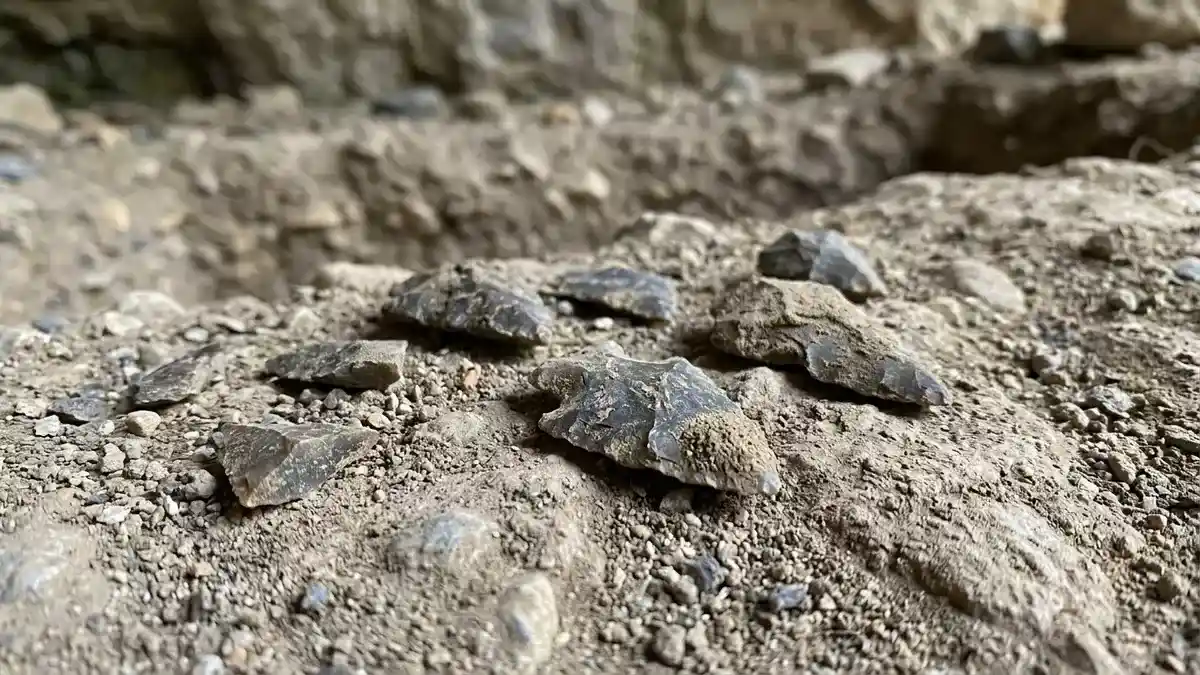
A groundbreaking archaeological study has unveiled what may be the oldest evidence of bow-and-arrow technology in human history. Excavating the Obi-Rakhmat rock shelter in northeastern Uzbekistan, an international research team uncovered a series of tiny, triangular stone tools—dubbed “micropoints”—dating back approximately 80,000 years.
If the scientific community confirms these findings, it will rewrite the timeline of advanced projectile weaponry. This discovery pushes the invention of the bow and arrow back by roughly 6,000 years, dethroning the previous record-holders: a series of 74,000-year-old points unearthed in Ethiopia.

80,000-Year-Old Weapons Found in Uzbekistan Could Be World’s Oldest Arrowheads
Hiding in Plain Sight: Decoding the Micropoints
For years, these miniature stone artifacts were largely overlooked by researchers. Because the tiny points were almost always recovered in fractured, splintered pieces, early excavators assumed they were merely accidental debris left over from the manufacturing of larger tools like handaxes or butcher knives.
 Mamluk Infrastructure Uncovered: Medieval Water System and Mosque Discovered Near Cairo’s Citadel
However, a meticulous new structural analysis published in the journal PLOS One changed everything. Using high-powered microscopic imaging, ballistics experts and archaeologists evaluated the dimensions and stress fractures of the stones, revealing two undeniable truths:
Impossibly Slender Dimensions: The stone points are far too narrow and delicate to have functioned as hand-held cutting knives or heavy thrusting spears. They were intentionally engineered to fit perfectly onto slender, lightweight wooden shafts.
High-Velocity Impact Fractures: The specific breakage patterns on the tips are highly distinct. The microscopic cracks, ripples, and tip-crushing match the exact diagnostic impact damage that occurs when a projectile strikes a target at extreme velocities—a force that can only be generated by a mechanical launch system like a bow.

[Slender Stone Micropoint] ──> Fitted to Lightweight Shaft ──> High-Velocity Bow Launch ──> Distinct Impact Fracture
The Evolutionary Mystery: Who Built the Bows?
While the function of the weapons is becoming clearer, the identity of the inventors has sparked an intense, high-stakes debate among paleoanthropologists. Eighty thousand years ago, Central Asia was the sovereign domain of the Neanderthals (Homo neanderthalensis).
To date, science has never found a definitive, universally accepted example of a Neanderthal utilizing bow-and-arrow technology; they are traditionally viewed as ambush hunters who relied on heavy, close-range thrusting spears.
Conversely, similar aerodynamic micropoints are a hallmark of our own species, Homo sapiens, appearing in later African and European contexts. This leaves scientists with a fascinating evolutionary puzzle.

The Crossroads of Eurasia
The rock shelter itself offers critical clues. In 2003, archaeologists working at Obi-Rakhmat discovered the fossilized skull fragments and teeth of a young child. Anatomical testing revealed a striking physical mosaic: the child possessed distinct Neanderthal features blended with clear Homo sapiens characteristics.
This hybrid anatomy strongly implies that Uzbekistan functioned as a dynamic prehistoric contact zone where distinct human lineages met, interbred, and exchanged ideas. It is entirely possible that Neanderthals invented this technology independently, learned it from arriving waves of early modern humans, or vice versa.
A Lethal Design for Long-Range Hunting
The structural style of the Obi-Rakhmat points reveals a sophisticated understanding of ballistics and anatomy. Rather than being built thick and heavy to smash through bone, these arrowheads were knapped from ideal Levallois stone cores to be razor-thin and piercing.
The goal of the design was pure penetration: to pierce deep into the flesh of prey, allowing the arrow shaft to pass through and cause rapid internal bleeding.
| Weapon Class | Launch Mechanism | Combat Distance | Target Impact Behavior |
| Thrusting Spear | Hand-held / Muscle Power | Close Range (Ambush) | Heavy, bone-crushing impact; requires physical proximity. |
| Obi-Rakhmat Micropoint | Mechanical Bow | Long Range (Distance) | Deep flesh penetration; minimizes hunter risk. |
This exact aerodynamic hunting philosophy appears thousands of years later in western Europe. At the Grotte Mandrin cave system in France, archaeologists documented early Homo sapiens utilizing nearly identical stone points to hunt migrating game roughly 54,000 years ago.
Finding this exact level of technological mastery in Central Asia at an 80,000-year horizon highlights just how intelligent, adaptive, and interconnected the ancient inhabitants of Eurasia truly were.
Frequently Asked Questions
Why do scientists think these stone points are arrowheads rather than spear tips?
The stone points are physically too narrow and thin to withstand the crushing forces of a hand-thrust spear. Furthermore, microscopic analysis revealed high-velocity impact fractures on the tips, which can only be replicated when a stone point strikes a target at the high speeds generated by a bow string.
Were these arrowheads made by modern humans or Neanderthals?
The identity of the creators remains a mystery. While bows are traditionally associated with Homo sapiens, Neanderthals were the dominant population in Central Asia 80,000 years ago. The discovery of a hybrid child fossil at the site suggests it was a contact zone where both groups mingled and shared technologies.
Where is the Obi-Rakhmat rock shelter located?
The Obi-Rakhmat rock shelter is a premier Paleolithic archaeological site located in the rugged mountainous terrain of northeastern Uzbekistan, a region that served as a major geographic highway for migrating ice-age populations.
How does this discovery change the timeline of human technology?
If fully verified by additional testing, the 80,000-year-old Uzbek artifacts push the origin of mechanical projectile weaponry back by at least 6,000 years, proving that complex engineering and long-range hunting are much older traits than previously assumed.
What is the next step for researchers studying these artifacts?
Archaeologists plan to excavate even older geological layers in Central Asia and look for technological links to early human sites in the Levant (modern-day Middle East). The ultimate prize would be finding macro-evidence, such as a fossilized animal skeleton with a micropoint still embedded directly in the bone.