
Table of Contents
- 1. The Relics of Lu’an: Decoding the Panchi Mirrors
- 2. From Rebel Ore to Imperial Standards: The Metal Metamorphosis
- 2.1. Era 1: The High-Lead, Low-Tin Legacy
- 2.2. Era 2: The Low-Lead, High-Tin Imperial Shift
- 3. The Architecture of Restoration and Recuperation
- 4. A Cultural Revolution: From Ritual to Commodity
- 5. Frequently Asked Questions
- 5.1. What are Panchi mirrors?
- 5.2. How did scientists analyze these ancient mirrors?
- 5.3. What did the chemical changes in the bronze reveal?
- 5.4. What was the “Restoration and Recuperation” policy?
- 5.5. Why did bronze lose its religious status in the Han Dynasty?
How Ancient Bronze Mirrors Unlocked the Secrets of early Han Dynasty China
When we look at the historical rise of a massive superpower, we often attribute its success to brilliant military campaigns or aggressive territorial expansions. For ancient China’s Han Dynasty, textbooks frequently give sole credit to Emperor Wu, whose legendary reign consolidated imperial power and secured the Silk Road. However, a groundbreaking archaeo-metallurgical study suggests that the true foundation of China’s golden age wasn’t forged on the battlefield, but rather within the boiling cauldrons of everyday industrial foundries.
By conducting a high-precision chemical and isotopic analysis on a collection of 2,200-year-old bronze mirrors, researchers have uncovered a story of economic recovery, resource management, and calculated state-backed reform. The findings reveal that long before Emperor Wu ascended the throne, his predecessors were quietly engineering a massive, standardized industrial infrastructure.
The humble cosmetic mirror, once viewed merely as a luxury item for the elite, has suddenly become a vital window into the early imperial policies that shaped one of the most powerful dynasties in human history.
How Ancient Bronze Mirrors Unlocked the Secrets of early Han Dynasty China
The Relics of Lu’an: Decoding the Panchi Mirrors
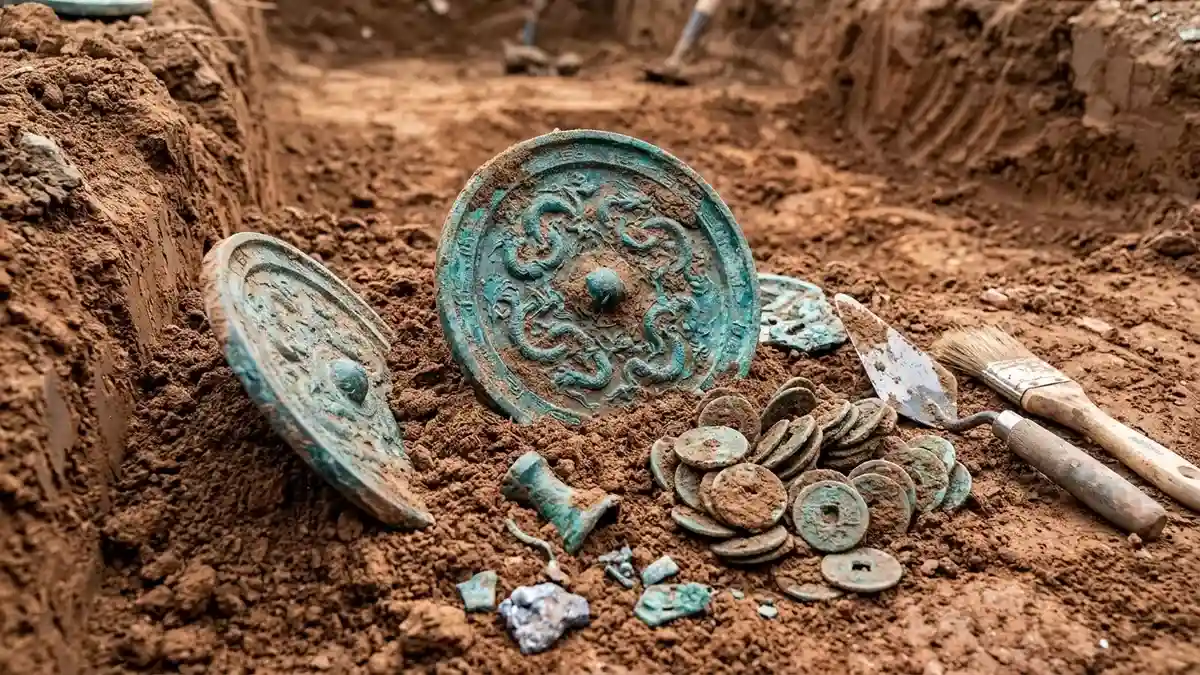
The study, spearheaded by the Archaeo-metallurgy Laboratory at the University of Science and Technology of China (USTC), centered around an analysis of 40 specific bronze artifacts known as Panchi mirrors. Characterized by highly complex, intertwining dragon motifs, these circular mirrors were among the most popular and fashionable household goods of the late Warring States period and early Western Han Dynasty.
The tested samples were recovered from two separate public cemeteries located in Lu’an, Anhui province, and date precisely between 221 and 141 BCE. To trace how these objects were manufactured, scientists subjected the mirrors to a battery of high-tech tests, analyzing:

Decorative styles and calligraphic inscriptions
Total chemical composition (metal alloy ratios)
Lead isotope ratios (to pinpoint exact mining locations)
Trace elements trapped within the metal lattice
What they discovered was a clear, sudden shift in manufacturing technology, dividing the mirrors into two completely different economic eras.
From Rebel Ore to Imperial Standards: The Metal Metamorphosis
The USTC team discovered that the 40 mirrors were manufactured using two entirely different metallurgical recipes, tracking a massive shift from decentralized, local production to a tightly controlled state economy.
Era 1: The High-Lead, Low-Tin Legacy
The earliest mirrors in the collection carried a distinct technological fingerprint inherited from the independent Chu state. These mirrors were forged using a high-lead, low-tin bronze alloy. The lead isotope ratios revealed that the metal was sourced from a highly localized, short-lived ore supply. This indicates a decentralized market where independent regional workshops collected whatever local materials they could find to turn a quick profit.
Era 2: The Low-Lead, High-Tin Imperial Shift
As the Western Han Dynasty matured, this local method completely vanished. In its place emerged a standardized, low-lead, high-tin bronze recipe. More importantly, the lead isotope data showed that the copper was flowing from a highly diversified, continent-spanning network of supply chains.
[Decentralized Era]  ──► Local Mines ──► High-Lead, Low-Tin Alloy  ──► Varied Regional Styles
                                                                               │
                                                                       Government Reform
                                                                               │
                                                                               ▼
[State-Regulated Era] ──► Empire-Wide ──► Low-Lead, High-Tin Alloy ──► Standardized Production
This sudden uniform shift could not have happened naturally in a free market. It represents direct, state-coordinated oversight. The imperial government had successfully stepped in, taken control of the major mining regions, stabilized volatile supply routes, and distributed a standardized chemical recipe to foundries across China.
The Architecture of Restoration and Recuperation
This dramatic industrial evolution aligns perfectly with the historical reigns of Emperor Wen (180–157 BCE) and Emperor Jing (157–141 BCE). This specific era is celebrated in Chinese history for its “Restoration and Recuperation” policy—a period of internal healing following decades of brutal civil war.
Instead of funding costly military campaigns, Emperors Wen and Jing focused entirely on internal stability. They slashed heavy agricultural taxes, drastically reduced government spending, and actively fostered local manufacturing and crafts.
The USTC study provides rare, concrete material proof of this policy in action. The flourishing of the mirror-casting industry was a deliberate result of these peaceful decades. The legendary military and economic might later displayed by Emperor Wu was not an accidental boom; it was entirely built upon the stable, highly efficient industrial base engineered by his father and grandfather.
A Cultural Revolution: From Ritual to Commodity
Beyond the politics of metallurgy, the evolution of the Panchi mirror charts a massive cultural transformation across ancient Chinese society.
During the older Shang and Zhou dynasties, bronze was considered a sacred, deeply religious material. It was almost exclusively reserved for casting massive, heavy ritual vessels used in elite ancestral sacrifices. However, by the time of the early Han Dynasty, these religious vessels had fallen heavily out of favor.
   [Zhou Dynasty Era]     ──► Sacred Bronze Vessels ──► Restricted to Elite Sacrificial Rituals
                                                                  │
                                                          Commercial Evolution
                                                                  │
                                                                  ▼
   [Western Han Dynasty]  ──► Practical Commodities  ──► Mass-Traded Domestic Consumption
Bronze shifted from a tool of the gods to a commodity of the masses. Practical, mass-produced items like minted coins and domestic mirrors came to dominate the market. Mirrors, in particular, transformed into highly fashionable, widely traded commercial goods.
The reverse sides of these mirrors became dynamic canvases for artistic expression, allowing ordinary citizens to showcase modern fashions, personal philosophies, and regional identities. The sweeping spread of these dragon-adorned Panchi mirrors along the Yangtze River corridor serves as a physical map, tracking how imperial trade networks successfully knit a fractured puzzle of independent warring states into a single, unified Chinese identity.
Frequently Asked Questions
What are Panchi mirrors?
Panchi mirrors are circular bronze artifacts featuring highly complex, intertwining dragon motifs. They were incredibly popular everyday consumer items in China during the late Warring States period and the early Western Han Dynasty.
How did scientists analyze these ancient mirrors?
Researchers from the University of Science and Technology of China analyzed 40 mirrors found in Lu’an using advanced archaeo-metallurgical testing. They studied the chemical alloy composition, trace elements, and lead isotope ratios to determine exactly how and where the metals were mined and melted.
What did the chemical changes in the bronze reveal?
The earliest mirrors used a low-quality, local high-lead alloy from independent workshops. Later mirrors utilized a superior low-lead, high-tin formula supplied by a massive, government-coordinated network. This indicates that the Han government had successfully standardized the entire bronze industry.
What was the “Restoration and Recuperation” policy?
Instituted by Emperors Wen and Jing, this early Han Dynasty policy focused on domestic healing, cutting taxes, halting military conflicts, and encouraging local industrial growth. The study proves this peaceful era successfully built the economic engine that funded China’s future golden age.
Why did bronze lose its religious status in the Han Dynasty?
Historically, bronze was reserved for sacred elite sacrificial pots. By the Han Dynasty, society had become more secular and commercialized. Bronze production shifted toward useful everyday consumer products, like currency and cosmetic mirrors, which were traded across all social classes.