

Table of Contents
**Neanderthals’ Symbolic Skull Ritual Uncovered in Spanish Cave**
Archaeologists have uncovered compelling new evidence that Neanderthals in Spain engaged in complex symbolic behavior, deliberately collecting and depositing large animal skulls deep inside a cave over thousands of years. The discovery at Des Cubierta Cave in central Spain’s Lozoya Valley adds significant weight to the growing recognition of Neanderthals as culturally sophisticated humans capable of ritualistic practices and shared traditions.
This remarkable find from the Middle Paleolithic period challenges old assumptions about Neanderthal cognitive abilities and highlights their repeated use of specific cave spaces for non-utilitarian purposes.
Neanderthals’ Symbolic Skull Ritual Uncovered in Spanish Cave

### A Deep Dive into Neanderthal Behavior at Des Cubierta Cave
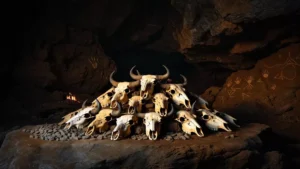
Located in the Madrid region, Des Cubierta Cave has yielded extraordinary insights into Neanderthal life during the Middle Paleolithic, roughly 135,000 to 43,000 years ago. Excavations focused on Level 3, a deposit formed during cold climatic phases, revealed a concentrated collection of 35 skulls from large hoofed mammals, primarily steppe bison and aurochs.
What stands out is the deliberate selection: nearly all skulls came from horned or antlered species and lacked lower jaws. Accompanying these were over 1,400 stone tools typical of Mousterian technology—the hallmark toolkit associated with Neanderthals across Europe—along with clear traces of fire use. This combination suggests the cave was more than just a shelter or hunting camp.
### Separating Natural Chaos from Intentional Human Action
Caves are dynamic environments. Rockfalls over millennia can scatter and damage materials, making it tricky to distinguish human actions from natural processes. At Des Cubierta, researchers faced exactly this challenge. The bone cluster initially appeared jumbled due to repeated debris falls.
To solve this, the team employed meticulous spatial mapping of every stone, bone, and tool. They analyzed the distribution patterns: geological rockfall debris formed a clear cone-shaped accumulation, while the skulls and tools followed distinctly different layouts. This spatial mismatch strongly supports intentional placement by Neanderthals rather than random burial by falling rocks.
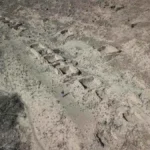
Geostatistical methods further refined the picture. By studying stone sizes and density changes, scientists identified pauses in sediment buildup that created stable surfaces for human activity. Archaeological materials consistently sat above early rockfall layers, indicating Neanderthals visited the site after initial debris had settled, using the space repeatedly over an extended period.
### Bone Refitting and Spatial Patterns Reveal Careful Placement
Bone refitting proved especially powerful. Researchers successfully matched broken skull fragments found in close proximity, demonstrating limited post-deposition movement. Central areas of the gallery preserved skulls in better condition, while southern zones—narrower and more uneven—showed greater fragmentation due to gravity, erosion, and soil movement.
This detailed analysis revealed patterned behavior. The consistent focus on horned skulls in specific locations, far from typical living or butchery areas, rules out simple food storage or waste disposal. Other animal bones common in residential contexts appeared in much lower numbers here, reinforcing the idea of a special-purpose zone within the cave.
### What the Skull Deposits Tell Us About Neanderthal Symbolism
The repeated return to Des Cubierta Cave to deposit these crania points to a long-standing cultural tradition. Neanderthals likely passed knowledge of this practice across generations, selecting horned heads for their symbolic power. Horns and antlers may have represented strength, vitality, or spiritual significance in their worldview.
Unlike everyday habitation sites, this chamber lacks signs of domestic activity. Instead, it appears dedicated to ritual or ceremonial use. The careful arrangement, combined with fire evidence and stone tools, suggests meaningful activities that went beyond survival needs—possibly linked to hunting magic, ancestor veneration, or marking important locations in the landscape.
This discovery joins a small but growing body of evidence for Neanderthal symbolic behavior, including deliberate burials, personal ornaments, and cave art. It strengthens arguments that Neanderthals possessed abstract thinking, planning, and cultural transmission comparable in some ways to early modern humans.
### The Broader Context of Neanderthal Intelligence and Culture
For decades, scientists debated whether Neanderthals were capable of symbolic thought. Older views portrayed them as brutish survivors with limited cognitive flexibility. Modern research, including advanced dating, genetic studies, and high-resolution excavations like this one, paints a far richer picture.
Neanderthals thrived across Europe and parts of Asia for hundreds of thousands of years. They developed sophisticated hunting strategies, controlled fire, cared for the injured, and created complex tools. Finds like the Des Cubierta skull accumulations demonstrate they also invested time and effort in behaviors with no obvious practical benefit—hallmarks of symbolic culture.
The choice of a deep cave location adds another layer. Dark, remote chambers often held special meaning in prehistoric societies, possibly as places for initiation, storytelling, or connecting with the spirit world. The long-term reuse of the same spot over tens of thousands of years implies strong cultural continuity and social memory.
### Why This Spanish Discovery Matters for Human Evolution
The Des Cubierta findings represent one of the strongest cases yet for structured, repeated symbolic deposition by Neanderthals in Europe. By integrating spatial statistics, geological analysis, and detailed bone studies, researchers overcame the complexities of cave taphonomy—the processes affecting remains after deposition—to reveal clear human intent.
This approach sets a new standard for cave archaeology. It demonstrates how careful methodology can recover nuanced behavioral signals even in challenging, disturbed contexts. The results contribute to ongoing discussions about the cognitive capabilities of our extinct relatives and the origins of symbolic behavior in the human lineage.
As climate cooled and warmed during the Pleistocene, Neanderthals adapted to harsh conditions while maintaining these cultural practices. Their ability to return repeatedly to the same symbolic location speaks to territorial knowledge, group identity, and perhaps spiritual beliefs tied to specific places.
### Implications for Future Neanderthal Research
Discoveries like this encourage more interdisciplinary work combining archaeology, geology, and advanced digital modeling. 3D reconstructions and refitting studies are proving essential for understanding formation processes in caves worldwide.
The research also underscores the importance of protecting archaeological sites from modern threats like development or tourism. Des Cubierta Cave continues to yield secrets that reshape our understanding of human prehistory, reminding us how much remains to be learned about the deep past.
### Conclusion: Redefining Neanderthals Through Symbolic Acts
The deliberate deposition of animal skulls in Des Cubierta Cave offers a powerful window into Neanderthal minds. Far from primitive, these ancient humans created lasting traditions centered on symbolic objects, returning across generations to honor or activate meaning in the skulls of powerful beasts. This Spanish cave discovery enriches our appreciation of Neanderthal complexity and highlights the shared human capacity for ritual, memory, and cultural expression that connects us across deep time.
As more evidence emerges, the line between “us” and “them” continues to blur, revealing a richer story of human evolution filled with creativity, adaptation, and wonder.
### FAQ: Neanderthal Symbolic Skull Deposits in Spain
**What makes the Des Cubierta Cave find significant?**
It provides strong evidence of repeated, deliberate skull deposition by Neanderthals over thousands of years, indicating symbolic cultural practices rather than everyday activities.
**How old are the skull deposits?**
The materials in Level 3 date to the Middle Paleolithic, between approximately 135,000 and 43,000 years ago, during cold climatic phases.
**Why did Neanderthals choose horned animal skulls?**
Researchers believe the consistent selection of horned or antlered species (bison and aurochs) held symbolic importance, possibly related to strength, hunting success, or spiritual beliefs.
**How did scientists prove the placement was intentional?**
Through detailed spatial mapping, geostatistical analysis of rockfall patterns, bone refitting, and comparison of debris distribution versus artifact locations, researchers distinguished human actions from natural processes.
**Were there tools and fire evidence with the skulls?**
Yes—over 1,400 Mousterian stone tools and traces of fire use were found in the same layer, suggesting ceremonial or ritual activities alongside the skull deposits.
**Does this mean Neanderthals had religion or rituals?**
While “religion” is hard to define in prehistory, the patterned, non-utilitarian behavior supports the existence of symbolic traditions, social learning, and possibly ritual practices passed across generations.
**How does this compare to other Neanderthal sites?**
It stands out as one of the clearest examples of structured skull accumulation. Similar symbolic behaviors appear elsewhere in Europe, contributing to a broader picture of Neanderthal cultural sophistication.